

What Noce Travertine Tells You Before You Spec It
Noce travertine pavers carry a tonal range that most travertine colors don’t — deep walnut browns layered over amber, occasionally cut through with cream, all of it driven by iron-oxide mineral banding laid down during calcium carbonate deposition. That layering is not cosmetic; it’s a structural signature that tells you how the stone was formed and, critically, how it will respond to your specific site conditions. Understanding the color isn’t just an aesthetic exercise — it’s the first step toward a technically sound specification. Your finish choice, sealer selection, and joint strategy all interact with this stone’s natural banding in ways that aren’t obvious until you’ve worked with it on multiple projects.
Reading Travertine Pavers Colors Before You Order
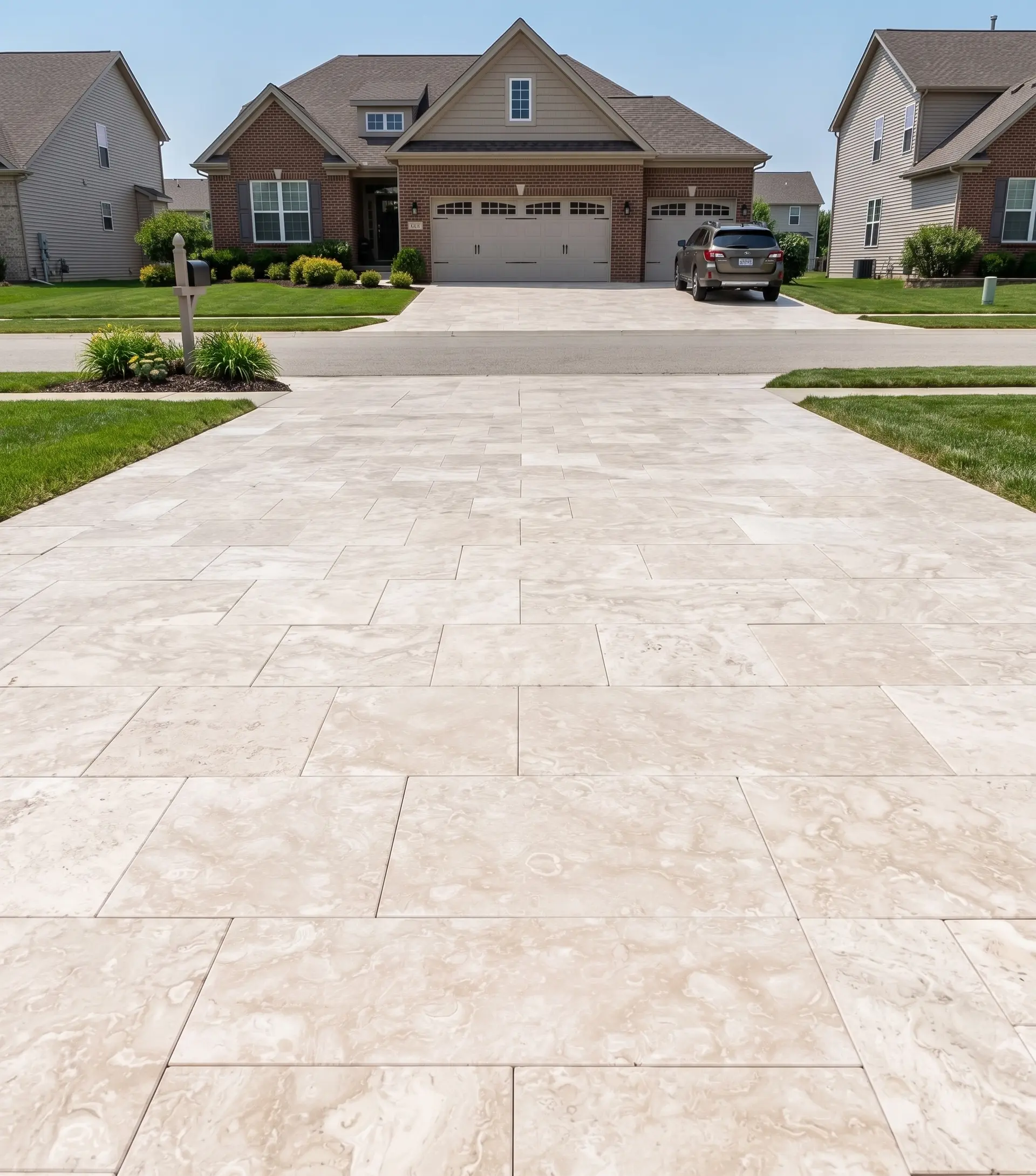
Travertine pavers colors shift significantly between the quarry slab and the installed surface — a reality that catches specifiers off guard more often than it should. Noce travertine pavers sit at the darker, warmer end of the travertine palette, but within that category you’ll encounter everything from rich espresso tones to lighter caramel browns depending on which bed the stone was extracted from and how deeply the face was cut. The variation is inherent to a natural, sedimentary stone, and it’s one of the material’s defining characteristics.
Your sample review process should account for this deliberately. Looking at a single tile under showroom lighting tells you almost nothing about how a full paved area will read in outdoor daylight. Request a range of samples that represent the full tonal spread Citadel Stone selects across a given batch — the contrast between a mid-amber slab and a deep walnut-veined piece is exactly the kind of movement that makes a noce travertine installation feel alive rather than flat. According to Natural Stone Institute travertine properties and outdoor suitability, the open-pore structure and mineral composition of travertine directly govern its surface appearance and how it interacts with light and finish treatments. Factor that into your review before finalising any colour approval.
- Request samples from multiple quarry beds — single-source sampling underrepresents the natural tonal variation
- Review samples outdoors in the project’s actual lighting conditions, not under artificial indoor lighting
- Approve a range, not a single tone — a colour-range approval manages expectations and acknowledges how natural stone actually behaves
- Consider how the installed pavers will read wet — noce deepens noticeably when damp, which shifts the visual warmth of the overall surface
Finish Options and Their Effect on Noce Tone
The finish you specify is the single biggest variable in how noce travertine pavers read on site. A honed finish opens the surface slightly and produces a matte, velvety appearance that amplifies the stone’s mid-brown tones while softening the contrast between its veining and background. It’s the most common specification for residential outdoor areas where you want warmth without visual complexity.
A brushed or antique finish works the surface texture more aggressively, leaving an open, directional texture with a naturally matte character — the colour reads a touch lighter than honed because more surface area scatters light. Tumbled finishes round all edges and create an irregular surface topography that sits between rough and matte, which gives noce an aged, cobbled appearance well suited to informal garden pathways and courtyards. Each of these finishes changes not just the look but the practical surface behaviour — a tumbled finish leaves an open, matte texture that holds fine joint sand differently than a honed face, something you’ll notice when compacting infill material after the first rain.
- Honed: richest colour expression, velvety matte surface, suits formal and transitional settings
- Brushed or antique: lighter tonal read, directional texture, works well in high-traffic areas where visual surface activity is welcome
- Tumbled: informal, aged aesthetic, irregular surface profile, best suited to garden paths and low-formality courtyards
- Filled vs. unfilled: filled pavers produce a consistent, smooth surface; unfilled preserve the natural voids and create a more rustic character
Sizing and Format Selection for Noce Travertine Pavers
Your format selection shapes how the stone’s warm tonal variation presents at the installation scale. Large-format noce travertine pavers — anything north of 24 inches in either dimension — give the banding room to express itself fully, and the visual movement across a paved surface reads as deliberate and richly geological. Smaller modular formats, by contrast, break that banding into shorter intervals and produce a more regular, grid-like rhythm that subdues the stone’s natural character.
For areas where noce travertine pavers share space with pool water or reflective architectural elements, a mixed-format layout in a versailles or French pattern can reconcile the stone’s warmth with a structured geometric context. The key consideration beyond aesthetics is thickness: your load application governs minimum thickness, and for pedestrian-only patios you’ll typically specify a different thickness than you would for light vehicular access. Specify the relevant ASTM test method and request the test report from your supplier — thickness and structural performance should appear on documentation, not be assumed from a product description.
Ordering Logistics and Delivery Planning
At Citadel Stone, we select noce travertine at our selected quarries for banding consistency and cut quality before any order ships — a step that makes a measurable difference to the tonal cohesion of what arrives on site. Your project’s access constraints should be confirmed early in the order process, because delivery scheduling is built around site conditions: restricted access points, overhead clearances, and weight limits on shared drives all affect how your stone reaches the installation area. Offloading arrangements are confirmed before the delivery date, not assumed on the day.
Lead times are quoted with the order and should be factored into your project programme before groundworks begin. Ordering to a tight timeline without buffer for transit and acclimatisation puts your installation schedule at risk. For large residential or commercial projects, a phased delivery can be arranged to manage on-site storage footprint — discuss this at the order stage, not after the first pallet arrives.
Thermal Cycling and Joint Specification for Outdoor Installations
The detail most specifiers underestimate for outdoor noce travertine pavers is thermal movement across the installation as a whole — not just of the stone itself, but of the jointed system behaving as a composite. Day-to-night temperature swings of 40°F or more, common in arid and semi-arid climates, create a cumulative expansion-contraction cycle that loads grout and mortar joints repeatedly across a season. In freeze-thaw regions, that cycling is more aggressive: water that has penetrated unfilled surface voids or tight joints can expand on freezing, and repeated cycles stress the setting material’s bond at the stone interface.
The engineering response is straightforward but frequently skipped: calculate thermal expansion from your stone’s expansion coefficient, available on the supplier’s test report, and specify joint widths and movement joint spacing to accommodate the calculated movement rather than using a generic rule of thumb. For a large paved area in a high-swing climate, the difference between an installation that holds its joints cleanly after five winters and one that starts showing cracks at year two often comes down to whether movement joints were positioned correctly at the specification stage. ASTM C1527 travertine dimension stone standard specifications provides the testing framework that governs dimensional and mechanical requirements for travertine paving — use it as the reference standard when reviewing supplier documentation. Sealers also play a role here: a penetrating impregnator reduces the volume of water that can enter surface voids before a freeze cycle, which directly limits the damage mechanism.
- Calculate joint width from thermal movement data, not from memory or habit
- Position expansion joints at intervals consistent with the panel dimensions and the climate’s temperature swing range
- In freeze-thaw regions, specify a filled paver format and apply a penetrating sealer on the manufacturer’s recommended schedule
- Avoid rigid bedding mortars without movement accommodation in climates with significant seasonal temperature range
Sealing Noce Travertine to Protect Tone and Performance
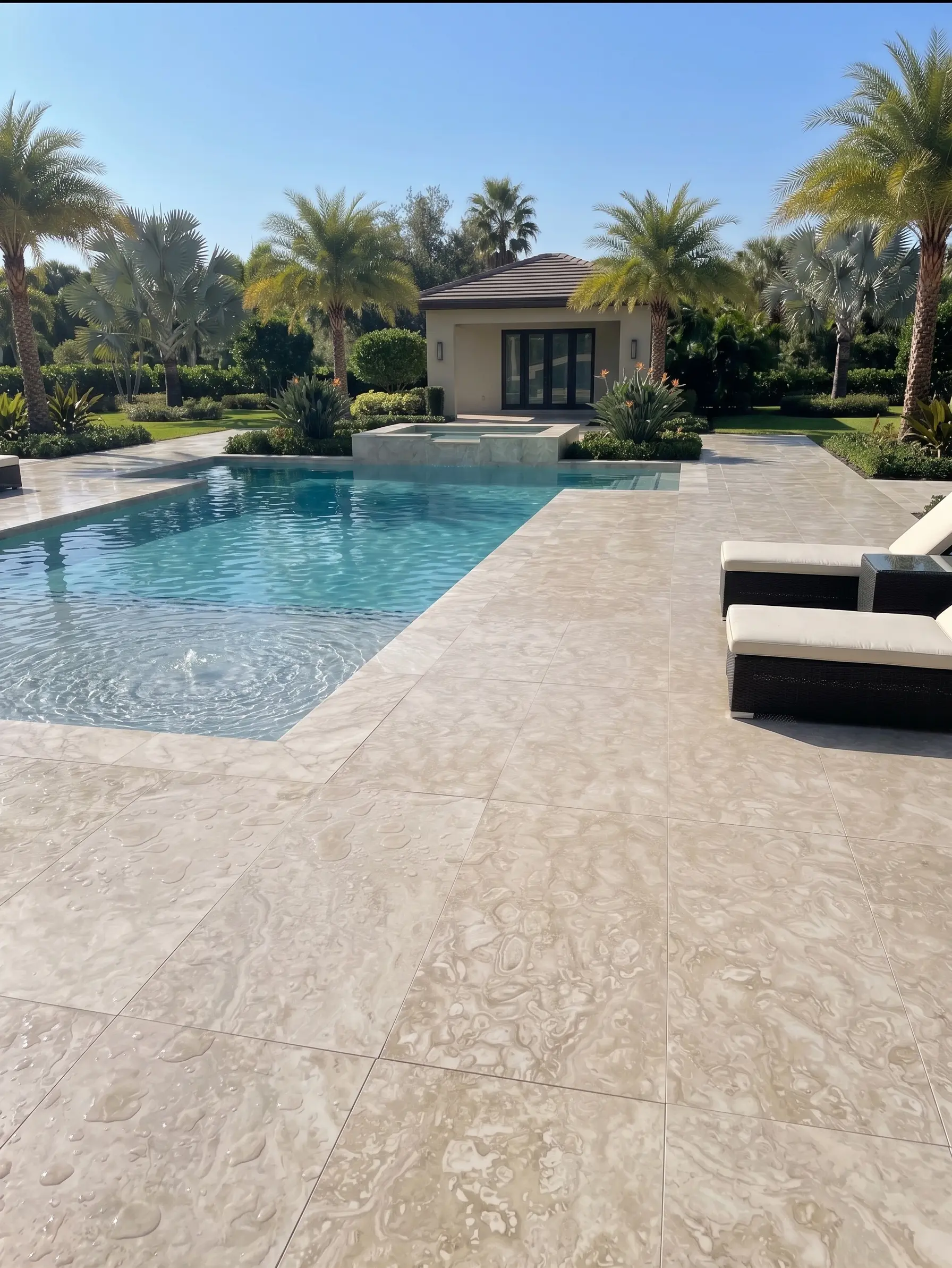
Noce travertine pavers benefit from sealing because travertine is a porous, calcium carbonate stone — its interconnected pore structure means that surface liquids, organic debris, and airborne iron-oxide compounds can stain the surface if left unprotected. The sealing decision for noce is also an aesthetic one: a colour-enhancing penetrating sealer deepens the amber and chocolate tones and brings forward the banding contrast, which suits most design intentions. A neutral impregnator, by contrast, preserves the natural matte tone without enrichment.
Neither option changes the fundamental character of the stone — they manage what gets into the pores, not the stone’s density. Reapplication interval is governed by the sealer manufacturer’s tested recommendation for your traffic volume and climate exposure, not by a universal schedule. You can assess seal integrity yourself by applying a few drops of water to the surface: if the droplet beads, the seal is functioning; if it absorbs within a few seconds, reapplication is due. According to USGS limestone and travertine natural mineral formation, the calcium carbonate matrix of travertine has inherent absorption characteristics that make sealer maintenance a practical long-term commitment rather than a one-time step.
Pairing Noce Travertine with Other Materials on Site
The warm, brown-amber range of noce travertine pavers pairs particularly well with materials that carry complementary warmth rather than competing coolness. Brushed stainless steel and grey concrete elements sit in visual tension with noce’s amber base; warm-toned hardwoods, terracotta, and aged bronze metalwork sit in harmony with it. This isn’t a rule — contrast can be deliberate and effective — but it’s worth working through the material pairings at the sample stage rather than discovering the conflict at practical completion.
You’ll find our noce and walnut travertine specified across a range of applications, from pool surrounds to internal-external transitional floors, where the tonal continuity between an internal honed finish and an external brushed finish creates a coherent visual flow through glazed openings. Pool coping pairings deserve particular attention: the coping profile and its stone tone should read as a deliberate extension of the paved deck, not as an afterthought. Travertine pavers colours in the noce range allow for a rich, tonal relationship between deck and coping that lighter travertine varieties can’t always deliver.
- Pair with warm-toned timber decking for residential outdoor living areas — the amber in noce reads as a natural continuation of timber grain
- Use consistent finishes between horizontal and vertical travertine elements where both appear in the same sightline
- In transitional indoor-outdoor floors, specify the same stone batch for both zones to maintain tonal consistency across the threshold
- For pool surrounds, confirm the coping profile is cut from the same stock as the field pavers — tonal drift between separate orders is a common site issue
Specifying Noce Travertine Pavers with Confidence
Getting noce travertine pavers right means treating the tonal selection, finish specification, thermal movement accommodation, and sealing programme as a connected system rather than a series of independent decisions. The stone’s rich amber and chocolate banding is a natural material property — your job is to specify around it in a way that lets it age well rather than fight against site conditions. Review your samples in natural light, confirm your movement joint strategy against the climate’s temperature cycling range, and fix your sealer schedule to the manufacturer’s guidance rather than to a rough estimate. For projects where a less structured layout suits the brief, irregular travertine crazy paver layouts offer a complementary approach worth considering alongside a conventional grid specification — noce’s warm banding reads just as well in an informal random lay as it does in a structured format. Sourced at our selected quarries in the Middle East, Citadel Stone selects noce travertine for its rich amber and chocolate banding.
Related reading: travertine paver cost per square foot · how to seal travertine pavers · gray travertine pavers.