

Specifying limestone exterior applications comes down to understanding the material’s relationship with its environment — not just aesthetically, but structurally. The density, pore structure, and finish of the limestone you select will determine how it ages under UV exposure, handles moisture cycling, and holds up against point loads from foot traffic or vehicle access. Most specifiers focus on colour and texture during material selection, which is understandable, but the decisions that actually govern long-term performance happen deeper in the specification — bed thickness, setting system, joint width, and sealing schedule.
What Limestone Exterior Applications Actually Cover
The term gets used loosely, but limestone exterior applications break down into three distinct product families, each with its own structural logic: cladding (vertical face panels fixed to a backing structure), veneer (thin-section material bonded or mechanically fixed to masonry), and paving (horizontal units set into a prepared base). These aren’t interchangeable — the loading direction, fixing method, and thickness specification differ significantly across the three. Getting this wrong at the specification stage creates problems that can’t be corrected on site without full removal.
Your project’s structural engineer needs to weigh in on cladding and veneer systems before you finalise material thickness. Natural limestone cladding on a commercial facade operates under wind load, thermal cycling, and differential movement in ways that freestanding paving never does. A 30mm face panel on a steel subframe behaves very differently from a 50mm paving slab set in mortar, and the specification needs to reflect that distinction from the outset.
- Cladding: typically 20–40mm nominal thickness, mechanically fixed or adhesively bonded to a substrate, specified to resist wind uplift and lateral shear
- Veneer: 15–25mm sections, more commonly used on residential and decorative applications, reliant on mortar bond or concealed clip systems
- Paving: 30–80mm depending on traffic class, set into compacted aggregate base with bedding mortar or on a fully compacted DGA layer for pedestrian-only use
- Each system requires expansion accommodation — typically 10–12mm movement joints at corners and every 4–5m on run lengths
Limestone Grades and Formation: What Your Spec Needs to Reflect
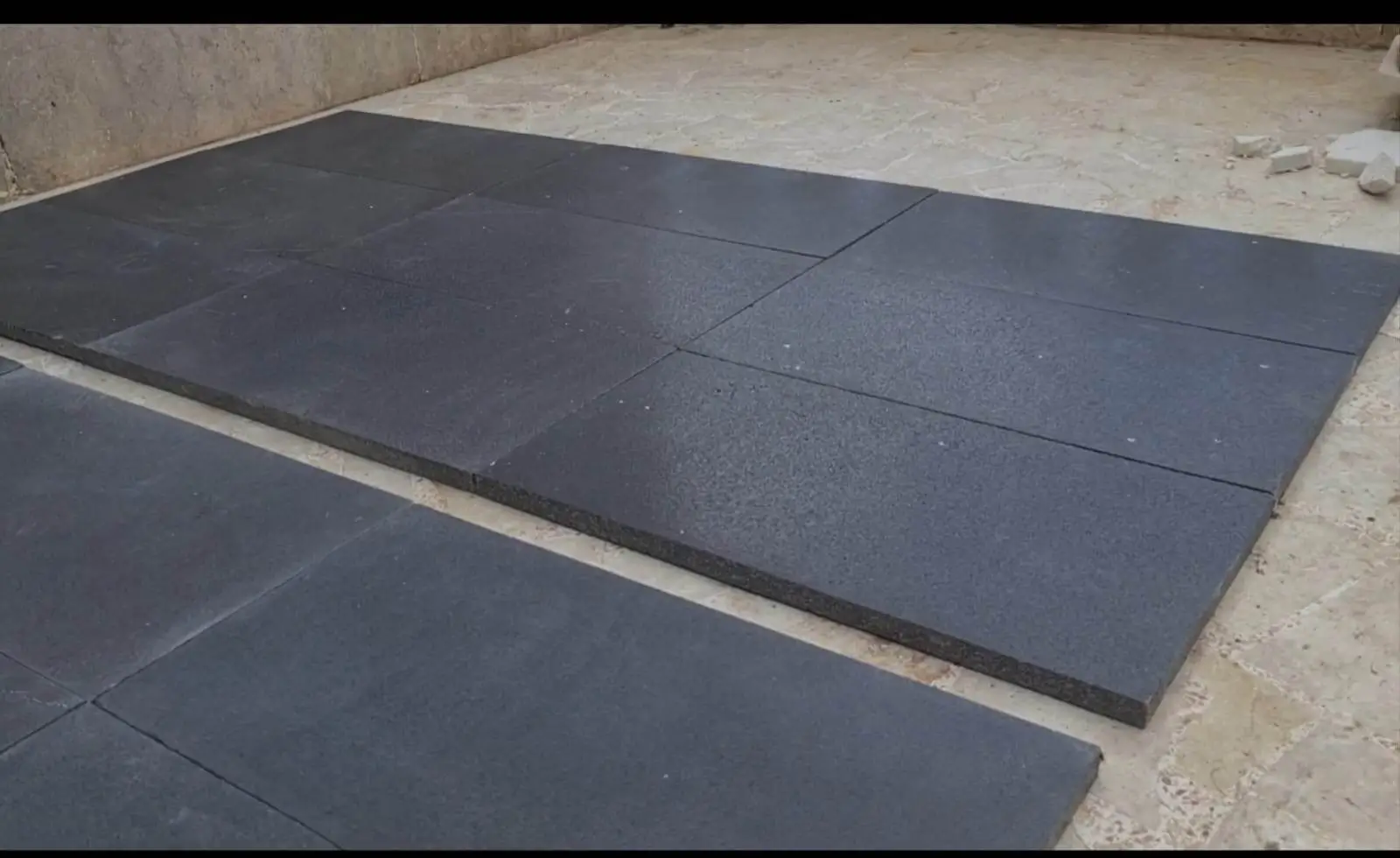
Not all limestone is formed the same way, and the variation matters far more in exterior applications than it does for interior flooring. Limestone is a sedimentary carbonate rock, and its mineral composition, fossil content, and crystallisation pattern vary considerably depending on where and how it was deposited. According to Britannica’s entry on limestone formation and characteristics, the rock’s properties are directly tied to its depositional environment — shallow marine formations tend to be denser and more uniform, while lacustrine deposits can be highly variable across even a single quarry face.
For exterior use, you want to specify material that meets a minimum compressive strength of 1,800 psi for pedestrian paving and 4,000+ psi for vehicular or mixed-use surfaces. Water absorption is equally important — aim for values below 7% for exterior cladding in wet climates, and below 5% where freeze-thaw cycling is a regular occurrence. These numbers need to appear in your specification, not just in the supplier’s brochure.
- High-density limestone (2.4–2.6 g/cm³): highly resistant to surface wear, well-suited to heavy-traffic paving and commercial cladding
- Medium-density limestone (2.2–2.4 g/cm³): appropriate for residential paving and low-rise veneer, requires sealing on exposed faces
- Bioclastic or fossiliferous limestone: attractive aesthetically but requires careful assessment of porosity before specifying for exterior paving
- The Natural Stone Institute’s technical guidance on limestone offers baseline performance benchmarks worth cross-referencing against supplier test data
At Citadel Stone, we source limestone from quarries across Europe, Turkey, and selected quarries from the Middle East — and our warehouse quality checks include visual grading, thickness verification, and calibration assessment before material ships. That process matters because dimensional consistency on cladding panels directly affects site productivity and setting accuracy.
Natural Limestone Cladding: Structural Fixing and Substrate Compatibility
Natural limestone cladding fails most often at the interface between the stone and its substrate — not within the stone itself. The three common failure modes are mortar bond failure due to differential thermal expansion, mechanical anchor corrosion in marine environments, and delamination caused by moisture ingress behind the panel. All three are preventable with correct specification, but each requires a different response.
For mortar-bonded systems, you need a flexible adhesive mortar with a deformability classification of S1 or S2 (per EN 12002) — not a standard OPC-sand mix. The coefficient of thermal expansion for limestone sits around 5–8 × 10⁻⁶ per °C, which means a 2-metre panel exposed to a 40°C temperature swing will expand or contract by approximately 0.6–0.8mm. That movement needs somewhere to go, and a rigid mortar bed won’t accommodate it without cracking.
- Specify stainless steel (Grade 316) fixing anchors for any cladding within 5km of a coastal environment
- Maintain a minimum 25mm cavity behind cladding panels to allow drainage and ventilation
- Use open-joint designs where the drainage plane can be managed — closed-joint systems require fully water-resistant secondary membranes behind the face
- Expansion joints at floor slab lines are non-negotiable on multi-storey applications — the slab deflects under load and the cladding cannot resist that movement
You’ll find that our limestone cladding collection includes material supplied at consistent nominal thicknesses with calibrated tolerance, which simplifies the anchor spacing layout on complex grid facades.
Limestone Veneer Exterior: Thin-Section Specification and Bonding Systems
Limestone veneer exterior applications operate under tighter tolerances than cladding because the reduced section depth leaves less margin for bending stress. A 15mm veneer panel has roughly one-third the flexural capacity of a 40mm cladding panel for the same surface area, so the bond area and setting system need to compensate for that difference. This is where specifiers consistently underestimate the importance of substrate flatness — an 8mm deviation across 3 metres will create isolated bridging points that become stress concentrations under wind load or thermal cycling.
The substrate for limestone veneer exterior installations should be brought to within ±3mm flatness over a 2-metre straight edge before any adhesive is applied. That standard is achievable on masonry and concrete substrates with skim coat or scratch coat preparation, but it requires a dedicated labour step that often gets value-engineered out. Don’t let it be — the failure cost is always higher than the preparation cost.
- Back-buttering veneer panels in addition to applying adhesive to the substrate ensures 95%+ contact area — critical for wind-exposed facades
- Polymer-modified mortars provide the flexibility and adhesion strength exterior natural stone veneer requires across seasonal temperature swings
- Panel weight per m² for 20mm limestone veneer sits between 48–52 kg/m² — factor this into your substrate’s structural capacity assessment
- Reveal edges and corner returns require either mitred joints (precision cut) or purpose-made corner sections — butt joints at exposed corners read poorly and are prone to chipping
Exterior Natural Stone Paving: Base Preparation and Thickness Selection
The base layer is where most limestone paving installations either succeed or struggle — and it’s invisible once the job is complete, which is exactly why it gets cut. Your base preparation specification determines drainage geometry, load distribution, and resistance to frost heave, and none of those factors can be corrected from the surface after installation. For residential pedestrian paving, a minimum 150mm compacted DGA base is the standard starting point; for mixed-use or vehicular areas, 250mm is more appropriate.
Limestone exterior paving in climates that experience regular freeze-thaw cycles needs particular attention to sub-base drainage. Standing water beneath a mortar bed freezes and expands, and when that happens repeatedly across seasons, the mortar bond fractures progressively. The fix is a properly sloped sub-base (minimum 1.5% gradient) draining to a perimeter collection point, combined with a permeable bedding layer rather than a solid mortar bed in freeze-prone zones.
According to USGS data on limestone composition and construction applications, the material’s compressive strength and durability make it a strong candidate across a wide range of exterior natural stone applications, provided the underlying system is correctly designed. The USGS figures confirm what field performance consistently shows: limestone’s long-term behaviour is primarily a function of the installation system, not the stone alone.
- 30mm paving: appropriate for residential pedestrian paths and patios with a well-compacted mortar bed on a DGA sub-base
- 40–50mm paving: the right specification for most domestic driveways and commercial pedestrian plazas
- 60–80mm paving: required for vehicular areas with regular car traffic; this thickness distributes point loads across a wider base contact area
- Always specify limestone exterior cladding and paving from the same quarry batch where possible — colour and vein character vary between production runs
Finish Selection for UV Resistance and Long-Term Appearance
Here’s what most project specifications miss on sun-exposed elevations: the finish you select has as much impact on long-term appearance as the stone’s inherent colour. Polished limestone on a south-facing facade will show micro-etching from UV-driven acid rain and carbonation within 3–5 years, dulling progressively in a way that looks like accelerated ageing. Honed and brushed finishes, by contrast, age far more gracefully in high-UV environments because there’s no specular sheen to lose.
UV exposure doesn’t bleach limestone the way it affects timber or painted surfaces, but it drives oxidation of iron-bearing minerals within the stone. Buff and cream limestones with naturally occurring iron veining can develop surface rust staining under sustained sun exposure as those minerals oxidise and migrate to the face. Selecting lower-iron material for exterior applications in sunny climates is worth the specification conversation with your supplier, and it’s something our technical team at Citadel Stone can help you navigate when reviewing quarry samples.
- Honed finish (400 grit): the workhorse for exterior natural stone applications — readable texture, no specular reflection, highly resistant to UV-driven surface degradation
- Brushed or antique finish: excellent for paving in sun-exposed areas, provides natural slip resistance and disguises minor surface variation from weathering
- Sandblasted finish: appropriate for very high-traffic exterior paving where maximum grip is needed, but expect more rapid surface soiling accumulation in the open pore texture
- Polished finish: reserve for covered exterior applications or sheltered cladding — not appropriate for open-air horizontal paving or south-facing facades exposed to sustained UV
Sealing schedules also need to account for UV degradation of the sealer itself, not just the stone. Penetrating silane/siloxane sealers in heavily sun-exposed applications should be refreshed every 2–3 years rather than the standard 4–5 year cycle recommended for shaded or indoor use. Plan that maintenance frequency into your client’s handover documentation from the start.
Sealing Protocols for Exterior Limestone Applications
Sealing exterior limestone isn’t optional on most applications — it’s a maintenance decision with structural consequences. Unsealed limestone in outdoor settings absorbs atmospheric pollutants, biological growth from algae and lichen, and iron compounds that migrate from adjacent materials. Once those contaminants penetrate beyond the surface layer, they can only be removed with acid cleaning, which itself carries risk if the stone is already moisture-stressed.
The right sealer chemistry depends on the limestone’s porosity. High-porosity material (absorption above 5%) needs a penetrating silane or siloxane sealer applied in two coats, with the second coat applied before the first is fully cured — this cross-linking effect fills the pore network more completely. Lower-porosity limestone can accept a single coat, but the surface must be absolutely dry before application. Applying sealer to damp stone traps moisture below the surface film and causes osmotic blistering within weeks.
- Apply sealer when stone surface temperature is between 10°C and 30°C — below this range, the sealer polymerises too slowly; above it, solvent evaporates before penetration occurs
- Flood-coat application is more effective than spray application on textured or brushed finishes — you want full saturation, not a surface film
- Allow minimum 72 hours before the sealed surface is exposed to rainfall — earlier wetting dilutes the uncured sealer and reduces protection by 30–40%
- Re-seal on a fixed schedule rather than waiting for visible water beading to diminish — by the time hydrophobic performance is lost, some contaminant ingress has already occurred
Ordering, Lead Times, and Project Logistics
Natural stone projects almost always run into the same supply chain problem: the material gets specified correctly but ordered too late. For limestone exterior cladding and paving at meaningful volume — anything above 100m² — you should be placing your confirmed material order at least 8–10 weeks ahead of your installation window. That timeline accounts for quarry cutting, quality inspection, crating, shipping, and warehouse arrival processing. Compressing that schedule creates pressure that shows up in the finished work as inconsistent calibration or batch colour variation.
Citadel Stone maintains warehouse stock of core limestone grades nationally, which can reduce that lead time to 2–3 weeks for in-stock items. For custom dimensions, special finishes, or large project volumes, the full lead time applies and should be built into your programme from the design phase. Your truck delivery scheduling also matters more than people anticipate — large crated stone deliveries require level, unobstructed site access, and the truck offload window needs to be factored into the site programme with the main contractor.
- Order a minimum 5% overage on cladding panels to account for site cuts, waste, and any handling damage during installation
- Request production samples from the same batch as the main delivery — colour consistency between the sample and the delivery batch should be confirmed before the stone leaves the warehouse
- Verify truck access dimensions at the delivery address before confirming the delivery date — crated stone pallets are heavy and tall, and site access constraints can delay the unload significantly
- Store delivered material flat, covered, and off the ground — even short periods of moisture exposure can cause calcium bloom on freshly cut faces that requires acid washing to remove
Per Natural Stone Institute guidance on limestone technical specifications, material handling and storage protocols are as critical to final appearance as the specification itself — a detail that often gets overlooked in the rush between delivery and installation start.
Getting Limestone Exterior Specifications Right
Limestone exterior applications reward specification precision more than almost any other hardscape material. The stone has genuine performance breadth — it works well on vertical cladding, thin veneer sections, heavy-traffic paving, and everything between — but that breadth only translates into long-term results when the fixing system, base preparation, finish selection, and sealing schedule are all aligned to the specific exposure conditions of the project. Getting any one of those elements wrong tends to compound the others, which is why site problems with limestone are rarely isolated failures. They’re usually the visible result of a specification decision made months earlier at a desk.
Your exterior stone projects may extend to other applications that benefit from similar specification rigour. limestone pool surface applications covers how the same material performs under a very different set of demands — wet contact, chemical exposure, and slip safety requirements that add another dimension to the specification process. Reviewing that guidance alongside this article gives you a fuller picture of limestone’s exterior performance envelope. Architects specifying Citadel Stone limestone note that consistent bed depth across cladding and paving panels simplifies setting-out on complex elevations.
Related reading: Is Limestone a Natural Stone? Geology Explained · Natural Limestone Colors Guide: Picking the Right Shade.