What “Discount” Really Means in the Stone Market
Understanding discount stone slabs starts with a simple but critical distinction: discounted price and discounted quality are not the same thing — but they overlap far more often than suppliers will admit. Pricing anomalies in the natural stone market exist for legitimate reasons, including overstock cycles, discontinued lot closures, and minor cosmetic variation that falls below a project’s aesthetic threshold without affecting structural performance. Knowing which category a specific slab falls into is the difference between a smart buy and an expensive mistake.
The natural stone supply chain creates multiple pricing pressure points. Slabs get marked down when quarry production outpaces demand, when lot sizes don’t match standard project quantities, or when stone moves from primary warehouse inventory into clearance stock after extended storage. None of those conditions necessarily compromise the material — but they each require you to ask different verification questions before committing to a purchase.
Common Sources of Discounted Stone Slabs
Discount slabs enter the market through several distinct channels, and each channel carries its own risk profile. Overstock from large commercial projects is often the cleanest source — you’re getting first-quality material that simply wasn’t installed, frequently at 20–40% below standard pricing. Remnant yards are another legitimate source, though slab dimensions may not accommodate your layout without significant waste.
- Overstock lots from completed commercial builds — typically first quality, verified thickness
- Quarry seconds with cosmetic variation — colour banding, minor vein irregularity, surface pitting
- Discontinued series from importers closing out specific stone families
- Damaged edge lots where one face or corner is compromised but the field area remains intact
- Auction clearances from project cancellations or estate liquidations
- Grade B material that passed structural testing but failed aesthetic grading
The sourcing channel directly predicts what inspection criteria matter most. Overstock slabs need thickness verification. Quarry seconds need colour consistency mapping. Auction material needs edge integrity assessment across every piece before you commit a layout to it.
Stone Grading and What It Actually Tells You
Natural stone grading is not a universal standard — it varies by quarry, importer, and sometimes by individual salesperson. Grade A, Grade B, and “commercial grade” designations mean different things across different supply chains. According to Natural Stone Institute technical stone specifications, dimensional accuracy, surface finish consistency, and edge integrity are the primary factors separating grade classifications — but these parameters aren’t always applied uniformly across the industry.
What you actually need to evaluate is independent of whatever label the seller applies. Thickness tolerance matters most structurally — slabs that vary more than ±1/8 inch across a lot will create lippage issues during installation that no amount of substrate work can fully correct. Colour consistency matters aesthetically but rarely affects performance. Surface integrity — checking for micro-fractures, fill quality in travertine, or lamination in certain sedimentary stones — matters most for long-term durability.
- Thickness tolerance: ±1/8 inch maximum across any given lot
- Colour variation: acceptable if your design can accommodate natural range
- Edge condition: look for chipping, spalling, or stress fractures at corners
- Surface fill quality: critical in travertine and certain limestone varieties
- Back-mesh integrity on thinner slabs: delamination creates field failures
Freeze-Thaw Cycles and What They Reveal About Discount Stone Slabs
Here’s what most specifiers miss when evaluating discount slabs: freeze-thaw performance separates structurally sound material from material that merely looks acceptable at the time of purchase. A slab with hairline micro-fractures, existing fill that’s beginning to degrade, or elevated moisture absorption will show no visible distress in a warehouse environment — but temperature cycling from 35°F overnight to 75°F midday puts cumulative stress on those weaknesses that compounds year over year.
Thermal expansion coefficients for natural stone typically run between 3.0 × 10⁻⁶ and 8.0 × 10⁻⁶ per °F depending on stone type and crystalline structure. Across a 40°F daily swing — common in continental climates through spring and autumn — that translates to measurable dimensional movement at every joint. Stone that’s structurally intact handles this cycling without issue. Stone with pre-existing micro-fractures uses each thermal cycle to propagate those fractures toward visible surface cracking within 3–5 years. ASTM dimension stone quality and testing standards provide the freeze-thaw cycling test protocols (C99 and C170) that properly graded material should be able to reference — and discount stone that lacks this documentation warrants additional scrutiny before installation in exposed outdoor applications.
Your inspection of any discount slab lot for outdoor use should include a moisture absorption check. Absorption rates above 0.75% (by weight) in limestone or travertine indicate pore structures that can trap water — and trapped water expands approximately 9% upon freezing, which is precisely the mechanism that drives freeze-thaw spalling on compromised pieces.
Real Savings vs. Hidden Downstream Costs
The genuine savings calculation for discount stone slabs has to account for more than the per-square-foot price reduction. Material price is only one input in total installed cost, and it’s frequently the smallest variable when a project runs into field problems traced back to inconsistent material quality.
- Labour cost to work around irregular dimensions: add $3–$8 per sq ft for significant variation
- Waste factor increase for damaged edges or mixed thickness: budget 15–25% overage vs. standard 10%
- Adhesive and setting material adjustments for thickness variation: additional material cost plus time
- Remediation cost if lippage or cracking develops within 2–3 years of installation
- Replacement sourcing risk: discontinued lots may not be re-sourceable for repairs or additions
A 30% price reduction on material that drives a 20% labour cost increase and a 15% waste factor premium often nets to zero savings — or worse. Run the numbers against your specific project conditions before treating the discount as a given advantage. You can explore a wide range of well-graded stone slabs through Citadel Stone where pricing reflects documented quality rather than clearance uncertainty.
Inspection Protocol Before You Commit to Discount Slabs
Physical inspection is the single most important step in understanding discount stone slabs — don’t rely on photos or representative samples. The nature of discount lots is that variation within the lot is higher than in first-quality inventory, so a representative sample genuinely may not be representative.
- Inspect a minimum of 20% of pieces in any lot under 50 slabs — 10% for larger lots
- Measure thickness at four corners and the centre of each inspected piece
- Run a straightedge diagonally across the slab face to check for warping
- Tap the slab surface with a coin — hollow sounds indicate delamination or internal voids
- Check edge condition on all four sides, not just the visible face
- Wet the surface: colour variation that’s hidden dry becomes apparent when wet, matching finished installed appearance
- Stack-examine — look at the lot from the side to identify thickness outliers before they reach the job site
According to USGS dimension stone production and use data, dimension stone graded for construction applications must meet specific compressive strength and absorption thresholds. Discount material that carries documentation confirming it meets those thresholds — even if it’s been graded out on aesthetics — is a fundamentally different purchase than material with no documentation at all.
When Discount Stone Slabs Actually Make Sense
Discount slabs are genuinely the right choice in specific project scenarios. Understanding which scenarios those are saves you from both over-caution and careless optimism about the material you’re specifying.
Interior feature applications — fireplace surrounds, accent walls, decorative countertops in low-moisture zones — tolerate cosmetic variation better than structural paving installations. A slab with minor colour banding that would look inconsistent across a 500 sq ft floor reads as intentional character on a 12 sq ft accent panel. The freeze-thaw concern disappears entirely in controlled interior environments, which expands the acceptable quality range significantly.
- Interior accent panels and feature walls — cosmetic variation is acceptable
- Projects where the full lot can be inspected before purchase commitment
- Applications where you have a proven fabricator who can manage thickness variation in the cutting process
- Renovation additions where you already have some installed material and are matching from the same discontinued lot
- Commercial feature installations with lower foot-traffic load than primary paving areas
Discount slabs are a higher risk in freeze-thaw exposed outdoor paving, high-moisture environments like pool decks, and any application where replacement sourcing from the same lot will be impossible. In those contexts, the long-term risk math rarely favours the initial savings.
Sourcing, Warehouse Inventory, and Delivery Logistics
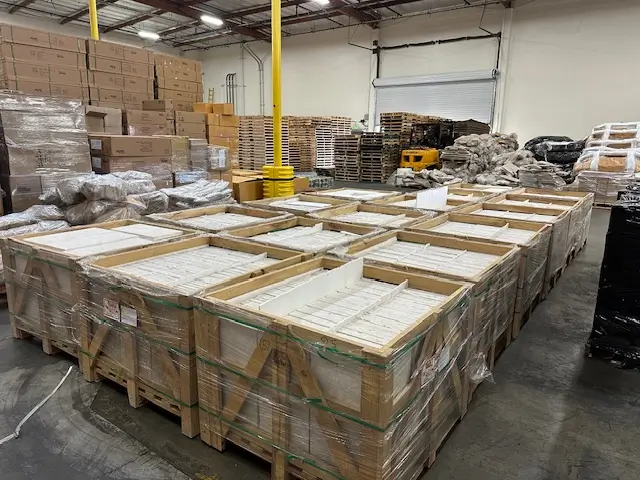
Discount slab sourcing introduces logistics variables that standard procurement doesn’t. Lot availability is finite and typically non-replenishable — once a clearance lot sells, the material is gone. Your project timeline has to align with that constraint, and your quantity take-off needs to account for a higher waste factor than standard material would require.
Warehouse availability for discount lots often moves faster than project timelines. At Citadel Stone, we’ve seen situations where a client identifies a discount lot, takes two weeks to finalize project scope, and returns to find the material sold. If you’re committing to discount slabs, have your quantity calculation ready before you inspect — not after. Factor in your truck delivery access as well: discount lots may be palletized differently than standard inventory, affecting how efficiently material can be offloaded at your site.
- Confirm full lot quantity before committing — partial lot availability creates matching problems later
- Verify warehouse hold policies: some suppliers will hold material for 48–72 hours, others won’t
- Check truck delivery lead time against your installation schedule — clearance material may ship from different warehouse locations than standard stock
- Order 12–18% overage minimum for discount lots vs. 8–10% for standard material
- Get written documentation of the lot’s grade classification and any disclosed defects
Evaluating Discount Stone Slabs: The Complete Specification Framework
Understanding discount stone slabs comes down to a straightforward evaluation framework: identify why the material is discounted, physically verify that the discount reason doesn’t compromise your specific application’s performance requirements, and run the full installed-cost calculation before treating the lower material price as guaranteed savings. Discount slabs sourced from overstock or discontinued lots can deliver genuine value — particularly in interior or low-risk applications — when you’ve done the verification work upfront.
For outdoor paving in freeze-thaw exposed environments, the structural integrity threshold is non-negotiable regardless of price. Material with documented compressive strength and absorption testing that meets ASTM thresholds, even at a reduced price point, is a sound specification. Material without that documentation in a freeze-thaw application is a risk that discount pricing rarely compensates for adequately. As you consider your broader stone project, understanding how specific stone families perform in demanding applications is equally valuable — choosing travertine slabs for your project covers selection criteria worth reviewing alongside your discount slab evaluation.
Slab auctions can surface legitimate material, though Citadel Stone recommends physically inspecting any discounted piece for edge chipping or surface irregularities.
Related reading: inspecting used marble slabs before buying · remnant granite slabs vs full slabs · how to choose a marble slab.