Two Stones, Two Failure Modes
Limestone and basalt do not go wrong in the same way, and that is the useful starting point. Limestone is a sedimentary stone whose behavior in a salt climate is governed largely by its pore structure, so absorption is the figure to interrogate. Basalt is a dense volcanic rock, tighter and heavier, which makes it a natural fit where loads concentrate and abrasion is constant.
Neither is the better stone in the abstract. The real question is always which zone, which loads, which exposure, and who is crossing it with bare feet. Answering that once for a whole property, rather than area by area, is how a schedule ends up over-specified in the quiet corners and under-specified exactly where the ground is worked hardest.
Start With an Exposure Map
Before either material is priced, draw the site and mark what each area actually faces. On Bonaire the variables are consistent enough to list on one page.
- Wind aspect: the trade wind arrives from the northeast at roughly 15 mph on average.
- Salt load: distance from the water and whether spray reaches the surface.
- Traffic: bare feet, foot traffic in shoes, or turning vehicle wheels.
- Sun: hours of direct exposure and whether any built shade falls there.
- Water: pool splash, wash-down routines, and where runoff collects.
Five lines on a drawing settle arguments that otherwise run through the whole procurement.
Where Limestone Is the Right Call
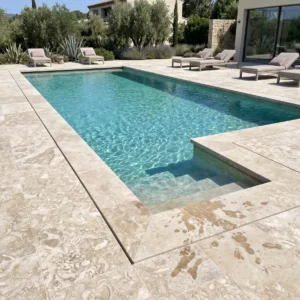
Pale limestone earns its place where surface temperature and comfort lead the brief. Around pools, on open terraces used at midday, along the routes between water and shade, and on interior floors carrying the same tone through a threshold, a light stone with a worked face is the straightforward answer. The formats and depths in limestone units held for Bonaire builds are cut with those areas in mind.
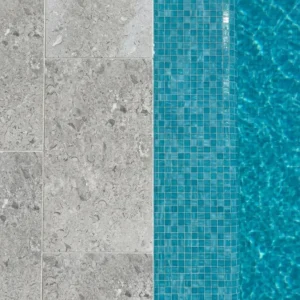
- Pool decks and coping, where barefoot comfort decides everything.
- Open terraces and dining areas taking long hours of direct sun.
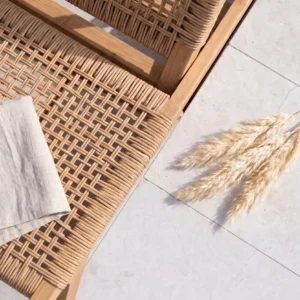
- Interior floors carrying the same material through a threshold.
- Steps and paths where a lighter tone helps definition in strong light.
Where Basalt Earns Its Place
Basalt answers a demand that is mechanical rather than barefoot. Driveways, turning aprons, service yards, delivery routes and any area taking point loads from vehicles all favor a dense, tight stone in a heavier depth. A darker tone also carries tire marks and oil far better than a pale floor ever will. That practicality is the case for basalt cut for the harder duties on a mixed site.
- Driveways and entrance aprons where wheels turn under load.
- Service yards, bin stores and delivery routes behind the house.
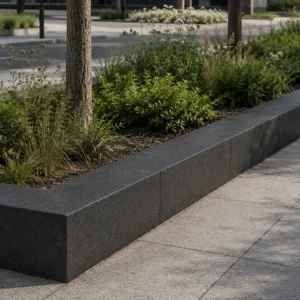
- Edge courses and bands that frame a lighter field of paving.
- Areas taking regular abrasion where marks would show on pale stone.
The Heat Trade-Off Is Real
The honest caution on basalt in this climate is temperature. A dark surface absorbs more of the sunlight that lands on it, and under a high sun with little cloud that is felt immediately through bare feet. Basalt belongs where shoes and tires go, not where towels and children go.
Handled deliberately, that contrast becomes an advantage rather than a compromise. A dark edge band or a dark apron reads as a deliberate frame around a pale field, marks the change from barefoot ground to vehicle ground, and puts the harder-wearing material exactly where the wheels are. Using both stones in their proper zones, rather than forcing one across the whole site, is what makes a mixed scheme work.
Salt Is the Shared Problem
Whichever stone is chosen, the mechanism working against it is the same. Salt-bearing moisture enters the surface, evaporates, and the crystals left behind expand. With roughly 14 to 18 inches of rain a year there is little natural rinsing, and the trade wind delivers salt continuously rather than seasonally, which is why the defenses are detailing decisions rather than product decisions.
- Specify the lowest absorption available for splash and wind-facing zones.
- Bed and joint on washed, chloride-free material, never on beach sand.
- Fall surfaces so water leaves rather than evaporating where it sits.
- Rinse with fresh water wherever a supply is available.
A Note on the Island’s Own Rock
This is worth saying plainly, because the coincidence invites confusion. Bonaire’s bedrock, the Washikemba Formation, includes basalt pillow lava formed as lava cooled in seawater, and the coastal terraces are coral limestone. That is the island’s geology. It is not a supply route, it is not an invitation to collect anything, and the paving discussed here is dimension-sawn material from selected quarries, cut and calibrated to serve as a wearing surface. Those are different product categories with nothing to compare.
Weight, Freight and the Landed Number
Basalt is heavier than limestone at the same thickness, and a driveway depth is thicker than a terrace depth, so a mixed schedule changes the container math more than a square-foot total suggests. Work the weights before the areas are finalized, because that is what decides how many containers a phase needs.
The route itself is straightforward. Ocean freight reaches Kralendijk directly, with a weekly Saturday departure from Port Everglades arriving on the Thursday, a five-day sailing with no transshipment through another island. The tax side is short: import tax on goods is set at nil, and ABB applies at eight percent on goods at import, calculated on value plus insurance plus transport. Quote in US dollars, official on the island since 1 January 2011.
Split the schedule by zone and the two stones stop competing.