Why floor temperature is a real design question
Bonaire is semi-arid. Annual rainfall runs only about 350 to 450 mm, roughly 14 to 18 inches, and sun rather than rain is the constant. A floor specified for a temperate house behaves differently under that much light, and the difference shows up in daily use rather than on a test certificate. Where doors stay open and feet are often bare, the surface underfoot becomes part of how comfortable the building feels. That makes floor temperature worth settling early in the drawings, while it is still free to change and before a finish has been chosen for reasons that have nothing to do with how it performs.
Tone, reflectance and surface temperature
Tone is the biggest single lever on how warm a stone floor becomes. Pale stone reflects more of the energy that lands on it and holds less of it, which is why light limestone belongs at the top of the list for any surface that catches direct sun. Darker stone still has a job on the property, but it belongs where wear and load matter more than bare feet do. The useful way to think about it is by zone rather than by preference, dividing the site into places people stand barefoot and places vehicles and tools go.
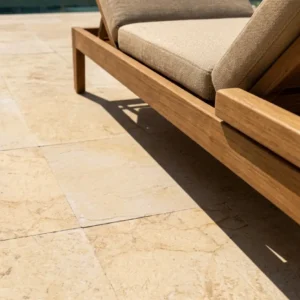
- Pale limestone for sun rooms, terraces and any floor that runs out to an open door.
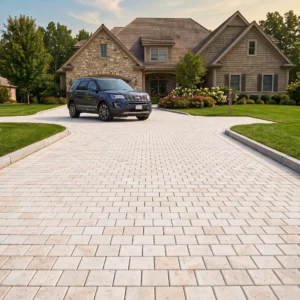
- Darker basalt for driveways, service aprons and the places where wheels turn.
- Shaded interiors, where tone can follow the room rather than the heat.
- Transition zones, where a change of tone marks a change of use without a metal strip.
Thermal mass and the daily swing
Stone stores heat and gives it back slowly. Where the daily temperature range is modest and a breeze is almost always present, that mass can work in your favor: a shaded slab stays cooler than the surrounding air through the afternoon and does not spike the moment sun clears a roof edge. The same property works against you when a wide glazed opening throws sun onto a dark floor with no cross ventilation to carry heat away. For interiors that take direct sun for hours, pale tile that resists heat gain is the safer specification, and choosing it at drawing stage costs nothing at all.
What sits under the floor matters too
Comfort is not only a property of the stone. Bedding, slab and the shading in front of an opening all change the result, and each of them is usually cheaper to adjust than the finish material itself.
- Bed depth and mortar type, which govern how quickly the surface picks up heat from the slab below.
- Overhang, louver or pergola depth at the openings that face the sun.
- Cross ventilation, which lifts warm air off the surface instead of trapping it.
- Light-toned external paving beside a glazed wall, which cuts reflected glare into the room.
- A clean break between exterior and interior beds so movement is not carried through.
The trade wind changes the brief
A steady north-east trade wind averaging roughly 7 m/s, about 15 mph, crosses the island almost without pause. It cools a terrace, but it also carries salt and fine dust onto every horizontal surface, and with so little rainfall there is not much natural washing to take it away again. That combination quietly shapes several everyday decisions.
- Choose faces that stay comfortable when a thin film of dust is present.
- Keep highly absorptive units away from splash and windward positions.
- Plan a rinse routine rather than assuming rain will do the work.
- Detail joints so wind-blown grit can be swept out rather than ground in.
Getting material onto the island
Bonaire is a special municipality of the Netherlands and uses the US dollar, official since 1 January 2011, so a US supplier can quote without a currency conversation. King Ocean Services has run a dedicated ABC service since 1982, sailing from Port Everglades in Florida on Saturday and reaching Kralendijk on Thursday, a five-day direct transit with no transshipment. The tax picture is unusually clean as well: the import tax rate is set at nil for all goods, and the operative levy is ABB, the Algemene Bestedingsbelasting, at 8 percent on the import of goods. Freight and levy planning sits inside our Bonaire stone supply notes for anyone costing a container.
Checks worth making before you specify
A short list of questions removes most of the risk from a stone floor decision, and all of them are easier to ask before an order is placed than afterward. None of this requires a laboratory; it requires the supplier to put numbers on paper instead of adjectives.
- Ask for absorption and density figures rather than a description of the color.
- Confirm calibrated thickness so bed depths stay consistent across a long floor.
- Establish what the surrounding building fabric actually is before fixing tone and texture.
- Agree joint width early, because it changes both the look and the cleaning routine.
Working with us on a Bonaire floor
We can reserve material from the same batch so a second phase matches the first, and we send a physical piece before anything is committed. Tell us the orientation of the room, how much direct sun the opening takes through the day, and whether the floor continues outside to a terrace, and we will shorten the list instead of handing over the whole range. Quotes are written in US dollars, and the freight leg can be planned against a published weekly sailing. Choose the floor for how it will feel at two in the afternoon, not for how it looks in a photograph.