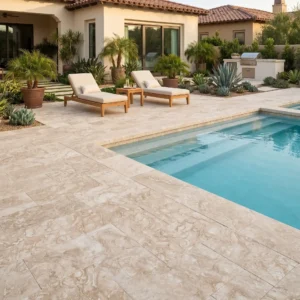
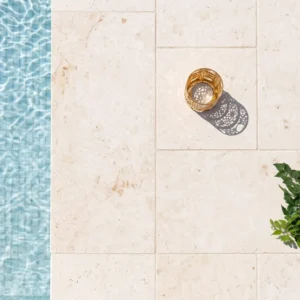
The Dominican Republic swims at every scale the region knows: private villa basins behind Bávaro’s corridors, condo amenity decks serving tower populations, estate pools above the Chavón, and the lagoon complexes where the mega-resorts host thousands of guests a day. One canon serves the whole spectrum – pale dense limestone, textured for wet traffic, batch-disciplined for consistency – and the country’s market applies it with the region’s deepest installation industry behind it. This guide walks the national pool craft, basin by basin.
The Full Spectrum
Dominican pool procurement spans three registers that share one specification skeleton: villa packages at the regional canon – weir tolerance, textured decks, same-batch spares; amenity decks at hospitality duty – crowd-rated textures, documented slip ratings, fast-reset maintenance; and resort lagoons at project scale – phased consignments, mockup approvals, batch continuity across thousands of meters. The skeleton holds because the physics hold: the same sun, the same salt, the same barefoot test at every scale, answered by the same pale textured stone.
The Barefoot Test, Busiest Edition
The country’s tourism volume makes the barefoot test statistical: on any given noon, more feet cross Dominican pool decks than any other decks in the Caribbean, and every uncomfortable surface files its complaint in a review. The answers are canonical:
- Light tones that reflect rather than bank the heat – the deck walkable at the day’s peak.
- Textures graded by zone: grippiest at the wet line, finer at the loungers, working-grade at the swim-up bars.
- Shade engineered into the plan – palapas, pergolas and sail lines drawn with the paving.
- Rinse architecture at guest-flow scale, keeping salt and sand off the main field.
The Villa Canon
Behind the resort statistics, the villa market runs the intimate version: infinity edges over the east’s blue, family basins beside the outdoor kitchens, plunge pools in courtyard shade. The specification is the region’s villa standard – millimeter weir stones, drip-grooved coping profiled to the architecture, decks in one single-batch family – and the comparative shopping is real: the two-ocean pool playbook walks the Pacific coast’s edition, and Dominican buyers who know both coasts order to the same tolerances here.
Lagoon Scale
The resort lagoon is the Dominican specialty – pool complexes that read as landscapes, with islands, swim-up bars, activity zones and quiet coves phased across hectares – and its stone logistics are the market’s masterclass: batch-matched container series landing against construction milestones, deck fields laid by crews who measure output in thousands of meters, spare inventories provisioned for a decade of operator audits, and every phase matching the mockup the first phase approved. The lagoon is where procurement discipline becomes visible from a drone – one tone, one texture, one uninterrupted field.
The Operations Rhythm
Dominican pool decks live on operational clocks: dawn washdowns before the first loungers claim their ground, mid-morning safety walks, the afternoon peak absorbed, and the overnight reset that returns the field to opening condition. Stone serves the rhythm by design – falls that drain the washdown fast, textures that grip through the wash cycles, tones that show honest-clean, and the piece-by-piece repairability that lets night crews replace what the day cracked. The rhythm is why operators specify stone in the first place; the specification’s job is never interrupting it.
The Storm Clause
The hurricane belt writes the pool terrace’s structural clause: copings mechanically fixed against uplift, furniture-scale loose elements designed out of exposed decks, drainage sized for the band of rain a passing system delivers, and the pool plant’s stone surrounds detailed to shrug a wet week. The country’s resort coasts have rebuilt through the region’s storm history and specify accordingly – the deck that survives the season without a punch list is the one whose fixing schedule assumed the season honestly.
Swim-Up Craft
The swim-up bar is Dominican resort vernacular, and its stone brief is the canon’s wettest corner: submerged stools and counters in dense stone that shrugs permanent immersion, bar-side decks at working grade for staff who serve standing in water half the shift, textures rated for wet glass-carrying traffic, and drainage that keeps the bar’s operational splash inside its own zone. The detail engineering is real – and the register is pure hospitality, photographed hourly and reviewed nightly.
The Decade Batch
Dominican operators think in decades, and the batch discipline follows: production runs sized not just to the build but to the audit horizon – attic stock provisioned at project scale, batch records filed with the operator, and renovation cycles matched from the standing documentation years later. The country’s refurbishment culture renews properties wing by wing without closing; its pool decks renew basin by basin on the same logic, and the original batch paperwork is what keeps a 2030 phase matching a 2024 field.
One Canon, Every Scale
From courtyard plunge to hectare lagoon, the Dominican pool canon holds: pale, textured, batch-disciplined, storm-fixed and operations-ready. The island parallel for the intimate end is mapped in surface-interval decks compared; the Dominican contribution is proving the canon at volumes nobody else attempts. Specify to the canon at whatever scale the project swims, and the busiest pool market in the Caribbean lays it, audits it and photographs it – daily.
The Natural-Pool Neighbor
The country’s built pools swim beside famous natural ones: the cenotes and ojos of the eastern limestone – sinkhole pools in jungle settings whose turquoise clarity headlines every excursion list – and the freshwater lagoons the interior keeps. The natural inventory shapes the built brief in two ways:
- Design language: the cenote’s composition – dark water in pale stone, jungle framing, entry by carved steps – is the region’s native pool aesthetic, and villa designers quote it deliberately.
- Guest expectations: visitors who swam a cenote at noon judge the villa pool by dusk – clarity, calm and stone-framed composition are the standard the day set.
The homage stays homage: natural sites are protected, their operators run the visits, and the built pools compete by craft rather than imitation – carved-step entries, pale coping against dark-tiled depths, planting that borrows the frame. The country’s pool culture grew beside the hemisphere’s prettiest natural benchmarks; the specification simply respects the tutor.
Setting a Slip Standard You Can Defend
Pool decks are the one surface where specification arguments become liability arguments. The sensible approach is to fix a measurable wet slip target early and hold it through every finish change. The ANSI A326.3 method measures dynamic coefficient of friction under wet conditions, with 0.42 as the widely cited benchmark for level walking surfaces, and it is the number worth putting in the specification rather than a description like textured.
- Specify wet DCOF on the finish, thickness and batch actually being supplied
- Increase texture at steps, ramps and the shallow end approach
- Avoid changing finish mid-route, since the change is where people slip
- Re-test whenever the quarry block or finishing line changes
The explanation of how frictional properties are tested on stone walking surfaces is short and worth circulating to the design team.
Detailing That Decides the Ten Year Result
Most failed pool terraces were specified correctly and detailed badly. Installation method, not material choice, is what determines whether a deck still looks composed after a decade of chlorine, sunscreen and salt.
- Full mortar bed with no voids under coping, since voids crack edges
- Movement joints at the right centers and at every restraint
- Falls set away from the pool, with a drainage line that can be cleaned
- Coping fixed so a single unit can be lifted and reset without cutting neighbors
The guidance on detailing natural stone paving for durability covers the failures worth designing out.
Living With Sunscreen, Chlorine and Salt
Dominican decks take a chemical load that few other surfaces do. Sunscreen is oily and it stains; chlorinated splash-out is constant; and on coastal sites salt crystallizes in the surface pores every dry afternoon.
- Choose a finish that hides oil marking rather than one that shows every drop
- Agree a cleaning regime, and approved products, before handover
- Rinse coastal decks with fresh water where irrigation allows
- Keep spare units for the two or three positions that always take the damage
Our Dominican Republic supply overview explains what is realistic to hold in stock for repairs.
Pool terrace stone in the Dominican Republic, chosen once
A pool terrace is the most photographed and most walked surface on the property. Specify it once, properly, and it stops being a maintenance line item.
- Fix a wet slip target in writing
- Detail the bedding, joints and falls before selecting a color
- Plan for cleaning chemistry, not just for looks
- Hold matching attic stock from day one
The busiest sun in the region is unforgiving, and the deck that survives it was decided at specification stage.