Costa Rica builds pools against two horizons – the Pacific sunset that owns the country’s postcards and the Caribbean dawn that owns its quieter coast – and one national standard has emerged across both: the infinity terrace as the villa’s stage, the family deck as its daily workhorse, and pale stone as the surface both roles agree on. The country’s pool culture is mature, its builders are capable, and its climate splits the specification in ways worth walking carefully. This guide does exactly that, ocean by ocean.
The Infinity Nation
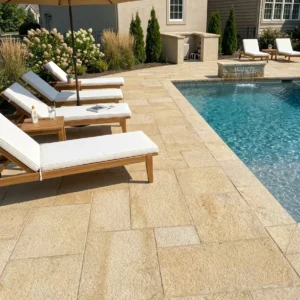
The ocean-view infinity pool is Costa Rica’s signature real-estate image, and the market builds it from Tamarindo’s hills to the whale-coast ridges: a weir edge aimed at the water, a pale deck framing the drop, the jungle or the dry forest closing the composition. The stone craft is the regional canon at full tolerance – weir stones cut to millimeter precision, cap tones matched to the sea’s band, maintenance access designed with the edge – and the country’s steep lots add the structural prologue: the terrace stands on engineered ground long before it holds water.
One Standard, Two Climates
The specification splits at the climate line:
- Guanacaste and the dry Pacific: barefoot heat is the enemy – light tones lead, textures rate for pool-wet feet, and dust joins salt in the maintenance pair.
- The southern zone and the Caribbean: biology is the enemy – brushed textures without exception, falls that dry fast between rains, and the wash calendar kept religiously.
- The Central Valley: the gentlest brief in the country – moderate sun, afternoon rains, and finish choices freed to follow taste.
- Everywhere: the seismic rule – unit paving over engineered structure, flexing where slabs would crack.
The Rancho Adjacency
Costa Rican pools rarely stand alone; they partner the rancho – the great roofed outdoor room – and the terrace plan reads the pair as one composition: deck flowing to rancho floor in the same stone family, the finish stepping from textured to honed at the drip line, and the circulation between water, shade and kitchen running without a threshold to stub a wet toe. The pairing is the country’s outdoor architecture in miniature, and the properties that draw it as one surface live twice as well as those that built it twice.
The Family Standard
Behind the infinity photographs, most Costa Rican pools serve families – resident, visiting or renting – and the working specification leads with forgiveness: rounded coping where climbers haul out, step geometry consistent for legs of every age, texture graded from fine at the loungers to grippy at the wet line, and a shallow shelf where the youngest own their depth. the surface-interval terrace craft details the working-pool register on an island that lives it daily, and the transfer to a Costa Rican family deck is direct.
Rain on the Water
The green season adds a design case dry islands never face: serious rain falling on the pool itself and the terrace around it. The engineering answers are routine when planned – deck falls that shed cloudburst volumes away from the shell, overflow and skimmer capacity sized for the season, channel drains where roof lines concentrate water – and awkward when retrofitted. The wet months also do the terrace a favor: they audit every fall and joint annually, and the surfaces that pass the audit need almost nothing else.
The Night Pool
Costa Rica dines early by island standards and swims late by any standard – the climate makes the evening pool the day’s reward – and the lighting craft follows the regional rules: warm fittings washing pale stone, step edges lit as courtesy and insurance, circuits split so the deck can drop to jungle-dark when the stars earn it. Conduit under the paving at build time makes the whole repertoire cheap; the country’s frequent power of storms also argues for the low-voltage route throughout.
The Spares Culture
The rental economy runs the country’s pool terraces hard, and the attic-stock rule holds at full strength: five percent same-batch spares with every order, stored flat, turning mid-season damage into overnight repairs. Costa Rica adds its own argument – the two-ocean freight chain means a matching reorder is weeks away at best – and its own solution: the spares travel with the original consignment, clear customs once, and wait out their years in the pool-plant room at zero marginal cost.
The Valley Pool
The Central Valley writes the country’s gentlest pool brief and its one special clause: water temperature. At altitude the eternal spring cools the pool past comfortable, so valley pools heat – solar arrays on the rancho roof doing most of the work in the country’s sunshine – and their terraces borrow the highland’s virtues: finer finishes viable under the mild sky, stone floors that bank the morning sun for the evening swim, and none of the coastal salt clauses at all. The valley pool works more months in comfort than any coastal basin precisely because its terrace was never fighting the tropics; it was hosting the spring. Specify the heating at build time – plumbing under the deck, panels planned with the roof – and the highland pool becomes the daily habit the coast’s heat only promises.
The Standard, Settled
Costa Rica’s pool terrace standard settled years ago because the market tested everything: pale dense limestone, textures zoned by climate, unit construction over engineered ground, one batch throughout. What remains is execution – and the premium end of the craft is mapped in infinity edges cut to tolerance, whose disciplines the country’s better builders already speak. Two oceans, one standard: build the terrace to it and the pool serves whichever horizon the lot was bought for, for decades.
The Renovation Pool
The country’s pool stock spans decades, and the renovation market re-skins as much as it builds new: tired shells gaining modern envelopes, painted concrete surrendering to real coping, cracked decks lifted for stone over corrected falls.
- The shell’s structure is assessed first – the envelope renews finishes, not engineering.
- Coping replacement leads the transformation: the profile change alone re-dates the pool a generation.
- Deck renovation is the drainage correction opportunity the original build missed – falls redesigned, channels added, the green season finally answered.
- The waterline refresh completes the reading: new tile band, new coping, new deck, one coherent age.
Renovation economics flatter the work: the shell’s cost stays sunk, the envelope carries the visible value, and a fortnight’s installation returns a pool the listing photographs cannot distinguish from new construction. The country’s renovation wave learned the lesson early – the pool is re-skinned first, because no other surface moves the property’s reading faster.
Two coasts, two entirely different decks
A pool terrace in Guanacaste and one outside Puerto Viejo share almost nothing beyond the water. The Pacific northwest runs six dry months of hard sun, so heat, glare and dust govern. The Caribbean side receives rain across the whole year, so the deck is rarely fully dry and biological growth is the standing maintenance item. The same stone can serve both, but only if the drainage design and the cleaning plan are written separately for each.
- Pacific decks detailed for heat, glare and long dry spells
- Caribbean decks detailed for slow drying and constant growth
- Drainage sized for the local extreme rather than a national average
- Cleaning intervals set by coast, not copied across the country
Grip is the number that has to be proved
Wet and barefoot is a measurable condition. The work behind frictional testing of natural stone walking surfaces sets out the ANSI A326.3 method, tested wet with a tribometer, and a benchmark dynamic coefficient of friction of at least 0.42 for level interior floors expected to be walked on wet. A tropical pool deck carrying sunscreen, sand and rain sits beyond that reference, which argues for testing the delivered finish and specifying with margin.
- Wet values requested on the exact finish and batch supplied
- More margin on steps and any sloping approach
- One texture across deck, coping and surround
- The test record kept with the property file
Heat, absorption and how a pale deck ages
Surface temperature and staining both come back to material properties. The Natural Stone Institute overview of limestone and travertine shows how far density and absorption range inside one commercial name, and in this climate those numbers decide whether a deck is usable at midday and whether it holds its color under chlorinated water.
- Light tones on unshaded areas to keep surface temperature down
- Low absorption wherever splash-out is constant
- One source across deck and coping so the terrace weathers evenly
- Batch numbers logged for future repairs
Choosing pool terrace stone for the coast you are actually on
Specify for water first, heat second and appearance third, restrain the coping mechanically, and keep a documented surplus on site so a chipped unit never waits on a container.
- Coping profile chosen for the swimmer before the elevation
- Mechanical restraint in addition to bedding at every unit
- Expansion provision between pool shell and deck
- Attic stock stored dry from the first delivery
Our Costa Rica stone supply guide sets out the formats, finishes and lead times that suit this country. One country, two oceans, and a deck that has to know which one it is on.