St. Kitts & Nevis gardens negotiate with management: the vervet monkeys — descendants of ship-borne arrivals three centuries back, now outnumbering the human federation by most counts — raid fruit trees on schedule, audit vegetable beds with professional thoroughness, and treat garden furniture as gymnasium equipment. Monkey country writes its own landscape rules, and the gardens that thrive are the ones designed for the negotiation. Here is the vervet-country guide.
Knowing the adversary
The vervet is a planner: troops running daily circuits with remembered fruit calendars, raids timed to ripeness with orchard-manager precision, athletic reach that laughs at ordinary fencing, and social learning that shares every discovered weakness. Garden design starts from respect: the defensive-garden logic rewritten for an adversary that climbs, plans and teaches — where the goat tests boundaries, the vervet solves them.
The defended kitchen garden
Productive beds in monkey country build like small fortresses, and stone does the permanent work: walled kitchen-garden enclosures — the walled-plot tradition at full commitment — carrying mesh superstructures on honest masonry, footing courses defeating the digging the troops delegate to patience, gate discipline as household culture, and the working-garden registers inside: harvest paths, potting corners and rain-fed irrigation living inside the defended walls. The enclosure that works is architecture, not netting; the island’s gardeners learned to build it once and well.
- Assume anything liftable will be lifted, so fix or weight every loose element.
- Use heavy units that a troop cannot move rather than light decorative pieces.
- Keep planters low and wide, since tall narrow pots tip easily.
- Avoid soft jointing material, which gets picked out within a season.
Designing the undefended garden
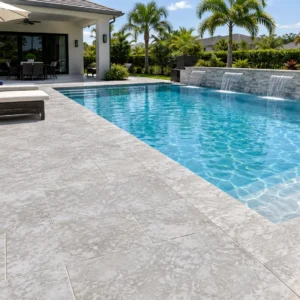
Beyond the walls, strategy replaces armor: ornamental plantings selected off the vervet menu — the troops audit and ignore what does not pay — fruit trees accepted as shared assets with the shade-inheritance value intact even when the mangoes travel, water features on the robust-structure rules because the troops will use them regardless, and furniture-and-fixture honesty: nothing light enough to relocate, nothing delicate enough to audition as a toy. The undefended garden thrives by being uninteresting; its beauty is the strategy.
Hospitality in monkey country
The islands’ resorts run the negotiation at commercial stakes: breakfast terraces on the inn-tradition registers patrolled by staff and architecture together, buffet lines sited inside screened pavilions, the pool-court realities — troops drink poolside with guests photographing them — managed as amenity and liability at once, and the guest-education layer the nature-hospitality craft teaches: the monkeys are the excursion photo and the reason the pastry vanished; the property’s design keeps both stories charming.
- Design guest areas so feeding is impossible rather than merely discouraged.
- Keep bins fully enclosed and mechanically latched, not simply lidded.
- Detail service routes so waste never sits in the open, even briefly.
- Brief staff on the same rules as the design, or the design will not hold.
The wider stewardship question
The vervet population is an ecological and agricultural policy debate the federation conducts seriously — crop losses against tourism charisma, management programs against animal-welfare scrutiny — and garden craft stays neutral infrastructure: defended production, uninteresting ornament, and the wildlife-margin manners applied to a species that ignores margins. Whatever policy decides, the walled garden keeps working; stone’s advantage in the debate is that it has no opinion and needs no revision.
Building for the negotiation
Monkey-country specification is the cluster’s garden law plus an adversary clause: masonry enclosures built once at full honesty, footings deep against patient digging, structures robust against athletic use, and materials from the federation supply guide chosen for the negotiation’s length — the troops have three centuries’ tenure and no plans to leave. The garden that accepts the terms thrives; the one that doesn’t feeds the neighborhood’s most organized customers. Build the walls, plant the strategy, and enjoy the show from the verandah: in vervet country, that is victory.
The dog, the dish and the compost: household routines in troop country
Beyond walls and planting lists, vervet coexistence is won or lost in household routine, and the settled federation household runs monkey-aware housekeeping without thinking. The kitchen’s rules lead: outdoor dining cleared promptly because an unattended plate is a training session, fruit bowls kept indoors and away from sightlines — the troops window-shop — and the yard-gathering culture’s buffet habits adapted with covers and timing. Waste management is the campaign’s real front: bins with latched lids on stone stands the troops cannot tip, compost enclosed rather than heaped — an open pile is a subsidized canteen — and collection-day discipline, because the street’s loose bags feed the whole neighborhood’s problem. The dog question answers itself locally: a garden dog is the most effective deterrent the island knows, its water and feeding station placed where the troops’ approach routes make its presence obvious, and its diplomacy — noise over contact — exactly what the situation wants.
The garden’s routines complete the system: harvest timed ahead of ripeness because the troops’ calendar is better than yours, fallen fruit gathered daily, bird feeders accepted as monkey feeders and sited or abandoned accordingly, and the defended enclosure’s gate culture — closed always, latched properly, children briefed — maintained as family law. None of it is burdensome once habitual; all of it collapses if intermittent, because the adversary’s social learning files every lapse.
The honest promise of the routines is proportion: the household that manages attractants lives beside the troops in armed truce, entertained more than raided, while the careless neighbor hosts the daily circus. The wall was the capital investment; the routines are the operating discipline; and together they deliver what the federation’s gardens actually offer — coexistence on human terms, most days, which in troop country is victory.
Why the population is where it is
The vervet situation is a land use story before it is a garden problem. The First Biennial Update Report of the Government of St. Kitts and Nevis records the closure of a 300 year old sugar industry after the 2005 harvest, vegetation succession across the former sugar lands, an expansion of secondary forest on the lower slopes, and a Central Forest Reserve of roughly 1,250 acres holding the last undisturbed tropical forest on the island. More cover on the lower slopes means more contact where people build.
- Expect pressure on any garden that backs onto regenerating scrub.
- Read the boundary between built land and secondary forest as the front line.
- Assume the situation is permanent rather than seasonal.
- Design for a resident troop rather than an occasional visitor.
- Keep fruiting planting away from the boundary if the crop matters to you.
Specifying fixtures that survive constant handling
Monkey country is an abrasion and impact problem in disguise. The Natural Stone Institute testing program gives the measures that matter for that: ASTM C1353 for abrasion resistance, C170 for compressive strength, C880 for flexural strength and C97 for absorption and bulk density. A garden element chosen on appearance alone rarely lasts here.
- Read abrasion resistance first, since surfaces get climbed on daily.
- Choose denser material for copings and any edge that gets sat on.
- Check flexural strength on anything that spans, because it will be jumped on.
- Prefer low absorption, as staining from handling is constant.
Designing a garden the troop finds boring
The defensible garden is not fortified, it is uninteresting. Nothing to lift, nothing to open, nothing to eat, and no reward for the effort. That is a design outcome rather than a product you buy, and it is much cheaper to build in from the start than to retrofit after a season of damage.
- Remove the reward rather than trying to add a barrier.
- Fix or weight every loose object in the garden as a matter of course.
- Keep water features shallow and hard-edged so they are not worth investigating.
- Accept that a fully productive kitchen garden needs a physical enclosure.
Monkey proof garden design that actually holds
The vervet population sits where the cane used to be, and gardens on that boundary are permanently negotiating. Specify for abrasion and impact, fix everything down, remove the reward, and enclose anything genuinely productive. Our St. Kitts and Nevis stone supply guide sets out the formats, finishes and lead times that suit this federation. You will not out-fence a troop that has all day, so the winning move is to make the garden not worth the trip.