Dominica’s hospitality achievement is teaching the luxury world a new grammar: small nature-first properties whose sustainability is not a marketing layer but the product itself — and whose standards match any address in the Caribbean. The model’s materials conversations are the most thoughtful we have anywhere, and stone earns its place in them on merits worth stating properly. This is the eco-luxury specification, argued honestly.
What nature-first properties actually ask
The eco-resort brief interrogates materials the way few clients do: Where is it from, and what did extracting it cost? How long will it last, and what happens then? What chemistry does maintaining it release into a watershed guests drink from? Does it belong visually in a landscape the property exists to honor? Stone answers each on its record — a geological material of stated provenance, a service life measured in generations, maintenance by water and brush, and a mineral palette native to the volcanic island it lands on — but the answers deserve documentation, not assertion, and we supply them as datasheets and plain statements rather than green vocabulary.
Longevity as the core sustainability
The most honest environmental mathematics in construction is service life: a surface replaced three times carries three manufacturing and shipping footprints, and the rainforest climate retires soft materials brutally fast — timber decks on their subscription, coatings on their cycles, composites on their promises. Stone’s claim is the one the subscription-versus-endowment ledger makes everywhere, compounded by Dominica’s weather: buy the surface once, maintain it with water, repair it by the unit from attic stock, and the decades amortize every footprint the first shipment carried. For properties whose brand is stewardship, the longevity argument is the sustainability argument.
- Measure the footprint of the ground plane, not only of the buildings.
- Choose permeable construction so the site keeps absorbing its own rainfall.
- Keep clearance minimal and work around mature trees rather than through them.
- Source and stage material to reduce the number of vehicle movements on site.
Maintenance chemistry in a watershed
Eco-properties sit inside living water systems — rivers guests swim, springs communities drink — and their maintenance regimes answer for everything that washes off. Stone’s regimen aligns natively: pH-neutral cleaning as the standing rule, no acid products ever, no coating cycles shedding into the ground, algae season met with brush and rhythm rather than biocide enthusiasm. The river-courtesy rules run at full Dominican strength, and the property’s care manual becomes part of its environmental documentation — a page we help write.
Building lightly in heavy terrain
The eco-model prizes light-touch construction — platforms over roots, paths that follow contours, buildings that could theoretically leave — and stone serves the ethic more flexibly than its mass suggests: stepping-slab paths bedded individually where continuous construction would scar, terraces on platforms the slope craft engineers respectfully, plinths lifting timber structures out of ground contact and extending their lives, and unit surfaces that can genuinely be lifted and relaid if a property ever rethinks a route. The heavy material, used thoughtfully, is often the lighter footprint.
- Design for demountable rather than permanent wherever the brief allows.
- Use dry-laid and pedestal systems that can be lifted without demolition.
- Keep foundations shallow and localized instead of continuous.
- Specify material that can be reused if a structure is later moved.
The guest experience the model sells
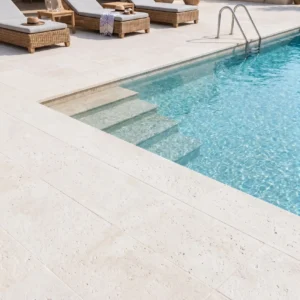
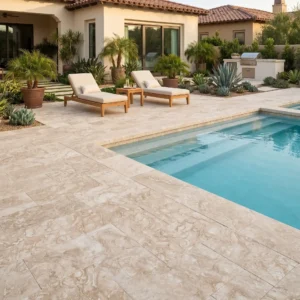
Eco-luxury guests buy immersion with assurance — rainforest by day, impeccable comfort by night — and stone carries both halves: barefoot-warm terraces at treehouse-villa thresholds, plunge-pool surrounds secure under daily rain, textured paths that grip the damp confidently enough that guests stop noticing the damp, and the visual register — pale stone against extravagant green — that fills the feeds these properties book from. Durability performs hospitality here: surfaces that look effortless in year ten are the brand promise, kept.
Specifying it properly
The eco-luxury package runs the cluster’s full discipline with the model’s accents: samples judged on site under canopy light, cutting lists heavy on treads and platform edges, textured finishes as default, spares stored on property, care manuals written for stewardship files, and logistics planned to the expedition calm remote sites deserve. The Dominica supply guide packages it end to end — and brings the documentation the model’s conversations rightly demand.
The audited property: certification and its evidence
Eco-hospitality’s credibility increasingly runs through certification — the sustainability frameworks whose audits examine operations, sourcing and impact — and the materials file is part of every assessment. Stone contributes evidence gladly when the documentation habit ran from the start: provenance records naming quarry origin and processing, transport documentation letting footprint accounting proceed honestly, datasheets establishing service-life expectations that anchor lifecycle arguments, and the maintenance regime — water, brush, pH-neutral chemistry — written into the property’s environmental procedures where auditors verify practice against paper. The repairs log tells certification’s favorite story: unit-level repairs from attic stock across years evidence the anti-replacement philosophy frameworks exist to reward.
The audit conversation also values what stone does not require: no coating cycles introducing solvents to a watershed property, no treatment chemistry entering the graywater story, no end-of-life disposal stream — lifted stone is reusable material, not waste — and no irrigation, power or consumable dependency in its upkeep. Properties preparing for assessment do well to assemble the stone chapter proactively: a two-page materials statement, the documentation set filed, the maintenance procedures cross-referenced, and photographs of the repairs practice in evidence. Certification is ultimately storytelling with receipts, and stone’s story — geological material, generational service, water-and-brush stewardship — audits as well as it lives. We prepare the receipts as standard for eco-model clients; the specification guide explains the philosophy they evidence.
What the planning system asks of a rainforest site
A low impact brief still meets a statutory process. The Physical Planning Act 2002 requires development permission for building operations, material changes of use and subdivision, gives the Authority 120 days to determine an application with a possible 60 day extension, and treats an undetermined application with no extension notice as deemed refused. Environmental impact assessment is required for development listed in Schedule II, with the Authority giving written notice of assessment terms within 30 days.
- Build the 120 day determination period into the program as a fixed cost.
- Expect an environmental assessment on a forest or coastal parcel.
- Treat a silent application as refused, since that is the statutory position.
- Allow for the additional 60 day extension the Authority may take.
- Keep the approved drawings and the delivered specification aligned in writing.
Building beside a World Heritage landscape
The reason guests come is protected at the highest level. The World Heritage listing for Morne Trois Pitons National Park records a 6,857 hectare property inscribed in 1997, roughly nine percent of Dominica, containing five volcanic centers, fifty fumaroles, hot springs, three freshwater lakes and the Boiling Lake at around 95 degrees Celsius, protecting one of the very rare largely intact forest areas remaining in the insular Caribbean across at least five distinct forest types.
- Read the park boundary early, since proximity changes the approval process.
- Design so the forest reads as the setting and the building as the guest.
- Keep lighting low and directed, because the value here is the dark and the quiet.
- Expect ecological constraints on clearance, drainage and planting.
A light footprint that still takes heavy use
The contradiction in every eco resort brief is that a minimal ground plane has to carry a full commercial load. Guests walk the same paths several times a day, staff move supplies along them, and the rainforest keeps everything damp. A surface chosen only for its green credentials fails within two seasons.
- Specify the main circulation for commercial duty rather than garden duty.
- Expect algae and biofilm year round and choose a texture that stays safe with it.
- Keep service routes separate so guests never share a working track.
- Design for hand maintenance, since machinery cannot reach most of these paths.
Eco resort stone that earns the Nature Island label
A low impact resort still has to survive constant damp, constant use and a real planning process. Keep the ground plane permeable and demountable, specify for commercial traffic, read the park boundary before designing, and allow the full determination period. Our Dominica stone supply guide sets out the formats, finishes and lead times that suit this island. The forest is the product here, and the best hard landscaping is the kind guests never notice they are standing on.