The territory’s northernmost island breaks every BVI rule: Anegada lies flat as a drowned atoll where its sisters climb, rings itself with the Caribbean’s third-largest barrier reef, and runs an economy of lobster boats, flamingo salt ponds and beach settlements at the end of the chain’s longest supply line. Building here is coral-island craft inside a volcanic territory — the cluster’s flat-island playbook with BVI paperwork — and the exception’s guide reads distinctly. Here it is.
The horizontal register
Anegada’s design language is the flat islands’: low settlements along endless beach, the low-built promise as natural law, sightlines running to reef-break horizons, and ground-plane craft carrying the composition the terrain declines to. The salt-washed physics govern wholesale — everywhere is coast on an island this low — and the drainage discipline thinks in soakage because nothing slopes: the flat-ground rules at their purest, built over coral ground that drinks.
Reef-window waters
The island’s treasure is its lagoon-and-reef ring — bonefish flats, snorkel gardens, the wreck-strewn breaks that named the island — and shore infrastructure serves water access at Anegada’s gentle grade: walk-in entries over flats rather than ironshore engineering, flats-boat landings on the shallow-apron pattern, gear circuits sized for rod-and-fin culture, and the reef-courtesy siting that keeps construction runoff out of a living ring the watershed manners would recognize.
- Design for a horizon-dominated site where nothing tall breaks the view or the wind.
- Expect salt to reach the whole plot rather than just the seaward face.
- Keep planting low and structural, since exposed ground offers no shelter to anything tender.
- Use ground-level terraces rather than raised decks, because there is no slope to exploit.
The lobster economy’s shore
Anegada’s table legend — the lobster feasts that justify the crossing — runs on working shoreline: fishing-fleet landings and trap yards on honest working-quay grade, beach-restaurant rows firing grills at sunset on the institution register with crustacean-scale kitchens behind, and the seasonal pulse — festival weekends, high-season crossings — absorbed on surfaces built for feast-night crowds and hosed clean by morning. The genre’s stone stays humble and hardworking; the lobster is the luxury.
Salt ponds and flamingo margins
The island’s interior runs protected water — the salt ponds where flamingo flocks returned to nest — and development threads the margins on pond-courtesy rules at conservation grade: setbacks respected absolutely, runoff excluded, lighting held dark at the water side, and the viewing economy — pond overlooks, birding platforms — built light and reversible. The ponds are the island’s second signature; building keeps its distance and its manners.
End-of-the-line logistics
Anegada sits at the chain’s far end — the longest hop on the island-leg system, shallow-draft approaches, and an island whose stores stock essentials rather than contingencies — so the frontier disciplines run at full strength: consignments landing complete or waiting complete, crates sized for island handling, spares as policy, programs buffered to the service’s rhythm, and the settlement manners of a community where every delivery is news. Stone’s patience is the logistics’ best friend: it crosses when the crossing serves and waits without complaint.
- Order every fixing, adhesive and jointing product with the stone rather than locally.
- Send spares in the same consignment, since a second delivery is a separate boat trip.
- Bring cutting equipment and consumables to site rather than assuming a local hire.
- Build the program around one arrival, because a missed item can stop work for a fortnight.
The exception’s reward
What Anegada returns is the territory’s rarest offer: horizon solitude inside a sailing nation — beaches measured in empty miles, reef gardens off the porch, and a settlement pace the vertical islands traded away. Building here honors the exception: low, salt-honest, reef-courteous, frontier-provisioned — the territory supply guide serving its flattest client with the coral-island kit and BVI standards in one consignment. The sisters climb; Anegada floats — and floats best on stone that understands the difference.
Sky-wide nights: darkness as the flat island’s amenity
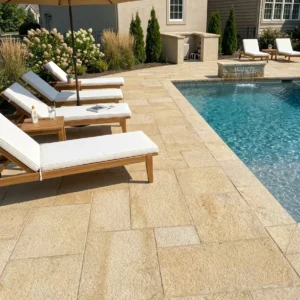
Anegada’s horizontality gives it the territory’s biggest sky, and its sparse settlement gives it the darkest — a combination the island’s properties should treat as an amenity with a specification. The dark-sky rules arrive naturally here: lighting held low, warm and shielded so the Milky Way keeps its billing; paths marked by fixtures that light the ground rather than the air; and the shoreline’s lights kept modest for the sea’s sake as much as the sky’s — the flats’ ecology and the night fishery both prefer an island that glows softly. Stone carries the night plan: pale paths and terrace edges hold the late light and read underfoot when fixtures are few, steps take their subtle texture contrasts, and the fire circle — the flat island’s natural evening room — sits on a generous stone apron that keeps sparks, chairs and drinks all on honest ground.
The practical layer respects the island’s logistics: fixtures chosen for salt life and simple replacement, since the end-of-the-line supply chain punishes exotic fittings; solar where it genuinely serves, wired where reliability matters; and everything mounted to be found and serviced by daylight common sense. Navigation courtesy belongs in the plan too — shore lights positioned so they never confuse the channel’s modest marks, a consideration the reef’s history makes more than polite.
The reward is the island’s signature evening: dinner on stone still warm from the afternoon, the anchorage’s lights low on the water, and above it a sky the high islands’ ridges interrupt but the flat island serves whole. Guests remember Anegada’s nights as vividly as its reef window, and the properties that designed for darkness — deliberately, in stone and shielded warmth — are the ones that gave them the memory intact.
A limestone island in a volcanic territory
Anegada is the geological exception in the Virgin Islands, and that changes what a builder is standing on. Research published through the US Geological Survey on Anegada places the island about 140 km east-northeast of Puerto Rico and describes limestone outcrops in its interior. The same work maps fields of dispersed cobbles and boulders derived from those outcrops, one running 200 m southward from limestone about 300 m inland from the north shore, another 100 m southward from a limestone knoll some 800 m from the nearest shore, with 161 clasts recorded and almost half partially buried in overlying sand and shell.
- Expect shallow soil over limestone rather than the deep volcanic material found on Tortola.
- Assume ground conditions vary sharply across a plot, because outcrop and sand sit side by side.
- Read the dispersed clast fields as evidence of extreme past overwash reaching well inland.
- Plan levels from a survey rather than from the apparent flatness, which hides real variation.
- Treat exposed limestone as a design asset, since it is the local material in its original state.
What limestone ground means for a limestone specification
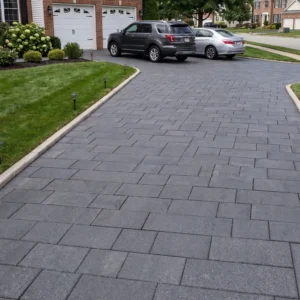
Building on limestone does not automatically mean paving with it, but it does make the family a natural fit visually. The reference material from the Natural Stone Institute on limestone is the practical filter: absorption across the family ranges from under one percent to over ten, dolomitic varieties run denser with lower absorption and higher abrasion resistance, and every limestone is vulnerable to acid attack. On an island ringed by reef and washed by salt, those three facts decide the shortlist.
- Choose the low-absorption end of the family for anything within reach of spray or standing salt water.
- Prefer dolomitic material where traffic is heavy, since abrasion resistance is measurably better.
- Ban acidic cleaners from the maintenance schedule before the first delivery arrives.
- Match tone to the local outcrop so new work reads as continuous with the ground it sits on.
Working a site with no vertical relief
Everything the rest of the territory takes for granted about slope is absent here. There is no gradient to drain a terrace, no hillside to shelter a courtyard, and no natural fall to move water away from a building. Drainage becomes a design problem solved entirely by falls the builder creates.
- Build falls into the paving itself, because the ground will not do it for you.
- Provide positive outfalls to defined soakaways rather than relying on ground absorption alone.
- Raise thresholds deliberately, since a flat site offers no margin when water arrives quickly.
- Use windbreaks and structure for shelter, as there is no topography to borrow it from.
Flat coral island building on Anegada terms
Anegada rewards builders who accept it on its own terms rather than importing habits from Tortola. Low absorption for salt, dolomitic where traffic is heavy, falls designed into the paving because the ground has none, and a single consignment that carries everything down to the last bag of jointing compound. Our British Virgin Islands stone guide sets out the formats, finishes and lead times that suit this territory. The Settlement builds the way it does for good reasons, and a specification that respects them lasts far longer than one that does not.