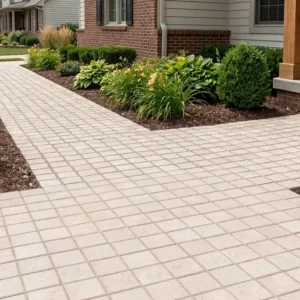
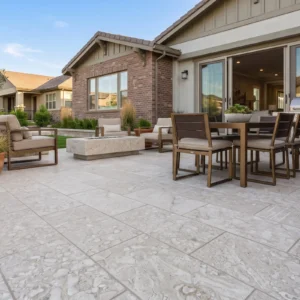
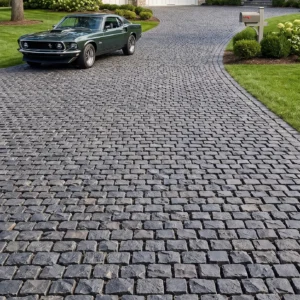
A TCI driveway has an easier structural life than most in the Caribbean — the ground is flat, the substrate drains, and torrential mountain runoff is somebody else’s problem. What it has instead is a social life: most driveways here sit inside estate communities with standards to meet, neighbors at close quarters, and an arrival-court role in properties where first impressions carry rental and resale value. Building one well is less about fighting terrain and more about precision, drainage without slopes, and living with sand.
The estate context comes first
Gated communities across Providenciales run design guidelines that reach the driveway: acceptable surfaces, reflectivity and tone expectations, curb and apron details where private paving meets estate road, sometimes even construction-hour rules for the build itself. The efficient sequence is approvals before ordering — submit the stone, format and layout for sign-off with a physical sample rather than a photograph, and have the apron detail agreed with the estate office in writing. None of this is onerous; all of it is faster done first. It also protects value: a driveway consistent with a well-kept estate’s language sells with the house.
- Acceptable surface materials and finishes, published by the estate rather than negotiated later.
- Reflectivity and tone expectations, which quietly rule out most dark paving.
- Curb and apron details where private paving meets the estate road.
- Approval drawings and timescales, which sit on the critical path more often than people expect.
Drainage on ground that will not slope
Flat sites remove gravity as a helper, so the driveway must make its own water plan even in a dry climate — because when TCI rain arrives, it arrives seriously. The toolkit: a gentle crown or cross-fall built into the laying (imperceptible underfoot, decisive in a downpour), permeable jointing that lets the coral substrate do what it does naturally — drain — and soakaways at the collection points sized for storm bursts rather than averages. The good news is that the islands’ limestone ground takes water willingly; the design merely has to deliver it. Standing water on a flat drive is always a design omission, never a climate inevitability.
- A gentle crown or cross-fall built into the base, since the finished surface cannot invent one.
- Permeable joints or an open-graded layer where runoff has nowhere obvious to go.
- A channel or slot drain across the apron so estate road water is not inherited.
- Outfalls to planting rather than to the neighbor, checked before the base is compacted.
Sand is a resident, not a visitor
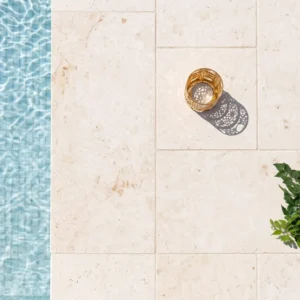
Near the coast — which in TCI is nearly everywhere — wind-blown sand drifts onto paving as a fact of life. The specification response is threefold. Tone: pale stone in the sand’s own family makes drift invisible between sweepings, where dark paving displays every grain. Texture: a brushed or lightly textured surface keeps grip when a film of sand acts as ball bearings on smooth stone. Joints: sand migrates into open joints, which is fine — permeable joints are self-dressing here — but mortared joints should be flush-finished so sweeping actually clears them. A monthly blow-off or sweep is the entire maintenance regime; design makes it a five-minute job or a losing battle.
Duty: carts, cars and the occasional truck
Many estate properties move by golf cart as much as car, and the temptation is to specify lightly. Resist it selectively: the daily surface can be engineered for light duty, but every driveway has its heavy days — delivery vans, a septic tanker, a construction visit — and the entrance apron plus the main running line deserve full vehicular build-up: proper compacted base, 4–5 cm dense stone, herringbone or coursed patterns that lock under turning wheels. The base-and-build-up guide from our Antigua series details the layers; TCI’s flat sites make the work easier, not optional.
The arrival court as a room
Where the driveway widens into an arrival court, its logic shifts from road to architecture: this is the property’s handshake. Borders and tone bands break large paved areas into composed fields and manage midday glare; a planting island or specimen tree gives the court a center; lighting and service sleeves go under the stone at build time, never through it later. The court’s stone should converse with the villa’s terraces — same family, adjusted duty — so arrival begins the material story the arrival-sequence guide completes at the door. Order the whole composition from one batch through the TCI supply page and the handshake stays consistent for decades.
The junction with the estate road
A driveway’s first meter belongs to two owners, and the junction deserves specific design. The apron — where private paving meets the estate road — takes the hardest use on the property: every arrival brakes and turns across it, service vehicles cut its corners, and estate traffic clips its edge daily. Build it accordingly: full vehicular base, the thickest stone on the project, and curb returns or a flush steel edge that protects the paving’s outer arris from wheel strikes. Sightlines rule the geometry — the junction should open visibility in both directions, with planting and wall lines held low near the mouth per most estate guidelines. Drainage politics matter too: the apron must neither shed private water onto the estate road nor accept the road’s runoff into the drive’s soakaways, which a subtle crest at the boundary line resolves. Agree the whole detail with the estate office in writing before building; the junction is the one piece of the driveway that is also somebody else’s infrastructure.
Guest parking and the overflow court
Estate villas entertain, and the driveway plan that only considers the household’s cars rediscovers the fact at every dinner party. The overflow question deserves design rather than improvisation: a widened run or discreet parking court sized for three or four guest vehicles, surfaced to the same standard as the drive (grass and gravel corners announce themselves as afterthoughts and migrate onto the paving), and positioned so guests park without blocking the household or reversing across the arrival court’s composition. Permeable-jointed stone earns its keep here doubly — the court drains itself and reads as terrace rather than car park when empty, which matters because overflow space spends most of its life empty. Estate rules frequently govern street parking precisely to keep verges intact, so the on-plot answer is also the neighborly one. Detail notes from the field: define bays with subtle border courses rather than painted lines, keep the turning geometry honest for a hesitant driver in a rental SUV, and light the court to the same low warmth as the drive so late departures end graciously. A villa that parks its guests well starts and ends every gathering without friction — hospitality measured, as usual, in the least photographed square meters on the property.
Base, bedding and the system that carries the load
On flat, free-draining ground the stone is rarely the thing that fails; the layer under it is. Choosing a setting system deliberately, and building the base to match the heaviest vehicle rather than the usual one, is what separates a driveway that stays flat from one that ruts at the apron. This overview of detailing natural stone paving covers the systems in play.
- Sand-set paving over a compacted base, easy to lift and relay where services run beneath.
- Mortar-set construction at the apron and any area where stability governs absolutely.
- Edge restraint on both sides of every run, because unrestrained paving migrates on flat ground.
- Base depth set by the septic tanker and the delivery truck, not by the golf cart.
- Compaction tested in layers rather than assumed from the machine that rolled it.
The material numbers a driveway actually needs
Vehicle traffic is a different demand from foot traffic, and the properties that matter are measurable. The Natural Stone Institute publishes the standards used for dimension stone testing, and four of them decide whether a paving unit belongs under a car.
- ASTM C170 for compressive strength, the direct answer to wheel loading.
- ASTM C880 for flexural strength, which matters wherever a unit spans a soft spot.
- ASTM C97 for absorption and density, since a thirsty stone stains where cars drip.
- ASTM C1353 for abrasion resistance, because sand under tires is an effective grinding compound.
- Thickness specified from the test data and the traffic, not copied from the terrace.
Living with sand, oil and turning circles
The maintenance profile of a TCI driveway is short but specific, and most of it is decided at design stage rather than with a mop.
- Turning circle checked against the vehicles that actually visit, including the longest one.
- A parking bay where oil drips are expected, in a stone chosen for low absorption.
- Joint sand topped up on a schedule, since wind removes it faster than traffic does.
- Blown sand swept off the running line before it grinds the surface finish flat.
- Spare units held from the original batch, so a damaged piece is swapped rather than patched.
Driveway stone in Turks and Caicos, done once and done right
Flat ground and free-draining substrate remove two of the hardest problems in driveway construction, which leaves the ones people underestimate: estate approvals, a water plan on land that will not slope, sand that never stops arriving, and the occasional very heavy vehicle. Solve those four at design stage and the surface itself becomes the easy part. Where the driveway opens into the arrival court, the detailing question shifts from engineering to composition, and our notes on designing a villa arrival sequence pick up there. Build the base for the heaviest day and the driveway will look new on all the ordinary ones.