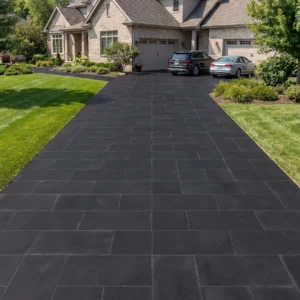
Every Antigua villa is judged before its door opens: the gate, the approach, the threshold — thirty seconds of stone doing the property’s introduction. Entrances are small in area, rich in detail, and disproportionate in effect, which makes them the highest-craft brief in the residential repertoire.
The entrance sequence, decomposed
An arrival is a sequence of moments, each with a stone job:
- The gate zone — threshold band, pier bases, the drive’s apron
- The approach — the walk or drive segment where the house reveals itself
- The landing — the generous flat moment before the steps
- The steps and portico — the formal rise
- The threshold itself — the line between worlds
Designing them as one composition, with one palette and one detail language, is what separates an entrance from a path.
Thresholds: the most symbolic square meter
The door’s stone line rewards ceremony: a full-width single piece (or grand pair) in the accent stone — basalt’s charcoal formality against pale limestone is the classic — flush to the interior floor, weathered edge outward, textured enough for wet sandals. It is one cut-to-order special that guests cross ten times a day; few stones on the property work harder per square centimeter.
Entrance steps: formality’s geometry
Portico and entrance flights carry the formal register: full-width treads (never pieced at the centerline), generous goings, closed risers — often in the accent stone for definition — and the strictest consistency of rise on the property, because arrival feet are distracted feet. The stair rules apply with ceremony added: wider than necessary reads as welcome; exactly-code reads as apartment block.
Installation method matters as much as the stone itself. Industry guidance separates mortar-set work, sand-set exterior paving and pedestal systems, and stresses that drainage, movement and substrate condition drive long-term performance more than the material name does — the detailing guidance is worth reading before you specify.
Gate piers, walls and the street face
Antigua’s properties meet the road in walls and piers, and stone finishes that meeting:
- Pier caps in coping-profile stone — the same profiles, repurposed
- A cladding band, or a full face, on the street wall
- The name plaque set in a dressed stone panel rather than screwed to render
These verticals take the street’s dust and the sprinkler’s spots, so the cladding maintenance logic applies, and they repay it with the only part of the house a passer-by ever reads.
Lighting the welcome
Entrance lighting is stone lighting: pier-cap lanterns or recessed wall washes grazing texture, step nosings shadowed for legibility, and the pale landing doing its usual multiplication of every lumen. Night arrival — guests from the airport, owners from dinner — is the entrance’s second performance, and the night-garden principles stage it: warm, low, few.
Absorption is the number that separates one limestone from another. The Natural Stone Institute records a range running from under one percent to over ten across the family, and notes that dolomitic stones generally carry higher density, lower absorption and better abrasion resistance — the industry variety data sets this out. That spread is why two stones sold under the same broad name can behave nothing alike underfoot.
Ordering the entrance package
Entrance stonework is a specials package — small quantities, high detail, all cut from drawings alongside the main order:
- Threshold pieces
- Treads
- Pier caps
- Plaque panel
- Apron band
Sketch the sequence, dimension the moments, and the thirty seconds that introduce the property forever cost a fraction of what they return.
Arrival by night: the entrance’s second audition
Airport transfers land after dark half the year, and the entrance performs its second audition by headlight and lantern: the pale landing returning the porch light, textured treads reading as shadow lines, the basalt threshold announcing the door by contrast. Walk your own entrance at night before finalizing the lighting plan — the stone will show you where the two or three fittings actually belong, which is the entire budget the design needs.
Entrances that age into landmarks
The entrance is the property’s most photographed stone and its most weathered: hands on pier caps, feet on the same treads, the gate’s arc polishing its threshold band. Specify for the wear — the textures that improve under traffic, the solid pieces that dress rather than chip — and the sequence ages the way island landmarks do: softer-edged, surer of itself, better in year ten than year one.
Turning circles and the car that actually arrives
Entrance geometry is decided by the largest vehicle that will use it, and on Antigua that is rarely the owner’s car. Delivery trucks, a generator on a trailer and the occasional cement mixer all have to reach the house without mounting a planted edge. Work the dimensions before the paving pattern:
- A turning circle sized for a light truck, not a sedan, or a hammerhead where space will not allow a circle
- Clearance at gate piers wide enough that mirrors do not decide the line
- Edge restraints strong enough to survive a wheel that clips them, because one day one will
- A drop-off point flat enough for a suitcase wheel and a heel
Getting this wrong shows up as a permanently scarred border and a rut in the planting. Getting it right is invisible, which is the point.
The entrance in the wet season
An Antiguan squall tests the entrance harder than any other part of the property, because it is the one surface people cross while carrying things. Falls should move water away from the threshold rather than toward it, and the landing outside the door wants a slightly coarser texture than the approach, since that is where wet shoes stop and turn. Where the approach runs downhill toward the house, a discreet channel across the head of the landing costs very little and prevents the one failure guests remember: a puddle at the door. Plan the drainage before the pattern, and the pattern will still look considered.
Planting that flatters the approach
Stone and planting arrive together at an entrance, and the interface decides whether both look intentional five years on. Three rules cover most schemes:
- Keep a hard edge between paving and bed, so the line stays crisp as plants mature and spill
- Avoid overhanging species with heavy leaf or fruit drop directly above the approach — the stone is fine, but the housekeeping is not
- Site irrigation heads so they never spray the stone face, because mineral spotting on a pale wall is far harder to remove than dust
The best Antiguan entrances read as one gesture: a floor, a wall, a threshold and a planting line that all agree with each other.
What a villa entrance in Antigua has to achieve
Entrances are the property’s only stonework every single visitor experiences — the postman, the wedding guests, the future buyer. Compose the sequence once, in solid pieces and honest textures, and the first thirty seconds work in your favor for as long as the house stands. The specials package that delivers it is a drawing and a sailing away. Thirty seconds is all the arrival gets, so give it stone worth the pause.