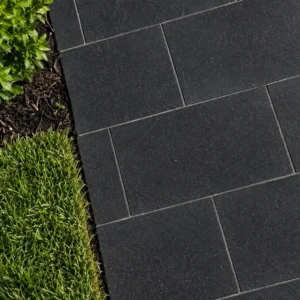
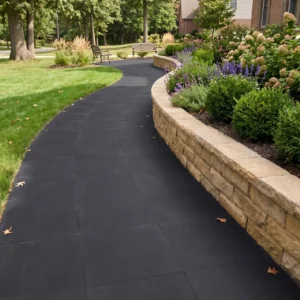
Every cluster guide mentions black basalt pavers as “the accent” — this one gives the accent its own brief. Volcanic, dense beyond argument, and graphite-dark against the island’s pale palette, basalt is Barbados’s exclamation mark: transformative in small doses, oppressive in large ones, and worth understanding properly before the first border is drawn.
What basalt is — and why it behaves
Basalt is cooled lava: a fine-grained volcanic stone whose density and hardness outclass nearly everything else on a paving palette. Practical consequences: it shrugs off vehicle loads (the driveway-field exception to the accents-only rule), takes crisp edges and tight tolerances beautifully, wears its finishes for decades, and — the caveat — absorbs solar heat like the dark object it is. Physics writes its job description: strength and drama, away from bare feet in full sun.
The accent grammar
Bajan designers deploy basalt in a recognizable grammar:
- Soldier borders framing pale fields — the single highest-value move, delivering definition, cut-hiding and composition in one course
- Banding that zones large terraces or marks the drive’s apron
- Step risers under limestone treads, reading each edge for the eye
- Thresholds that announce a transition
- Plinths lifting pots and sculpture into significance
The common thread is that basalt draws the lines rather than filling the field.
Where basalt takes the field
Three settings justify full basalt fields on Barbados: driveways, where its density is the engineering answer and tires — not toes — meet the heat; shaded utility and service zones, where its concealing darkness is an asset; and deliberate drama moments — an entrance court, a night garden — where the design accepts the temperature trade for the look, ideally under partial shade. Everywhere else, the deck guide’s albedo arithmetic keeps the field pale.
Absorption is the number that separates one limestone from another. The Natural Stone Institute records a range running from under one percent to over ten across the family, and notes that dolomitic stones generally carry higher density, lower absorption and better abrasion resistance — the industry variety data sets this out. That spread is why two stones sold under the same broad name can behave nothing alike underfoot.
Finishes on the dark stone
Basalt’s finish range mirrors the limestone family with darker results:
- Sawn and honed faces read almost charcoal-satin — interiors, thresholds, plinths
- Brushed textures gray slightly and grip well — borders, risers, walkable bands
- Bush-hammered lightens toward speckled steel-gray while maximizing traction — ramps and wet utility zones, and a handsome effect in its own right
Wet, all basalt deepens toward true black, which is worth seeing before you commit.
Maintenance in the dark
Dark stone inverts the maintenance optics: organic debris vanishes, mineral marks announce themselves — water spotting, dried splash, sunscreen smears all read in raking light. The counters are familiar: rinse regularly near irrigation and pools, blot oils fast, and favor textured finishes outdoors where spotting disperses visually. Density means stains rarely penetrate; the game is purely surface optics, and the calendar’s routine plays it easily.
Installation method matters as much as the stone itself. Industry guidance separates mortar-set work, sand-set exterior paving and pedestal systems, and stresses that drainage, movement and substrate condition drive long-term performance more than the material name does — the detailing guidance is worth reading before you specify.
Ordering the accent
Accent quantities are small — borders, risers and bands total far fewer square meters than they appear — so basalt rides the main limestone order economically:
- Same crates
- Same sailing
- Cut to the same drawings
The discipline is planning the accents at design time, because the cutting list needs those linear meters, rather than retrofitting drama later.
Basalt indoors: the charcoal interior
Inside, basalt’s heat argument vanishes and its drama survives: honed charcoal floors for moody powder rooms and wine corners, hearth surrounds where its igneous origin is practically thematic, and threshold-and-border work punctuating pale interior fields. The maintenance optics invert indoors too — dust shows on dark floors faster than on pale — which confines full basalt interiors to the rooms whose lighting and mood justify the mop rhythm.
Sourcing the dark stone right
Basalt quality varies by deposit, so the specification asks for:
- Dense, fine-grained material with consistent color — mottled or vesicular batches read cheap
- Calibration to match the limestone it accompanies
- Finishing in the documented textures
Because accent quantities are small there is no economy in compromising: the border’s few square meters carry the composition, and the good material rides the main order at a rounding-error premium.
Basalt underfoot, and where the heat matters
The honest limitation of a dark stone in the tropics is surface temperature, and it is the reason basalt belongs in the accent role rather than the field. A black surface in Bajan afternoon sun gets hot enough to be unpleasant on bare feet, which sets a simple rule about where it can go:
- Borders, bands and thresholds — crossed in a step, never stood on
- Step risers, which are vertical and barely touched
- Drives and parking courts, walked in shoes
- Shaded galleries and interiors, where sun never reaches the surface
What it should not be is the pool surround, the sun deck or any barefoot field. Designers who ignore this produce photographs that win awards and terraces that nobody crosses between eleven and four.
Cobbles, setts and the smaller formats
Basalt earns a second life in the small formats, where its hardness stops being a cutting nuisance and starts being the point. Setts and cobbles handle turning traffic on a drive apron better than any large unit, because the load spreads across many joints instead of stressing a single slab. They also solve curves without cutting: a fan or arc pattern absorbs a radius that would otherwise need template-cut specials. On a Bajan property the natural uses are the drive entrance, the turning head, the apron in front of a garage, and the narrow band where a path meets a gate. Order them with the main package, since the quantities are small and the freight is already sailing.
Basalt and water: rills, fountains and the wet edge
Wet basalt is the most dramatic surface in the palette, deepening to a true black that makes moving water read as light. That is worth designing for deliberately:
- Rills and channels lined in basalt, so a shallow film of water looks like ink rather than a puddle
- Fountain bowls and spillway lips, where the contrast against a pale field does the work no lighting scheme can
- Shower and wet-room floors under cover, where the surface stays wet and the heat problem never arises
Specify a textured finish for anything walked on wet, and remember that the same darkening that flatters a rill will show mineral deposits from hard water sooner than a pale stone does. A rinse habit solves it; ignorance of it does not.
How much black basalt a Barbados scheme can carry
Basalt’s entire philosophy fits in a sentence: the dark stone draws the lines that let the light stone sing. Master that grammar — borders, risers, thresholds, the rare deliberate field — and a modest tonnage of volcanic drama organizes every pale square meter around it. Sample it wet beside your limestone shortlist; the contrast decides its own quantities. Used sparingly, the dark stone does the most work.