Barbados pool decks work harder than most: full-sun exposure, salt air on both coasts, and villas whose rental value is judged partly by whether guests can cross the deck barefoot at two in the afternoon. The specification that survives all three is simpler than it sounds.
Start from surface temperature
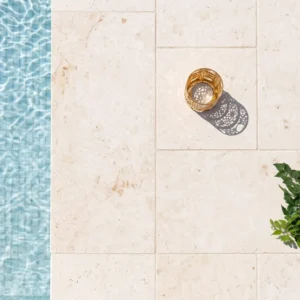
Deck comfort is albedo arithmetic: dark stone absorbs solar energy and stores it; light stone reflects it. White limestone is the Caribbean deck default for exactly this reason — the same sun that makes dark surfaces untouchable leaves light limestone usable all day. If a design tempts you toward darker stone, confine it to borders and shaded zones.
Texture where water lands
Splash zones, the first two meters around the water, want genuine texture: brushed grades or bush-hammered faces whose grip is cut into the stone. Lounging areas further out can soften to finer textures for comfort under furniture and feet. Zoning finishes this way costs nothing extra — it is the same stone, finished differently.
Salt is a specification input
Both Bajan coasts deliver airborne salt, and porous deck stone near the sea pits and powders within a few seasons (the mechanism — salt crystallization — is covered in our coral stone comparison). Dense, low-absorption limestone resists it by admitting almost no water in the first place; a freshwater rinse each month does the rest.
Formats, falls and the coping line
Large formats read resort-calm; 24 x 24 in is the versatile default, 36 x 36 in (90 x 90 cm) where the deck has room to breathe. Lay to a 1.5–2% fall away from the pool, and finish the water’s edge with coping cut from the same stone — bullnose for family villas, square-edge for modern lines — so deck and edge read as one design.
Absorption is the number that separates one limestone from another. The Natural Stone Institute records a range running from under one percent to over ten across the family, and notes that dolomitic stones generally carry higher density, lower absorption and better abrasion resistance — the industry variety data sets this out. That spread is why two stones sold under the same broad name can behave nothing alike underfoot.
Shellstone for the beach-house brief
Where the design language is barefoot-luxury rather than crisp white, Ocean Reef shellstone brings fossil texture, natural grip and a famously comfortable surface in heat — the West Coast look without the West Coast maintenance.
Prove it with samples
One hour of Bajan sun on two samples answers the temperature question; a bucket of water answers the grip question. Samples arrive within 3 working days — ordering, freight to Bridgetown and escrow are in the Barbados supplier guide.
Reading the two coasts differently
Barbados’s coasts are not interchangeable for deck specification:
- The sheltered west — the Platinum Coast — delivers gentler seas but relentless afternoon sun on west-facing decks, so temperature is the enemy and light stone with shaded zones leads the design
- The livelier south and the Atlantic-facing east add wind-carried spray, so salt loading is heavier, absorption matters even more, and rinse-friendly layouts earn their keep
The wet ring, engineered
Treat the coping and first course as their own zone with their own rules: coarsest texture on the property (bush-hammered or 16-grit brushed), falls that shed splash outward, and joints pointed or sealed so pool water — chemically treated and constantly splashed — cannot migrate under the field. Two courses of discipline here decide most of a deck’s safety and most of its long-term joint maintenance; everything beyond the ring can relax toward comfort.
Anything close to the shoreline sits inside a regulated environment. The Coastal Zone Management Unit assesses physical development applications affecting the coastal zone and monitors the shoreline directly through beach profiling and wave data — the unit publishes its remit in full. Confirm your setback position before you order stone, not after the pallets land.
Sun loungers, umbrellas and the furniture map
Bajan decks live under furniture, and furniture leaves biographies on the wrong stone — rust halos from steel feet, scuff arcs from dragged loungers, grease shadows under dining sets. The counters are simple:
- Felt or rubber pads under every metal foot
- A finer brushed texture in furniture fields, so pads slide rather than judder
- Dining zones near the kitchen run, so spills meet dense sealed stone that releases them
Rain, the forgotten deck designer
Barbados rain arrives hard and leaves fast — if the deck lets it. Design for the squall:
- Falls of 1.5–2 percent to planted edges or discreet slot drains
- Flush joints that give bare feet nothing to catch
- Textured surfaces that stay honest when sheeted with water
A deck that is walkable five minutes after a downpour is not luck; it is drainage detailing nobody photographs.
A copy-ready Barbados deck spec
Baseline for a West Coast villa:
- 3 cm dense white limestone, 24 x 24 in field, stack bond, tight joints
- Wet ring bush-hammered, transit zones medium brushed, furniture zones fine brushed
- Matching bullnose coping
- Falls of 1.5–2 percent
- Felt-padded furniture
- 3 percent attic stock from the same batch
East or south coast: the same spec, one texture grade coarser through transit zones, and a monthly freshwater rinse written into the housekeeping schedule.
Glare: the light deck’s one trade-off, managed
Honesty about pale decks includes their single drawback — midday glare off a bright field can be sharp. Managing it is design, not compromise: matte textured finishes scatter light where polished faces would mirror it (one more reason texture wins outdoors), planting and pergola shadows break the field visually, and furniture zones under shade give eyes a rest as well as skin. Sunglasses handle the remainder — which guests on a Caribbean deck were wearing anyway. The heat-versus-glare ledger still lands emphatically on the light side; it simply lands with open eyes.
Installation method matters as much as the stone itself. Industry guidance separates mortar-set work, sand-set exterior paving and pedestal systems, and stresses that drainage, movement and substrate condition drive long-term performance more than the material name does — the detailing guidance is worth reading before you specify.
The entertaining deck: parties without regret
West Coast villas host — sundowners, wedding parties, charity dinners — and the deck specification can plan for the hundredth event rather than the quiet Tuesday:
- Dense stone shrugs off dropped glasses and heels where softer surfaces scar
- Textured finishes hide the evening’s traffic
- Spilled wine blots off sealed dense limestone rather than soaking in
- A hose-down at midnight resets the stage
Add discreet power and lighting sleeves at layout stage and the deck hosts without improvising.
Outdoor kitchens and bars at the deck edge
Barbados outdoor living increasingly cooks where it swims, and the deck interface matters:
- Grease zones near grills want the densest, most sealable stone on the property, with a dedicated cleaning rhythm
- Counters flatter the scheme cut from the family’s darker accent — basalt reads kitchen-serious against a limestone field
- Floor drains earn their keep where ice, marinade and washing collide
The decisions that define pool deck stone in Barbados
Even well-kept decks reach a refresh moment — tastes shift, textures wear glassy in traffic lanes, a new owner wants a new mood. Stone’s refresh vocabulary is graceful: re-texture worn lanes mechanically to restore grip; swap the wet ring’s course from attic stock; introduce a new border or inlay in the existing field (the composition changes, the investment stays); or lift-and-relay the same stones over corrected falls where decades settled them. Compare that menu with “demolish and repour” and the first specification proves itself twice. Cool underfoot at two in the afternoon is the only test that matters.