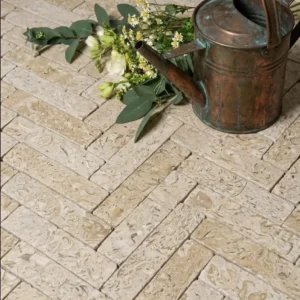
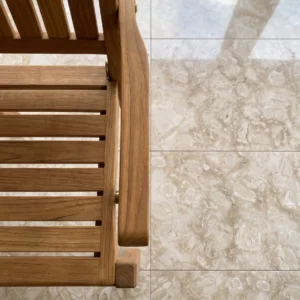
This cluster lives outdoors, but Antigua’s finest trick happens at the sliding door: interiors floored in the same stone family as the terraces beyond, rooms and gardens reading as one cool continuum. Interior stone plays by gentler rules — and mastering them completes the property’s single-material story.
Why stone owns the tropical interior
Air-conditioned or breeze-cooled, the Antiguan interior wants mass and coolness underfoot, and stone delivers it three ways:
- It holds the night’s temperature into the afternoon
- It shrugs off the sand traffic that carpets hoard and timber scratches
- It gives the humid season nothing to warp
Add the visual doubling when interior floor meets veranda and terrace in one tone, and the material choice makes itself. Only the finish question remains.
The interior finish freedom
Indoors the slip ledger relaxes and the finish spectrum opens fully:
- Honed faces — matte-smooth, the tropical-modern default — for living areas
- Polished fields where light and formality lead, the finish that makes white limestone read closest to marble
- Fine brushed where interiors flow hard to wet thresholds
Zone by micro-climate: bathrooms and kitchen aprons borrow one texture grade from outside, while pure living zones enjoy the silk.
Large formats and the seamless room
Interior calm scales with unit size: 24 x 24 in as the workhorse, large-format 36 x 24 and 36 x 36 in slabs where rooms deserve gallery grandeur, laid tight-jointed and — the interior privilege — with grout tone matched so close the field reads monolithic. Level substrates make it possible (screeds indoors are kinder than screeds outdoors), and the lippage-zero discipline from dining terraces applies wall to wall.
Absorption is the number that separates one limestone from another. The Natural Stone Institute records a range running from under one percent to over ten across the family, and notes that dolomitic stones generally carry higher density, lower absorption and better abrasion resistance — the industry variety data sets this out. That spread is why two stones sold under the same broad name can behave nothing alike underfoot.
The threshold: one line, one story
The continuum’s crux is the door line, and four details carry it:
- The same stone family inside and out
- Finishes stepping from silk to texture exactly at the threshold
- Levels flush, for the barefoot glide
- The threshold piece itself — often the accent-stone special — marking the transition with intent
Done right, guests cannot say where the living room ended. Done as two separate floor projects, the seam introduces itself forever.
Living on interior stone
Interior maintenance is the outdoor calendar’s gentle cousin: dust-mop as the default, damp-mop with neutral cleaner weekly, felt under furniture as scripture, and mats at the sand doors doing silent heavy lifting. Sealing follows the same impregnator logic on a longer cycle; spills follow the same blot-fast chemistry — citrus and wine respect no room boundaries. A decade in, the interior field wears its patina indoors as gracefully as the terrace does under sky.
Installation method matters as much as the stone itself. Industry guidance separates mortar-set work, sand-set exterior paving and pedestal systems, and stresses that drainage, movement and substrate condition drive long-term performance more than the material name does — the detailing guidance is worth reading before you specify.
Ordering the continuum
The interior package rides the property order: same batch as the exterior for the continuum tone, thickness typically 2 cm indoors, finishes zoned on the drawings, and thresholds cut as specials. One consolidated order, one sailing, one story from bedroom to pool edge — the logistical expression of the design idea itself.
Rugs, furniture and the lived interior
Stone interiors furnish differently:
- Rugs anchor seating islands on the cool field, and slide-proof underlays are scripture
- Felt pads graduate from advice to law
- Furniture layouts move freely, because no carpet seams dictate them
The design bonus is that pale stone floors make smaller rooms breathe, and let statement furniture — dark timber, rattan, color — carry the personality the floor serenely underwrites.
Bedrooms, baths and the quiet zones
The continuum reaches its final rooms:
- Bedroom floors, cool underfoot at both ends of the day, with rugs at the bedside for the toes’ sake
- Bathrooms, where the wet-room rules come indoors — textured shower floors, honed dry zones, the same neutral-cleaner chemistry
One stone family, gently re-finished room by room, and the villa’s entire ground plane speaks one calm language from pool edge to pillow.
Underfloor services and the stone above
A stone floor is the least forgiving surface on the property to lift, which makes what runs beneath it a design decision rather than a trade detail. Plumbing runs, conditioning condensate lines and cable routes all want to be settled and pressure-tested before a single unit is bedded, because a leak found later is a floor opened rather than a panel lifted. Where a run genuinely must stay accessible, plan an access unit into the setting-out from the start: a single stone lifted on a discreet joint looks deliberate, while one cut out in a hurry never does. It costs nothing at drawing stage and saves a room later.
Acoustics in a hard house
The one honest complaint about a full stone interior is sound. Hard floors, rendered walls and high ceilings make a lively room, and in a villa that hosts, liveliness becomes noise by the second drink. The floor is not the place to fix it — softening the stone would waste it — but the room can absorb elsewhere:
- Rugs sized to the seating group rather than token squares
- Upholstered rather than hard-backed dining chairs, which also spares the floor
- Curtains or fabric blinds at the openings, even where privacy does not demand them
- Something soft at ceiling level in the largest room, whether timber slats or a woven panel
Plan two of these and the room stays calm. Plan none and the loveliest floor in the house gets blamed for the party.
The interior floor in a rented villa
Rental use changes the interior specification in small ways worth naming. Suitcase wheels are the enemy of a polished field, so the entrance run and the corridor to the bedrooms are better specified honed than polished, whatever the living room does. Housekeeping turnover means the cleaning rule has to survive changes of staff, which argues for a single neutral product supplied on site rather than an instruction that gets reinterpreted. And attic stock matters more indoors than out: a chipped unit in a bedroom cannot wait for the next container, and a matched replacement swapped between bookings is the difference between a maintenance note and a lost week.
Where interior stone floors meet the terrace outside
Interior stone completes the promise every outdoor guide in this cluster made: one material story from gate to bedroom, cool underfoot at every hour, maintained by one gentle routine. The villa that achieves it feels inevitable — and inevitability, in tropical architecture, is the highest compliment a floor can earn. One batch, one order, one story. One floor, two rooms, no threshold worth noticing.