Cayman’s development pipeline sells much of its best stock before it exists: pre-construction purchases from drawings and show suites, with buyer-selection windows where finishes are chosen months ahead of walls. For buyers the window is leverage — the one moment upgrades cost their fair price and integrate seamlessly — and stone decisions made well here shape the property’s next decades. This is the off-plan buyer’s stone guide, written for the island where the model runs at scale.
Understanding the window
Developer programs run finish selections on schedules with real deadlines: standard packages defined, upgrade menus priced, customization windows that close when procurement locks. The buyer’s first discipline is calendar literacy — knowing when terrace, pool-surround and flooring decisions actually lock, and engaging before the menu becomes the only option. The second is menu literacy: developer standard lines are chosen for program economics; upgrade tiers vary enormously in value; and the “custom” path — buyer-specified stone through the developer’s process — is frequently available to those who ask early with credible specifics.
- Standard packages defined, so you know what you are upgrading from.
- Upgrade menus priced, with the developer margin already inside them.
- Customization windows that close hard when procurement locks.
- Terrace, pool-surround and flooring decisions each with their own cut-off date.
- Calendar literacy as the buyer first discipline, because a missed window costs full retrofit price.
Reading the specification behind the render
Show-suite marketing sells atmosphere; contracts deliver specifications — and the informed buyer reads the schedule of finishes like the document it is: stone named by type and finish rather than adjective, thicknesses and formats stated, exterior surfaces slip-rated, batch and matching provisions for phased projects, and the amenity-governance details that determine what shared realm the unit joins. Gaps in the schedule are questions to ask now: the answer “to be selected” is the buyer’s opportunity; the answer “equivalent” deserves a defined equal-or-better clause.
- Stone named by type and finish rather than by adjective.
- Thicknesses and formats stated in the schedule of finishes.
- Exterior surfaces slip-rated, with the test result available on request.
- Batch and matching provisions written in, so phase two is not a different floor.
- Attic stock quantified, since a new building will need repairs within five years.
Where upgrades earn: the buyer’s hierarchy
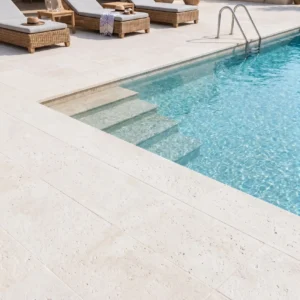
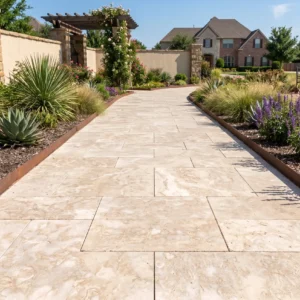
Upgrade budgets allocate best down the tenant-and-resale hierarchy the cluster knows well: private outdoor space first — the balcony or terrace on the above-grade rules, where an upgrade from builder-grade to dense calibrated stone transforms daily life and listing photographs alike; interior floors second, where cool continuous stone runs the island’s climate logic; wet areas third; and the delta-cost logic throughout — pre-construction upgrades price near materials cost because installation was happening anyway, while post-handover retrofits price as full projects with demolition. The window’s arithmetic is the argument.
Custom supply through the developer’s door
Buyers wanting specific stone — this cluster’s calibrated limestones among them — route it through the program rather than around it: early conversations with the developer’s design team, samples and datasheets submitted to specification standard, the developer-procurement etiquette respected (their program, their installers, their warranty chain), and supply coordinated so buyer-specified material arrives inside the construction schedule’s windows. Done properly the developer gains a differentiated unit and the buyer gains exact finishes at integrated cost; the island supply hub runs this coordination as a familiar dance.
Verification before handover
Off-plan protection is documentary: selections confirmed in writing with samples retained, progress inspections at the milestones the contract allows, and the pre-handover walk conducted with the finish schedule in hand — stone checked against retained samples, tolerances against specification, the lippage-and-line audit run before the snag list closes rather than after the furniture arrives. Deficiencies documented at handover get remedied inside the developer relationship; discovered later, they become the owner’s project.
The decade view from day one
The off-plan buyer’s advantage is starting the ownership file at zero: batch records requested at purchase, attic stock negotiated into the deal (the cheapest spares ever available), care documentation filed before the first season, and the property entering service with the rental-ready credentials or owner-occupier serenity its market demands. Cayman’s pipeline will keep selling futures; buyers who work the window buy them finished properly — which, in stone, means finished once.
Resale receipts: how upgrades read at the second sale
Off-plan upgrade decisions are usually argued in move-in terms, but their sharpest test comes years later, when the unit trades again and the market compares it to its identical neighbors. That comparison is where stone upgrades quietly collect. The listing photographs do the first work: a stone terrace against the development’s standard finish reads instantly in the gallery, and corridor agents will tell you which upgrades survive the second sale as price and which vanish into “refreshed by owner.” Surfaces that age gracefully are the ones still being paid for at resale; surfaces that dated or wore are discounts wearing their receipts.
The documentation compounds it. The buyer’s file that carries the upgrade’s paperwork — specification sheets, batch records, the developer-channel approval, the attic stock’s location in the building store — gives the second purchaser something rare in a resale: certainty about what they are standing on and how to repair it. Surveyors note it; strata boards remember it; and the valuation conversation shifts from “renovated balcony, condition unknown” to “original upgrade, documented, spares held.” In a market as professional as Cayman’s, that file is worth real money precisely because everyone in the chain can read it.
The practical rule for the upgrade window follows: spend where the second sale can see and verify — the terrace, the pool surround, the threshold the photographs lead with — and document as if the next buyer’s lawyer were watching, because eventually one will be. The upgrades that earn twice are chosen once, at the window, with the decade’s two transactions both in view.
The values worth asking the developer for
An upgrade conversation goes very differently when the buyer asks for numbers rather than opinions. The Natural Stone Institute publishes the scope of methods used in dimension stone testing, and asking for four of them is entirely reasonable.
- ASTM C97 for absorption and density, which also feeds any above-grade weight statement.
- ASTM C1353 for abrasion resistance in the circulation zones you will use daily.
- ASTM C880 for flexural strength on balcony units and any pedestal-supported paving.
- ANSI A326.3 for slip resistance on every exterior surface in the package.
- The batch reference recorded on your selection sheet, not just the product name.
Knowing what limestone you are actually being offered
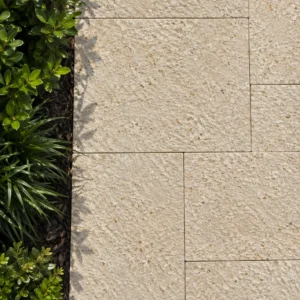
Two products can both be called limestone and behave completely differently on a Cayman balcony. The Natural Stone Institute records that limestone absorption ranges from below one percent to above ten, with dolomitic varieties generally denser, stronger and more abrasion resistant.
- Low absorption on balconies, terraces and pool surrounds, where salt and rain arrive together.
- Higher abrasion resistance in entrances and circulation.
- Acid sensitivity understood before the building hands over a cleaning contract.
- Calibrated thickness for large formats, so lippage is not left to the installer.
- A stated figure for the batch supplied, rather than a range from a brochure.
Protecting the selection through construction
Off-plan protection is documentary, and the documents have to exist before the concrete does.
- Selections confirmed in writing, with a physical sample retained by both sides.
- Progress inspections booked at every milestone the contract permits.
- Substitutions accepted only against the same test values, not the same description.
- Photographs taken at each inspection, from repeatable positions.
- A snagging walk before completion, with lippage and joint width measured rather than eyeballed.
Off plan finish upgrades and what buyers notice
The selection window is the only moment upgrades cost their fair price, and it closes quietly. Buyers who read the schedule of finishes as a contract, ask for test values rather than adjectives, spend first on private outdoor space, retain samples, and inspect at every permitted milestone end up with a better apartment for less than a retrofit would ever cost. Where the balcony is the upgrade in question, our above-grade stone guide covers the technical side. Treat the finish schedule as a contract and the handover holds no surprises.