Anguilla built the Caribbean’s most valuable brand out of restraint: no cruise piers, no towers, no logo-luxury — just perfect beaches, low white buildings and service that remembers your name. The aesthetic looks effortless and is anything but: quiet luxury is the most technically demanding style in the region, because with ornament renounced, execution is all that remains to admire. Stonework carries a great share of that burden, and this is its standard, explained.
Restraint as a technical specification
Strip decoration away and the eye audits what is left: the trueness of a coping line against the horizon, the consistency of joints across a terrace, the flushness of a threshold underfoot, the evenness of tone across forty meters of pale stone. Quiet luxury converts taste into tolerances — lippage that would pass unnoticed in a busier style reads as error here; a batch shift that pattern would camouflage announces itself across a plain field — and the specification responds in kind: calibrated stone, single batches per visual plane, setting-out drawn from sightlines, and mock-up panels approved before fields are laid. The style is minimal; the discipline is maximal.
The sand-and-shell palette
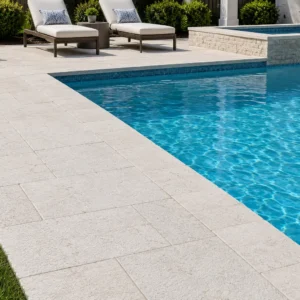
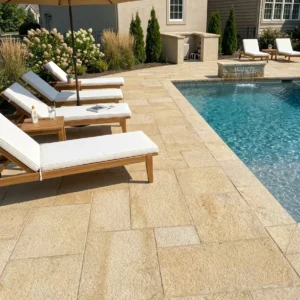
Anguilla’s palette is its geography distilled: whites and creams from the beaches, soft greys from driftwood and shell, the occasional dark line like wet rock at the tide’s edge. Stone selection works inside that range with connoisseur precision — undertones matter when everything is pale, and samples are judged against the island’s own brightness, at noon and at the golden hour the villas live for. Dark basalt earns its place as punctuation — a threshold, a shadow line, a pool’s waterline detail — used the way the island’s architecture uses shadow: sparingly and to effect.
- Draw the palette from the sand, the sea and the scrub rather than from a catalog.
- Keep tonal range narrow so nothing competes with the view.
- Choose texture over pattern, since pattern dates and texture does not.
- Let the material be recognizably natural rather than engineered flat.
Details that disappear
The style’s signature is resolution so clean it vanishes: thresholds flush through glass lines on the island-modern discipline, drainage concealed in shadow gaps and slot details, steps floating without visible fixings, coping meeting water with hairline precision. Each disappearing act is a drawn detail executed by careful hands — the cluster’s standing craft, held to couture tolerance — and each survives only through maintenance that keeps edges crisp and joints true. Understatement, it turns out, is a maintenance philosophy as much as a design one: nothing ages louder than minimalism done cheaply.
Barefoot perfection as a duty spec
Anguilla’s luxury is measured barefoot — guests may not wear shoes for days — and the surfaces underfoot are the brand experience: honed-but-textured finishes kind to soles and secure when wet, pale tones that stay walkable through beach-day heat, sand swept by rhythm so grit never rides between foot and floor, and transitions — deck to path to sand — graded so gently the walk never registers as one. The benchmark deck standard applies with the volume turned down and the stakes turned up: here, the deck is not a feature of the product; it is the product.
- Specify the surfaces guests actually touch to the highest standard on the job.
- Keep transitions seamless, because a bad threshold is what people remember.
- Detail edges cleanly, since restraint shows every shortcut.
- Hold a matched reserve so a repair never breaks the quiet.
Rental-grade invisibility
Most of Anguilla’s finest addresses earn: villa rentals at the market’s summit, where the understatement standard must survive turnover without ever showing effort. The operational package mirrors the aesthetic — same-batch attic stock so repairs vanish, turnover resets that return decks to photograph standard between guests, maintenance calendars run invisibly around bookings, and the turnover economics operating at a rate tier where a single review mentioning wear costs real money. Quiet luxury’s guests notice everything and mention nothing; the stone must give them nothing to mention.
Buying the standard
The procurement translation is short: specify calibrated stone in single batches, buy the mock-up panel, hold the tolerances in writing, keep spares on island, and maintain by rhythm rather than response. It costs more in discipline than in money — the materials are the cluster’s standard excellence; the difference is refusing every shortcut between them and the finished plane. The Anguilla ordering guide packages the standard end to end, and understands the island’s first rule: the best luxury never raises its voice, and neither should anything about how it was built.
Invisible service: the estate choreography behind the calm
Quiet luxury’s deepest illusion is effortlessness, and its machinery is the service choreography guests never see: villas that reset while the beach walk happens, dinners that materialize, grounds kept flawless by staff who seem never to be present. The service-side design rules run here at their most demanding pitch, because the standard is not efficiency but invisibility. Service circulation routes read the property’s sightlines like a stage plan — staff paths screened by walls and planting, timed around guest rhythms, surfaced in stone quiet underfoot because a barrow’s rattle carries across a silent luxury garden; service courts and stores position for function while photographing as garden walls; and the housekeeping choreography gets the infrastructure it deserves: dressed access points, flush thresholds for laden trolleys, staging corners where turnover happens out of frame.
The stone specification serves the illusion doubly. Operationally: surfaces that reset with a sweep and rinse enable the between-walk turnaround, attic-stock repairs happen in the guest-free windows without procurement drama, and the maintenance calendar runs dawn shifts on decks that dry before breakfast. Aesthetically: the service architecture wears the same understated palette as the guest realm — a screening wall in the estate’s stone reads as design, not operations — so even glimpsed backstage sustains the composition. The island’s finest properties are, functionally, small theaters running two shows at once: the guest’s effortless idyll and the staff’s precise choreography. The stonework builds both stages — and quiet luxury’s real definition might be exactly that: hospitality whose machinery is architecture.
Choosing stone that says nothing loudly
Restraint is a material decision before it is a design one. The reference from the Natural Stone Institute on limestone sets out what actually differs beneath the surface: absorption running from below one percent to above ten across the family, dolomitic varieties denser with lower absorption and higher abrasion resistance, and the whole family vulnerable to alteration by mild acids. Two stones that look identical in a showroom can behave completely differently on a terrace.
- Choose on absorption and abrasion rather than on appearance alone.
- Prefer dolomitic material where a quiet finish still takes heavy use.
- Keep acidic cleaners off the schedule, since the quiet look shows every etch.
- Expect the surface to be judged close up, because nothing else is competing.
- Order one batch for the whole property so nothing reads as a patch.
The approvals that still apply to a discreet build
Understatement does not remove the process. The Land Development (Control) Act defines development to include building and rebuilding operations, engineering operations and any material change in the use of land or buildings, brings road works, land subdivision and the filling of ravines and swamps within the same control, makes the Land Development Control Committee the approval body, and allows an applicant refused permission to appeal to the Executive Council.
- Establish that engineering works and site formation need permission too.
- Expect a subdivision or filling operation to be treated as development.
- Plan for committee timing rather than assuming an administrative sign off.
- Keep the appeal route in mind, since refusal is not necessarily the end.
- Align the delivered specification with the approved drawings in writing.
Why the quietest properties are the hardest to build
A restrained scheme has nowhere to hide. There is no pattern to distract from a poor cut, no contrast to disguise a settled paver, and no ornament to draw the eye away from an untidy junction. The tolerance on a quiet job is tighter than on a decorative one, and the material has to be good enough to carry that.
- Set tolerances tighter than the job appears to require.
- Use fewer components and get each one exactly right.
- Keep joint widths consistent, since they become the only visible line.
- Allow more time for setting out than a busier design would need.
Quiet luxury stone and the discipline behind it
The most expensive properties on this island are the ones that say the least, and that is a specification problem rather than a styling one. Choose on performance, order one batch, tighten the tolerances and let the sand and the sea supply the palette. Our Anguilla stone supply guide sets out the formats, finishes and lead times that suit this island. Restraint is unforgiving, and on Anguilla it is exactly what the market is paying for.