The tropics run half their social life after sunset, and a St. Lucian property spends more entertaining hours under lighting than under sun. Yet landscape lighting is routinely designed last, bought as fixtures rather than as effect, and aimed at plants while the stonework — the surfaces people actually walk, sit and dine on — is left to luck. Stone and light are natural partners: texture exists to be grazed, pale surfaces are reflectors waiting for a source, and steps are contracts requiring visibility. Here is the after-dark plan, written for the material that carries it.
Graze, don’t flood
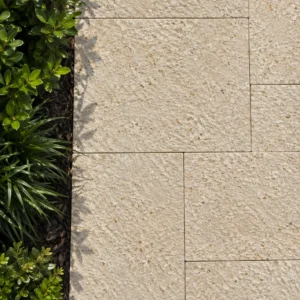
The single most useful lighting instruction for stonework is angle: light traveling nearly parallel to a surface turns texture into landscape — every brushed line and tooled mark casting its miniature shadow — while the same lumens aimed flat-on flatten the surface into glare. Practically, that means low fixtures washing walls upward or floors sideways, never the floodlight-on-a-pole that turns a terrace into a car park. The finishes chosen for daytime grip repay the favor at night: textured stone under grazing light is the richest surface in the garden, and the finish selection is, unadvertised, also the lighting design’s raw material.
Warmth is not negotiable
Color temperature makes or breaks tropical evenings. Warm light — the amber end of the range — renders limestone golden, skin flattering and evenings long; cool white renders the same terrace clinical and the same guests tired. The rule extends to consistency: one warmth across the whole garden, because a single cool fixture in a warm scheme reads as a mistake from fifty meters. St. Lucia adds its sunset logic — the golden-hour terraces should hand over from sun to lamps without a temperature jump, the lighting taking the sunset’s baton rather than interrupting it.
Steps, edges and the safety contract
Night landscapes owe their users two guarantees: every level change announced, every path edge legible. Steps take individual low-glare lights or a lit handrail line, with the consistent-riser discipline doing half the safety work before any electricity arrives; pool edges and view-edge parapets get definition without dazzle; and paths need markers, not runways — pale stone holds ambient light so well that a St. Lucian garden path often needs a third of the fixtures a dark-paved one would. Over-lighting is the amateur signature: the professional scheme is mostly darkness, punctuated exactly where feet and drinks travel.
The tropical realities: bugs, salt and storms
Island lighting earns its keep against island physics. Insects congregate at bright sources — so the scheme keeps light low, warm (which attracts measurably fewer) and away from dining faces, putting brightness on stone surfaces rather than in the air above tables. Fixtures live in salt air and wet season: marine-grade housings and fittings are the only economical choice on any coast, per the splash-zone hardware rule, and every cable route belongs in conduit sleeved under the stonework at build time — the retrofit trench through a finished terrace is the most avoidable expense in the whole discipline. Storm season adds its note: fixtures mounted in or flush with stone survive what stake-mounted spotlights donate to the wind.
- Light kept low, warm and away from dining faces, since insects gather at bright sources.
- Brightness placed on stone surfaces rather than in the air above tables.
- Marine-grade housings and fittings specified for salt air and constant humidity.
- Fixtures chosen so they can be removed and stored before a storm.
- Cable routes and joints kept accessible, because water finds every buried connection eventually.
Scenes, restraint and the off switch
The finished scheme wants layers on separate circuits: the everyday scene (paths, steps, a wall wash), the dinner scene (terrace intimacy, garden depth beyond), and the full-stage scene for parties — with the discipline to use the third rarely. Dark sky is part of the luxury: St. Lucia’s stars deserve terraces that can go nearly black, and turtle-adjacent coastal properties carry the shielded-fixture obligation as standard. The stone-first lighting plan is, in the end, modest hardware and strong placement — bought once, sleeved early, warm always — and it doubles the number of hours per day a landscape earns its cost. The supplier guide for St. Lucia flags conduit sleeving on every cutting list for exactly this reason.
- An everyday scene covering paths, steps and a wall wash.
- A dinner scene for terrace intimacy with garden depth beyond.
- A party scene that lifts the whole property without flattening it.
- A late scene that leaves only what is needed to walk safely.
- An off switch that genuinely turns everything off, so the stars come back.
Power honesty: solar, outages and the circuits that matter
Island lighting schemes meet island electricity, and the design should be honest about both. Stake-style solar path lights — the catalog’s tempting shortcut — underdeliver in the tropics’ quick dusks and shaded gardens, dying exactly when the dinner party needs them; where solar earns its place it is as proper fixtures with real panels and batteries, specified rather than impulse-bought. Mains schemes should assume the grid’s occasional opinions: low-voltage LED systems sip modestly enough to ride a villa’s inverter through an outage, and the scheme deserves triage — step, edge and pool-surround safety circuits on the backed-up supply, the scenic layers allowed to rest until power returns. Generator transfer adds its flicker note: drivers and transformers of quality shrug the switchover that cheap ones announce with a stutter. None of this changes the design language; it decides whether the design language stays lit on the nights the island tests it — which are, reliably, the nights with guests.
Retrofitting light into a finished terrace
The conduit-at-build-time sermon arrives too late for the island’s thousands of existing terraces, and the retrofit question deserves honest answers rather than regret. The workable options rank by invasiveness. Perimeter-fed fixtures come first: wall-mounted washers and step lights fed from adjacent structures reach most of a terrace’s needs without touching the paving, and the cable runs dress into planted borders and wall lines invisibly. Joint routing comes second: low-voltage cable is slim enough to travel a raked-out joint under a color-matched repair in short, planned runs — a craftsman’s afternoon, not a demolition. Lifting a paving line comes third and is less drastic than owners fear on unit-laid stone: a single course lifts, the conduit lays, the same stones relay — the repairability argument earning its keep again — though it is work for the crew that laid the floor or one of equal care. What retrofit budgets should resist is the surface-mounted shortcut: conduit clipped across finished stone announces itself forever, and solar stakes scattered as a substitute for design deliver neither light nor dignity. The strategic version: run the retrofit once, generously — more capacity than today’s scheme needs — so the terrace never faces this question twice. Every finished floor holds one graceful retrofit in it; the second one always shows.
Getting the groundwork in before the paving
Lighting fails as a construction sequence far more often than as a design. Sleeves, ducts and fixture positions belong in the paving drawing, not in a later conversation. This overview of detailing natural stone paving explains why the setting system decides what is possible afterward.
- Sleeves laid beneath the base with pull cords left in place for future circuits.
- Fixture positions marked on the setting-out drawing before any unit is bedded.
- Sand-set areas chosen where a cable may need to be reached again.
- Mortar-set zones accepted as permanent, so nothing unresolved is buried under them.
- Drainage falls coordinated with recessed fittings, which must never sit in a puddle.
How stone finish changes what light does
The same fixture produces a completely different effect on two limestones, because texture and surface hardness govern how light scatters. The Natural Stone Institute publishes the scope of methods used in dimension stone testing, and the values worth knowing before lighting a surface are short.
- ASTM C1353 for abrasion resistance, since a grazed surface shows wear the eye would otherwise miss.
- ASTM C97 for absorption and density, which decides how a wall reads when damp.
- ANSI A326.3 for slip resistance on every lit route, tested on the installed finish.
- ASTM C880 for flexural strength where lit treads cantilever or span.
- Sample panels lit at night before sign-off, which is the only reliable test of the effect.
Commissioning the scheme after dark
Almost every disappointing lighting installation was signed off during the day.
- Aiming carried out at night, on site, with the client present.
- Every fixture checked for glare from the seated position, not from standing.
- Beam spread adjusted after the planting is in, since foliage changes everything.
- Scenes recorded and labeled so staff can reproduce them without guesswork.
- A record drawing of sleeves, junctions and circuits filed with the house papers.
Landscape lighting stone, planned in the right order
Lighting is not a finishing trade on a stone landscape; it is a groundworks trade that happens to end in fixtures. Lay the sleeves before the paving, graze the surfaces rather than flooding them, keep everything warm and low, light every level change, choose marine-grade hardware, and commission the whole scheme after dark with the client standing there. Done in that order it costs less and looks immeasurably better. Where the lit routes are steps, our outdoor stone steps guide covers the geometry that does half the safety work. Bury the conduits first and the evening takes care of itself.