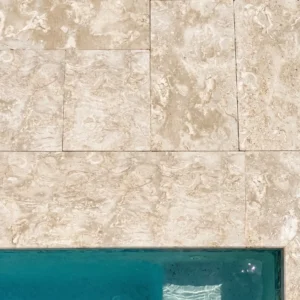
Some materials audition for a place; shellstone arrives already cast. A limestone laid down as ancient seabed, patterned with visible shell and coral fragments, it looks like the Caribbean’s own signature — and on Barbados, an island literally built from marine limestone, Ocean Reef shellstone reads less like an import than a homecoming. This is where it belongs in Bajan design, and how to use it well.
What shellstone actually is
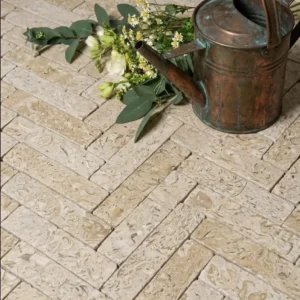
Shellstone is a fossiliferous limestone: a seabed’s worth of shells, corals and marine fragments compressed into stone, then quarried and finished so the fossil pattern reads on every face. No two pieces repeat — the variation is the point — and the surface carries a natural micro-texture that behaves beautifully underfoot. It is the anti-porcelain: a material whose pattern goes all the way through because the pattern is the material.
The barefoot argument
Shellstone’s Caribbean reputation rests on feet: its cream tone reflects heat like the rest of the light-stone family, while the fossil texture adds grip and a distinctive softness of feel that pool decks made famous. For Bajan pool surrounds, beach-house terraces and outdoor showers — anywhere bare feet and water share the surface — it competes with brushed white limestone on performance and wins on personality whenever the brief says relaxed rather than crisp.
Where it outshines white limestone — and where it defers
Choose shellstone when:
- The design language is coastal, tropical and informal
- Variation and texture are virtues rather than defects
- The setting is beach-adjacent and the stone should agree with the shoreline
Defer to white limestone when:
- The architecture is minimal and crisp
- Large calm fields matter more than pattern
- Interiors continue the floor outward and want quiet
Absorption is the number that separates one limestone from another. The Natural Stone Institute records a range running from under one percent to over ten across the family, and notes that dolomitic stones generally carry higher density, lower absorption and better abrasion resistance — the industry variety data sets this out. That spread is why two stones sold under the same broad name can behave nothing alike underfoot.
Formats, finishes and the French pattern
Shellstone loves the relaxed layouts:
- The Versailles or French pattern, whose four-size repeat was practically made for its old-world texture
- Generous rectangles in running bond, which suit verandas
- Large squares, where a calmer shellstone field is wanted
Finishes stay in the textured family — the fossil surface plus brushing is the classic — because high polish fights the material’s nature.
Living with shellstone
Maintenance mirrors the limestone family — neutral cleaners, rinses, sensible sealing — with two shellstone notes worth knowing before you commit:
- The pattern is a great concealer: a week of dust and leaf-drop vanishes into the fossil field, which is kind to relaxed housekeeping
- The texture holds a little more garden debris in exchange, which favors the blower over the broom
Weathered over years, shellstone does not fade so much as settle.
Anything close to the shoreline sits inside a regulated environment. The Coastal Zone Management Unit assesses physical development applications affecting the coastal zone and monitors the shoreline directly through beach profiling and wave data — the unit publishes its remit in full. Confirm your setback position before you order stone, not after the pallets land.
Specifying shellstone on Barbados
Order like the rest of the limestone family:
- Cut to size rather than to a catalog format
- Finished to your choice, kept inside the textured range
- Single batch per surface, so one terrace reads as one stone
Add one extra ritual: approve range samples enthusiastically, because shell density and pattern vary by block and the range is the beauty. Freight, escrow and the sampling path run through the standard Barbados guide.
Shellstone indoors and at the threshold
The fossil surface crosses thresholds beautifully: honed shellstone interiors carry the coastal story into living rooms without the literalness of themed décor, and the continuum logic applies with texture stepping at the door line. The pairing rule indoors mirrors outdoors — shellstone leads where character should, defers where furniture and art want a quiet floor.
Shellstone’s pairings
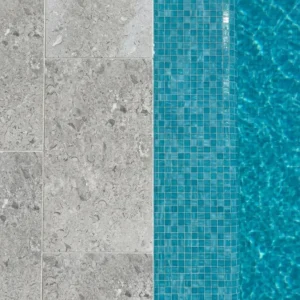
The material’s warm cream ground plays matchmaker: with basalt lines it gains modern structure; with timber it doubles the relaxed register; with white limestone it creates the two-texture family that lets one property speak both crisp and coastal. What it resists is competition — busy waterline tiles, patterned outdoor rugs, mosaic borders — because a surface that is already a pattern wants neighbors that are not.
Reading a shellstone range sample
A single shellstone sample tells you almost nothing, because the material is defined by its spread. What you want in front of you is a range set: three or four pieces chosen to show the extremes rather than the flattering middle. Judge it on four questions.
- How wide is the tonal band from the palest piece to the deepest, and can you live at both ends?
- How dense is the fossil content at its busiest, and how quiet does it get at its calmest?
- Do the shell voids read as texture or as holes when the piece is wet?
- Does the cut edge look consistent, or does one piece show a softer seam running through it?
Approve the range, not a favorite. A terrace laid from the range you signed off will look like the samples; a terrace laid after approving one hero piece will look like a compromise, because no quarry can supply forty square meters of the single best block face.
Shellstone at the water line
Shellstone works as coping as well as it works as deck, with one caveat worth stating plainly: the fossil texture that makes it pleasant underfoot also gives water more surface to sit in. At the pool edge that is an argument for a slightly denser selection and a properly formed drip groove, not an argument against the material. Cut the coping from the same batch as the deck, keep the overhang generous enough to throw water clear of the shell face, and the edge behaves like any other dense limestone edge while looking like nothing else on the island. Where the brief is a beach house rather than a modernist villa, that difference is usually the whole point.
Cutting and edges in a fossil stone
Fossil stone cuts cleanly but finishes differently, and installers meeting it for the first time benefit from knowing what to expect:
- Sawn edges expose shell voids, so exposed edges want an eased or bullnosed profile rather than a raw arris
- Small voids in a face are characteristic, not defective, and filling them flat destroys the reason you chose the stone
- Mitred corners read better than butt joints, because a butt joint puts two different fossil patterns in direct comparison
- Drilling for rail posts or lights wants a slow bit and a core rather than a percussion setting
Say all of this on the drawing and in the pre-start conversation. It costs nothing and it prevents the one bad outcome, which is a crew treating a characterful stone as if it were a flawed one.
Shellstone in Barbados: where it belongs
Shellstone closes where it opened: as the material that already belongs. On an island built of marine limestone, a floor of fossil seabed is not a design import but a continuation — the shoreline’s story told underfoot, at quarry-direct economics, in a stone that outperforms its own romance. Few materials let a property feel more Bajan by specification alone; sample it beside the beach it echoes and the argument finishes itself.