Barbados has one of the Caribbean’s oldest stocks of private pools — which means thousands of pools whose coping predates their owners. This guide approaches the water’s edge from the Bajan angle: what mature pools need, how renovation actually proceeds, and the detailing that makes a West Coast edge read as it should.
Reading a mature pool’s edge
Walk any twenty-year pool and the edge tells its history: precast units with worn arrises showing aggregate; tile-topped copings whose grout lines gave up seasons ago; mismatched replacements from three repair eras; and — commonly — a perfectly sound shell beneath all of it. The renovation diagnosis is usually cheerful: the structure survives, the edge retires, and the transformation is a surface project rather than a rebuild.
The Bajan renovation sequence
Recoping an existing Barbados pool runs a familiar rhythm, and every stage is short:
- Old units lifted — most precast pops free, while bonded tile tops need more persuasion
- The shell edge cleaned, checked and brought back to level
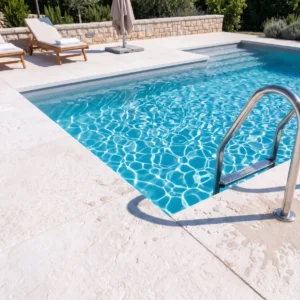
- New limestone coping dry-laid to prove joints and overhangs before anything is fixed
- Bedding, pointing, and a flexible sealant line at the shell junction
- A wash-down, and the pool re-opens
Three to four days for a typical villa pool, no shell works, and often scheduled between rental bookings — the highest-return, lowest-disruption upgrade the property offers.
Profiles for Bajan architecture
The island’s pools span plantation-classic to glass-edge modern, and the profile follows the architecture:
- Full bullnose for traditional villas and family pools — the soft edge hands and thighs prefer
- Square-edge with an eased arris where the architecture runs contemporary
- Precision-cut weir stones for infinity and wet-edge details — flat, sharp and level to tight tolerance, which makes them specials worth naming early in the quote conversation
Whatever the profile, the drip groove underneath is non-negotiable; it is the difference between water releasing cleanly and water tracking back under the deck.
Installation method matters as much as the stone itself. Industry guidance separates mortar-set work, sand-set exterior paving and pedestal systems, and stresses that drainage, movement and substrate condition drive long-term performance more than the material name does — the detailing guidance is worth reading before you specify.
Coping meets coral: the edge in context
Bajan pools often sit among coral-stone walls and mature gardens, and the coping choice negotiates that context: pale dense limestone harmonizes with coral’s warmth while out-performing it wet (the full physics lives in the coral comparison); and where a raised coral planter or wall meets the pool surround, capping it in the coping’s stone ties the composition while protecting the softer material below. The edge becomes the mediator between heritage texture and modern performance.
Salt systems, spa spillways and the wet details
Modern Bajan pools bring modern chemistry and features, and each one asks something specific of the edge:
- Saltwater chlorination — dense low-absorption coping plus regular rinsing handles it comfortably
- Attached spas, whose walls want narrower matching copings cut from the same batch
- Spillways, whose stones take constant sheet flow and should be specified in the same dense material
The recurring principle: at the wettest details, density and drainage do the engineering while profile does the manners.
Absorption is the number that separates one limestone from another. The Natural Stone Institute records a range running from under one percent to over ten across the family, and notes that dolomitic stones generally carry higher density, lower absorption and better abrasion resistance — the industry variety data sets this out. That spread is why two stones sold under the same broad name can behave nothing alike underfoot.
The finished edge, maintained
A renovated edge asks only the standard rhythm, plus one Bajan-specific habit:
- Rinse it down with the rest of the deck
- Inspect the sealant joint at the shell once a year
- Keep the drip groove clear of debris and render dust
- After any tropical blow, check the sealant line before the next season of splash
With that, the new edge’s decade looks like its first week, and the twenty-year pool wears a contemporary crown on its original bones.
Budgeting a Bajan recoping honestly
Recoping prices by the linear meter, and a typical villa pool’s perimeter — 20 to 30 meters — makes the arithmetic friendly: material for the coping run, a modest demolition-and-bedding labor line, sealant and sundries. Against the transformation delivered, it is the property’s best-value facelift, which is why management companies schedule it as routine asset care rather than exceptional works. The upsell worth taking while the crew is mobilized: the first deck course renewed with the edge, so the whole waterline reads new.
Sequencing around the rental calendar
The three-to-four-day job slots into changeover gaps with planning: stone ordered against the sailing schedule well ahead, crew booked for the gap, pool drained only to the skimmer line (full drains are rarely needed for coping), and the sealant’s cure respected before the next guests’ cannonballs. Owners who pair recoping with the annual service week get the disruption entirely free.
Measuring an existing pool edge
Most recoping quotes stall on measurement rather than material, because an existing pool rarely matches the drawing anyone still has. Walk the perimeter with a tape and a phone and capture five things:
- Running length of every straight, measured along the water line rather than the outside face
- Radius of each curve, taken as a chord and a rise so it can be reconstructed on paper
- Existing coping width and overhang, because a wider replacement changes the deck junction
- Shell thickness at the bond beam, which sets how much bearing the new unit has
- Step, ladder and skimmer positions, all of which need cut-outs rather than site chopping
Ten minutes of this converts a vague inquiry into a cutting list. It also surfaces the awkward truth early: a pool whose curves were poured by eye needs template-cut specials, and those are cheaper to accept at quote stage than to discover on a pallet.
What the old coping tells you about the shell
Lifting the first few units is the most honest survey a pool ever gets. The old edge has been sitting on the bond beam through every wet season since installation, and it records what happened underneath.
- Clean, dry bedding with intact mortar means the shell is sound and the job is genuinely cosmetic
- Damp, dark bedding suggests water tracking behind the coping line, usually from a failed sealant joint
- Rust staining points at reinforcement sitting too close to the surface, which is a structural conversation rather than a stone one
- Crumbling render on the beam face needs making good before anything new is bedded
None of these are reasons to abandon a recoping. They are reasons to know the scope before the crate is opened, which is why a good contractor lifts a corner unit during the quote rather than on day one.
Coping and deck: one order or two
The temptation on a tight budget is to replace the coping now and the deck later. It works, but only if the coping is ordered with the deck already decided. Stone from one block run matches; stone ordered eighteen months apart from a different block will not, and the join sits at exactly the height where every guest looks. If the deck is genuinely a later phase, order the coping and the deck field together, take delivery of both, and store the deck material dry until the second crew arrives. The freight is the same, the batch is the same, and the pool reads as one decision rather than two compromises.
Pool coping in Barbados: the renovation that lasts
Every argument in this guide compresses to one Bajan truth: the pool edge is the property’s handshake with the water, and a mature pool deserves better than the edge its decade left behind. Photograph yours today, compare it honestly with the pool in your listing photos, and let a coping sample in your own light make the case three working days from now. The shell has years left; give it the crown it earns.