Most granite remnant buyers get tripped up before they ever reach the stone yard — not by the material itself, but by misreading what a remnant actually is and how its dimensions constrain the project rather than define it. A solid granite remnant buyers guide starts with one fundamental shift: you’re working backward from available material, not forward from an ideal dimension. That reversal changes how you measure, how you budget, and how you evaluate slab quality on the spot.
What Makes a Remnant Different From a Full Slab
Remnants are the cutoff sections left after a fabricator finishes a countertop job. They’re genuine granite — the same quarried stone as a full slab — just in irregular or smaller dimensions. You’ll commonly find pieces ranging from roughly 20 inches to 60 inches in one direction, with the other dimension varying considerably depending on what the original slab required. The material quality isn’t diminished; a remnant from a premium Blue Pearl slab is still Blue Pearl granite with identical hardness, absorption rates, and finish characteristics.
The practical difference comes in planning. Full slabs give you layout freedom — you design the project and cut to suit. Remnant granite sizing and pricing work in reverse: the piece dictates the project scope, and your fabrication math has to account for kerf loss, edge profiles, and seam placement before you commit. Experienced buyers treat this constraint as a design filter, not a limitation.
- Remnants typically carry no minimum-order requirement, making them cost-effective for single-surface projects
- Surface finish is already factory-applied — polished, honed, or leathered finishes are consistent through the piece
- Vein continuity within a remnant is guaranteed; matching across multiple remnants requires careful selection
- Pricing is generally quoted per piece rather than per square foot, which simplifies project budgeting
Evaluating Remnant Granite Quality On Site
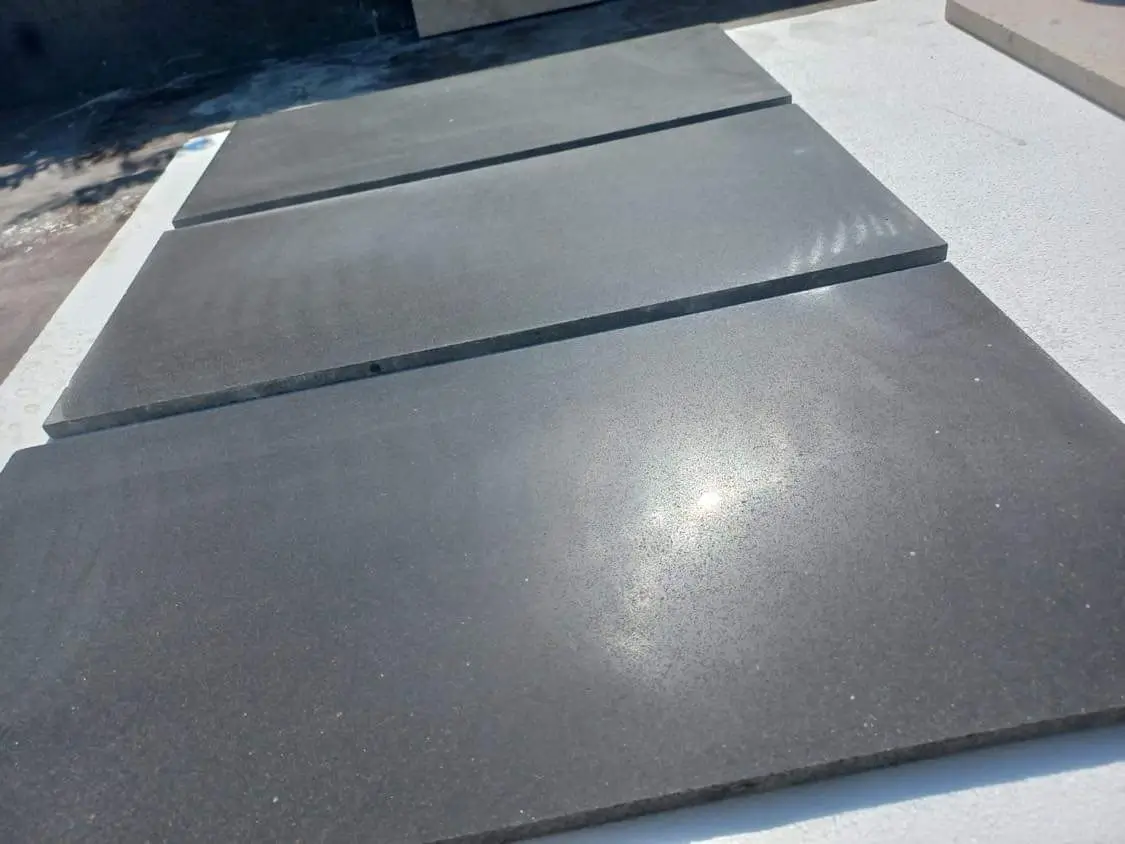
The first thing to check is the polished face for any micro-fissures running parallel to the primary vein pattern. These naturally occurring linear features are part of granite’s geological character — per NSI granite durability specifications, fissures are distinct from structural cracks and don’t typically affect performance in countertop applications. What you’re looking for is whether any fissure extends fully across a dimension you intend to use, particularly near edge zones where fabrication stress concentrates during cutting.
Flip the piece and inspect the back face. A well-stored remnant will show a clean mesh backing or bare stone; any evidence of moisture wicking, efflorescence, or salt deposits on the back surface tells you the piece has been stored directly on a wet floor or exposed to condensation cycles. That kind of moisture history doesn’t necessarily disqualify a remnant granite piece, but it warrants closer inspection of the face finish for any hazing or etching near the edges.
- Run your hand across the polished surface — any gritty texture in isolated spots indicates a fill repair, which is common and acceptable but worth knowing before fabrication
- Check corners for chipping or micro-fractures from transport and handling
- Verify thickness consistency with a caliper at three points along the length — variations greater than 3mm suggest uneven quarry processing
- Natural pitting in the stone surface is characteristic of some granite varieties and doesn’t indicate structural weakness
Measuring for Your Project: The Numbers That Matter
Your project dimensions need to account for more than the finished surface area. For a vanity top, add 1.5 inches to each unsupported edge for overhang if your design calls for it, plus the full depth of any integrated backsplash return. For a kitchen island or peninsula application, factor in the finished edge profile — a 3cm mitered edge with a full ogee consumes roughly 1.5 inches of usable face material compared to a simple eased edge.
The kerf loss from a wet diamond blade typically runs between 0.12 and 0.18 inches per cut, which sounds trivial until you’re trying to extract two pieces from a remnant with tight margins. Plan your cuts on paper first, including all required cutouts for sink openings, cooktop inserts, and outlet knockouts. A remnant that looks large enough on the floor can become inadequate once you account for all the material those cutouts remove.
- Standard granite remnant thickness runs 2cm (3/4 inch) and 3cm (1.25 inch) — confirm which you’re working with before specifying edge profiles, as 2cm typically requires additional support or laminate buildup
- Rectangular remnants are easier to work with than irregular polygons — measure the usable rectangular area, not the total piece outline
- For backsplash strips, confirm your remnant can yield consistent 4-inch or 6-inch widths after accounting for the largest straight cut available
- Always measure twice in each direction — stone pieces that appear square are often slightly trapezoidal from the original fabrication
Understanding Remnant Pricing and Value
Remnant granite pricing varies considerably depending on the material’s rarity, finish type, and the original slab cost. Exotic varieties like Calacatta Gold, Taj Mahal quartzite (often grouped with granite at stone yards), and certain Brazilian blues carry remnant prices that approach full-slab rates — the material is genuinely scarce regardless of form factor. Standard builders’ granite in black, white, and grey tones typically offers the strongest value-per-square-foot proposition in remnant form.
Warehouse storage cycles also influence pricing. Remnants that have been sitting in a warehouse for more than six months often carry a clearance reduction — the stock takes up floor space that faster-moving full slabs need. Asking about aged inventory is a legitimate negotiating point, and you’re not getting lesser material for asking.
- Piece pricing vs. per-square-foot pricing — understand which model you’re buying under before comparing across suppliers
- Fabrication cost is separate from material cost; budget 60–80% of the material price for professional fabrication on complex pieces
- Matching remnants for multi-surface projects adds complexity — verify that two remnants from the same batch share the same dye lot and finish run
- Delivery from the warehouse to the fabrication shop is often an overlooked line item — confirm whether truck delivery is included or quoted separately
Remnant Granite for Small Projects: Best Applications
The strongest use cases for remnant granite are single-surface applications where dimension flexibility is your greatest asset. Bathroom vanity tops with undermount sinks in the 24-to-48-inch range are the classic application — the project is small enough to work within remnant dimensions, and the fabrication complexity is moderate enough that cost savings remain significant even after professional cutting and polishing.
Reviewing the Citadel Stone remnant inventory before finalizing your project dimensions gives you a clearer picture of what’s actually available in the sizes you need. Many buyers make the mistake of designing to an ideal dimension and then struggling to find matching remnant material — reversing that sequence saves weeks of searching and usually produces a better result.
- Fireplace surrounds and hearth pads — 3cm remnants handle thermal cycling well and deliver a high-impact visual return
- Kitchen island extensions where a secondary surface supplements an existing countertop run
- Outdoor kitchen side shelves or prep stations in covered applications
- Custom windowsills and interior thresholds — remnant granite is ideal for these narrow-dimension applications where full slabs are cost-prohibitive
- Decorative table tops and console surfaces where the irregular outline of a remnant can become a design feature
Finish Selection and Surface Performance
Polished granite offers the lowest maintenance burden for countertop applications — the closed surface structure resists staining more effectively than honed finishes at the same sealer application rate. According to ASTM C615 granite dimension stone standards, polished granite exhibits absorption rates typically below 0.40%, which directly correlates to stain resistance in food-preparation environments. Honed finishes open the surface slightly, increasing absorption and requiring more frequent sealer maintenance — typically annual versus biennial for polished surfaces.
Leathered granite — a textured finish created by diamond brushing the surface after polishing — has become increasingly popular for kitchen applications because it hides fingerprints and water spots more effectively than a mirror polish. The trade-off is that the textured surface makes cleaning slightly more involved, and small debris can lodge in the surface texture. For high-use kitchen surfaces, leathered finishes genuinely perform well; for bathroom vanities with lighter use, polished remains the practical default.
Structural and Code Considerations for Granite Installations
Most countertop-scale remnant installations don’t trigger formal building permit requirements, but residential building codes still govern the substrate and support structure your granite sits on. The IBC Chapter 21 masonry and stone guidelines inform best practices for structural stone installations, and local jurisdictions often adopt modified versions of these standards that affect how stone is anchored in load-bearing or cantilevered applications.
For vanity applications specifically, the cabinet substrate needs to handle the dead load of 3cm granite, which runs approximately 18–22 pounds per square foot depending on the specific granite variety’s density. Standard residential cabinet construction handles this comfortably for spans up to 36 inches without additional support. Beyond that, you’ll want a continuous plywood backer of at least 3/4 inch under the stone, or a support cleat at the midpoint. This isn’t a theoretical concern — unsupported 3cm granite over a 48-inch span will develop micro-fractures at the weakest point in the vein pattern within a few years under normal use.
- Outdoor installations in freeze-thaw regions require a minimum 3cm thickness and flexible setting material to accommodate thermal movement
- Seismic zones add requirements for mechanical anchoring of stone elements above cabinet height — check local amendments to the IBC before specifying vertical stone applications
- Cantilevered edges beyond 6 inches require engineering review regardless of stone thickness
- Stone thickness requirements vary by jurisdiction — some commercial codes specify minimum 3cm for all horizontal granite surfaces regardless of span
Sealing and Long-Term Maintenance
Sealing remnant granite follows the same protocol as any granite surface, but there’s a detail that matters specifically in the remnant context: the cut edges. When a fabricator cuts a remnant to size, those fresh-cut edges expose the unpolished stone matrix — a surface that absorbs sealer at a significantly higher rate than the factory-finished face. Apply sealer to cut edges first, allow it to cure fully, and then apply to the face. Skipping this sequence leads to uneven sealer penetration and visible absorption differentials near edge zones over time.
For polished granite surfaces in kitchen environments, a penetrating fluorocarbon sealer applied every 18 to 24 months maintains adequate stain resistance. The simple water-bead test tells you when resealing is due: drip water on the surface and watch for absorption within 10 minutes. If the stone darkens rather than beads, the sealer has exhausted. At Citadel Stone, we recommend testing three separate areas — near the sink, at the cooking zone, and on an edge — because wear patterns are uneven across most countertop surfaces.
- Avoid acid-based cleaners entirely — citrus, vinegar, and many commercial bathroom cleaners etch polished granite permanently
- Daily cleaning with a pH-neutral stone cleaner extends sealer life significantly compared to dish soap, which strips sealer with repeated use
- Heat resistance in granite is genuine — the material handles standard cooking pot temperatures without damage — but thermal shock from sudden temperature changes on cold stone can cause fractures in thin sections
Before You Specify: Completing Your Granite Remnant Buyers Guide Process
This granite remnant buyers guide process ends where most people think it begins: at the moment you’ve confirmed a piece meets your dimensional, quality, and finish requirements simultaneously. Those three criteria rarely align on the first piece you inspect, which is why experienced buyers visit inventory in person rather than relying on photos — the depth of vein movement, the actual finish character, and the real-world color under ambient light are all factors that images consistently misrepresent. Your best purchase decision comes from handling the material, not browsing it.
Verify warehouse lead times and truck delivery scheduling before finalizing your fabrication appointment — a remnant reserved today may need two to five business days to reach your fabricator depending on logistics. For surface care once your installation is complete, granite stain removal guidance covers the full range of remediation approaches for common staining agents, making it a useful companion resource once your remnant granite surface is in place. Buyers who plan vanity or backsplash projects around remnant dimensions from Citadel Stone often achieve the same surface quality at a fraction of full-slab cost.
Related reading: granite slab size · granite edge profiles guide · granite density.