What Granite Density Actually Measures
Granite density explained in precise terms: it measures the mass of granite per unit volume, typically expressed in grams per cubic centimeter (g/cm³) or kilograms per cubic meter (kg/m³). Most granite falls in the range of 2.63 to 2.75 g/cm³, which translates to roughly 164 to 172 pounds per cubic foot. That range isn’t arbitrary — it reflects the mineral composition locked into the stone at the point of formation, billions of years ago, and no fabrication process changes it. Understanding this number before you commit to a specification saves you from structural surprises downstream.
The density figure tells you something more useful than weight alone. It’s a proxy for compactness — how tightly the mineral crystals are interlocked within the stone’s matrix. Higher density generally correlates with lower porosity, better compressive strength, and improved resistance to staining and freeze-thaw damage. Lower density within the granite range doesn’t necessarily mean a weak slab, but it does mean you’ll want to scrutinize the absorption rate more carefully before specifying it for countertops, flooring, or exterior cladding exposed to moisture.

Granite Density and Specific Gravity: Understanding the Relationship
Granite density and specific gravity are closely related but serve different purposes in specification work. Specific gravity is a dimensionless ratio — it compares granite’s density to the density of water (1.0 g/cm³). Because granite typically ranges from 2.63 to 2.75 g/cm³, its specific gravity falls in the same numerical range: approximately 2.63 to 2.75. The practical value of this ratio is that it lets you make quick structural load calculations without converting between unit systems.
Here’s what most specifiers miss when reviewing material data sheets: a reported specific gravity of 2.65 and a density of 2.65 g/cm³ are effectively the same measurement expressed differently. Confusion arises when data sheets list one but not the other, or when lab reports mix metric and imperial units. Your material data sheet should ideally report both, tested per ASTM C615 granite dimension stone quality standards, which establishes the minimum density and absorption thresholds granite must meet for construction use. If a supplier can’t provide ASTM C615 test data, treat that as a significant quality red flag.
The relationship between these two figures also matters when you’re comparing granite to other natural stone. Limestone, for instance, averages 2.3 to 2.7 g/cm³ — overlapping the lower end of granite’s range but rarely reaching granite’s upper density values. Travertine can drop as low as 2.2 g/cm³ due to its void structure. Granite’s consistently higher density is a direct result of its igneous formation under immense heat and pressure, producing tightly interlocked quartz, feldspar, and mica crystals with minimal void space.
How Mineral Composition Drives Density Variation
Your granite slab’s density is fundamentally a function of its mineral recipe. Quartz contributes a density of approximately 2.65 g/cm³. Feldspar sits slightly lower, around 2.56 to 2.76 g/cm³ depending on the specific feldspar variety. Mica adds complexity — biotite mica ranges from 2.7 to 3.1 g/cm³, while muscovite runs lower at around 2.76 to 3.0 g/cm³. Dark accessory minerals like hornblende and pyroxene can push local density higher, which is part of why dark granites — black absolute, for instance — tend to weigh more per slab than lighter variants.
- High-quartz granites typically land in the 2.63–2.67 g/cm³ range — stable and predictable for most applications
- Feldspar-dominant granites may vary more widely in density depending on alkali vs. plagioclase ratios
- Dark granites rich in hornblende or pyroxene can reach 2.75–2.80 g/cm³ or higher in some quarry runs
- Biotite-rich granites show localized density variation because mica concentrations aren’t uniform across a slab
- Exotic granites labeled as “gabbro” or “black granite” are technically not granite — they’re mafic igneous rocks with densities often exceeding 2.90 g/cm³
This mineral variability is why density ranges, not single values, appear on reputable data sheets. A single quarry can produce slabs across a 0.08–0.12 g/cm³ density range depending on where in the granite body the block was extracted. The density of granite typically increases toward the core of a pluton and decreases toward the margins where cooling was faster and crystal size smaller.
Structural Load Implications You Need to Calculate
Granite density explained in structural terms becomes immediately practical when you’re sizing support systems. At 2.65 g/cm³, a standard 3cm (1.18-inch) thick granite countertop slab covering one square foot weighs approximately 9.8 pounds. Scale that to a kitchen island measuring 4 feet by 8 feet — 32 square feet — and you’re looking at roughly 314 pounds of stone before substrate, adhesive, or edge profiles. Your cabinet specification, substrate panel, and base frame all need to account for that load before a single slab is cut.
Exterior cladding calculations become even more critical. A 3cm granite panel at 2.75 g/cm³ covering a 10-foot by 20-foot facade section generates approximately 3,400 pounds of dead load. Anchor systems, sub-framing, and the structural wall itself must be engineered to carry that weight plus wind load factors. For high-rise facades, structural engineers routinely request certified density test data — not catalog estimates — before finalizing anchor spacing and sizing. According to Natural Stone Institute granite durability and application specifications, density data paired with flexural strength testing is the foundation of safe facade engineering for dimension granite.
- Always use certified test data, not nominal values, for structural calculations involving granite panels or large-format slabs
- Factor in a 5–10% variance buffer above catalog density values to account for quarry-to-quarry variation
- Thicker slabs (4cm and above) used in flooring applications can add significant dead loads to floor structures — verify deflection limits before specifying
- Granite density and specific gravity together allow conversion between weight-per-area and weight-per-volume as needed for different calculation formats
Density as a Design Selection Factor
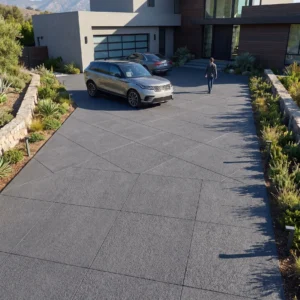
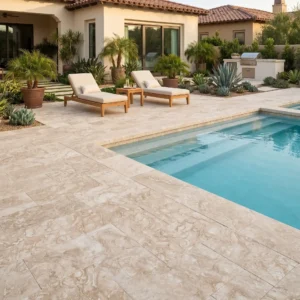
Beyond structural math, granite density plays a quieter but genuine role in landscape design and aesthetic integration. Denser, heavier granite slabs read differently in a finished landscape — they sit lower and more permanently in the grade, which suits formal or minimalist design languages where you want the stone to feel rooted and immovable. Lighter-density granite (still within the granite range) tends to work well in applications like garden stepping paths or dry-laid accent elements, where occasional repositioning may be needed over the installation’s life.
Design traditions across different landscape styles respond to granite’s weight and visual mass in distinct ways. Contemporary minimalist landscapes often favor large-format, high-density granite slabs in honed finishes — the mass and flatness reinforce the design’s spatial geometry. Xeriscaping designs use granite’s density advantage differently: a dense decomposed-granite mulch layer or granite boulder placement holds position under heavy seasonal runoff without displacement. Traditional or colonial landscape styles tend to select mid-density granite for cobbled pathways and border edging, where the irregular texture and weathered patina of the stone’s surface matter as much as its structural performance.
Color palettes also correlate loosely with the density of granite. Dark igneous varieties — often sold as black granite but technically gabbro or diabase — carry densities above 2.80 g/cm³ and deliver the deep, saturated color that works in both modern minimalist and lush tropical planting schemes. Lighter pink or white granites with higher quartz content sit in the 2.63–2.67 g/cm³ range and photograph better against warm-toned plantings or sandy hardscape elements. Your aesthetic brief and structural requirements don’t have to be in conflict — understanding the density range helps you find the granite that satisfies both simultaneously.
How to Read Granite Density Data Sheets Correctly
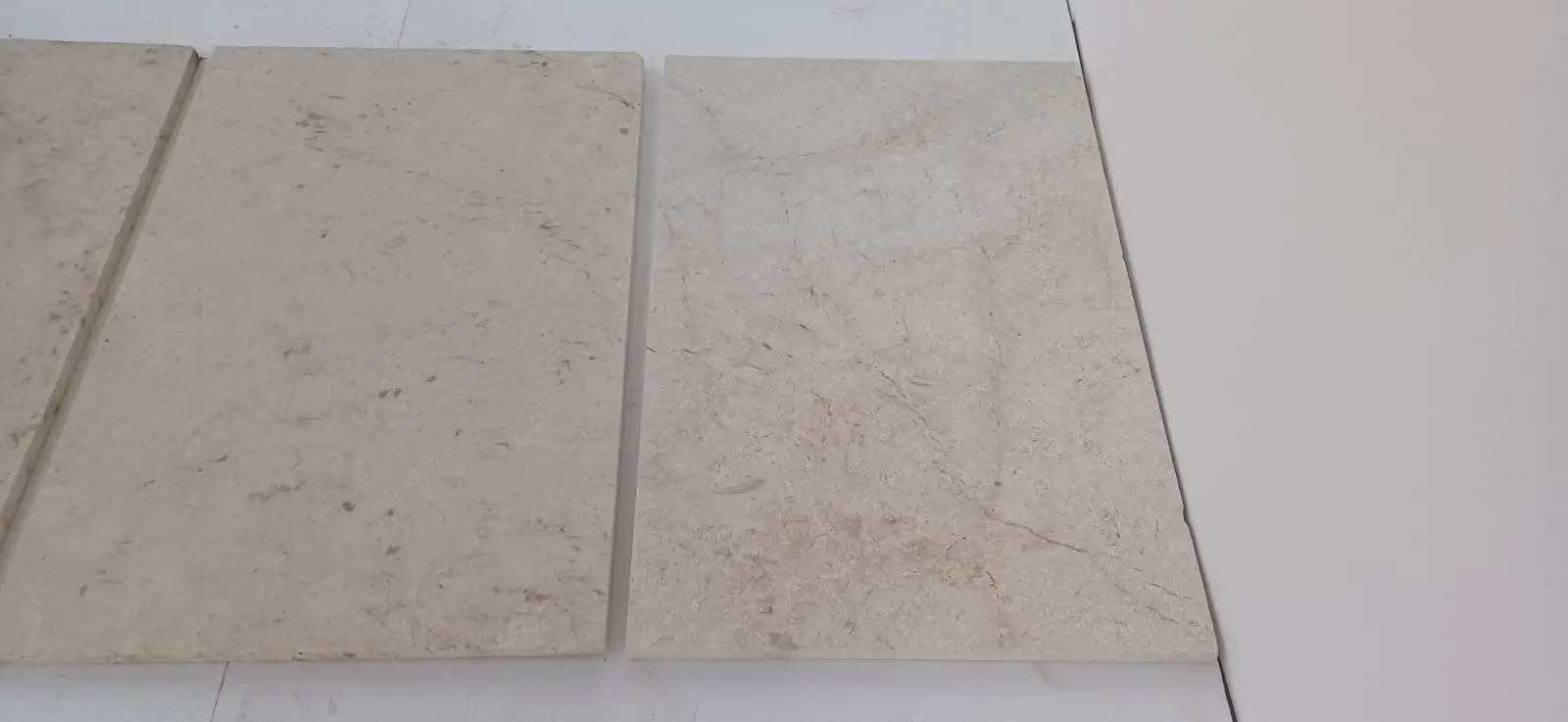
Density data appears on granite specification sheets in several formats, and misreading them is more common than most buyers admit. The most authoritative figure is bulk density — the mass of the stone measured in its natural state, including any micro-pores, tested per ASTM C97 or equivalent. You may also see apparent density (measured as if all pores were filled) and true density (measured on crushed powder, eliminating all void space). For construction and specification purposes, bulk density is the number you need. It’s the only figure that reflects how the stone will actually behave as a slab in your application.
- Bulk density: the correct figure for structural and performance calculations — use this value
- Apparent density: slightly higher than bulk density; useful for comparing void content between stones
- True density: highest of the three; relevant for mineralogical comparison, not construction specification
- Units vary by data source — g/cm³, kg/m³, and lb/ft³ are all used; convert before comparing across suppliers
- Test method citation (ASTM C97, EN 1936, or equivalent) must appear alongside any reported density value for the figure to be specification-grade
For projects where you’re sourcing through our granite slab sourcing, verify that test certificates accompany the material and reference the specific quarry batch — not just the stone variety. Granite density can vary meaningfully between quarry runs of nominally the same granite type, and your structural engineer needs batch-specific data, not catalog averages.
Density Considerations for Countertop and Flooring Specifications
Countertop applications put density requirements in sharp focus because the surface takes direct daily impact — cutting forces, thermal shock from hot cookware, and persistent moisture at sink zones. You’ll want granite with a bulk density of at least 2.63 g/cm³ for residential countertops, and 2.65 g/cm³ or higher for commercial kitchen environments where the surface sees continuous heavy use. Slabs at the lower end of the density range aren’t disqualified, but they’ll require more frequent sealing — typically annual rather than biennial — to maintain acceptable absorption resistance.
Flooring presents a different density challenge: the stone must resist abrasion as well as impact. The USGS granite production and construction use statistics confirm granite’s continued dominance in high-traffic commercial flooring precisely because its density underpins both compressive strength and hardness. For flooring applications, you should also request Mohs hardness data alongside density — granite typically scores 6 to 7 on the Mohs scale, meaning it resists scratching from most foot-traffic-associated grit effectively. Dense granite in flooring applications also handles polished-finish maintenance better: the tighter the mineral matrix, the longer the polish holds before mechanical re-honing is needed.
- Specify minimum 2.63 g/cm³ bulk density for residential countertop granite in wet zones
- Target 2.65 g/cm³ or above for commercial countertop and high-traffic flooring applications
- Pair density data with ASTM C241 abrasion resistance data for any flooring specification — density alone doesn’t capture surface wear performance
- Thinner cut slabs (2cm) from high-density granite perform better than 2cm slabs from lower-density stock — the tighter matrix compensates for the reduced thickness
- In freeze-thaw regions, exterior granite flooring should target absorption below 0.25% — achievable with density above 2.68 g/cm³ in most quarry stocks
What Matters Most When Specifying Granite Density
Granite density explained with full technical context leads to a straightforward specification discipline: start with certified bulk density data, understand what the mineral composition behind that number means for your specific application, and let the structural and performance math confirm your material selection rather than guessing from catalog descriptions. The density figure isn’t just a weight number — it’s a compressed summary of the stone’s mineralogy, its void structure, its absorption behavior, and its long-term durability in whatever environment you’re placing it. Buyers who treat it as a checkbox item miss the specification intelligence it actually contains.
Your projects — whether countertops, large-format flooring, exterior cladding, or landscape feature elements — deserve granite that has been evaluated against the performance thresholds relevant to each application, not just selected on color and surface finish. Verify ASTM C615 compliance, request batch-specific test data, and cross-reference density against absorption and abrasion data before finalizing your order. For natural stone projects that extend beyond granite slabs, complementary hardscape applications are worth reviewing alongside your primary specification — patio paver installation techniques covers another dimension of natural stone specification worth exploring as you plan your full project scope. Dense granite generally resists surface absorption better, a property Citadel Stone evaluates when sourcing slabs for countertop and flooring applications.