What Actually Makes Stone Steps Slippery
Surface finish determines slip risk on stone steps far more than the stone species itself — a distinction that catches a surprising number of specifiers off guard. Are stone steps slippery? The honest answer is: it depends almost entirely on the finish you choose, the drainage geometry beneath each tread, and whether the surface texture is maintained over time. A polished limestone tread in wet conditions offers very little underfoot texture, and should be verified against the ANSI A326.3 wet DCOF threshold (0.42) before use on any trafficked surface. A flamed or bush-hammered version of the same stone carries far more texture — a dramatic difference driven purely by surface finish, not material.
The three main traction killers on outdoor stone steps are standing water, organic buildup (algae, moss, biofilm), and smooth finish profiles that offer no mechanical grip. You can control all three through specification — the problem is that many buyers focus on aesthetics first and discover the traction gap after installation. Understanding what drives slip risk lets you make finish and drainage decisions before the concrete is poured.
Drainage Geometry: The Detail That Changes Everything
Your tread’s surface finish does most of the work, but drainage geometry is what keeps water moving off the step rather than pooling on it. A 1–2% cross-slope (approximately 1/8 inch per foot) is the industry standard for outdoor stone treads. That sounds modest, but it’s the difference between water sheeting off cleanly and water sitting on the surface long enough for algae colonies to establish.
Here’s what most specifiers miss: the riser-to-tread ratio also affects where water lands when it runs off a higher tread. A shallow tread (less than 11 inches of run) concentrates water near the leading edge — exactly where foot traffic is heaviest. Deeper treads of 12–14 inches allow water to spread across a larger surface and drain more efficiently. This is especially relevant for exterior stone walkway steps that see heavy foot traffic in wet periods, where the combination of short treads and flat cross-slope creates predictable slip zones.
At Citadel Stone, we recommend specifying a minimum 1.5% cross-slope on exposed treads and confirming your base drainage allows water to exit laterally rather than pooling against the riser face. That riser-face pooling is where biofilm starts — and once it’s established, even a well-textured surface loses traction.
Does the Stone Species Matter for Slip Resistance?
Stone species matters less than finish, but it’s not irrelevant. Some materials have inherent surface characteristics that affect grip independent of the applied finish. Granite, for example, has a tight crystalline structure that limits water absorption — which means it dries faster after rain but also means that polished granite offers almost no grip at all. Limestone and travertine are more porous, which can actually help texture finishes grip more aggressively because the surface has more physical relief at the micro level.
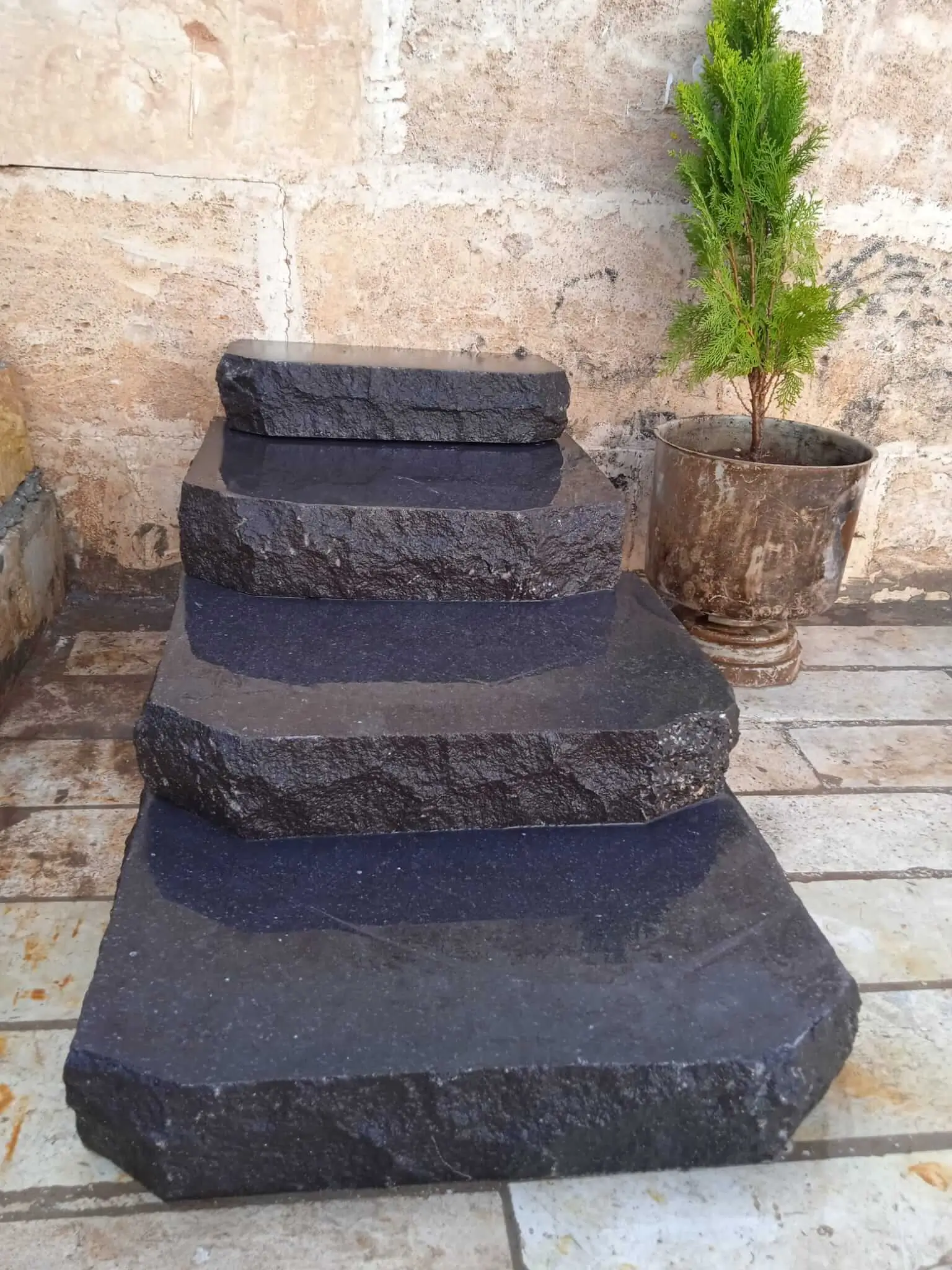
Basalt is worth noting here: its dense volcanic structure and naturally dark color mean it absorbs more heat during the day and retains it longer into the evening. In regions with significant temperature swings between day and night — 30°F or more — that thermal mass creates a secondary risk. Treads that stayed dry in the afternoon can develop surface condensation as temperatures drop sharply after sunset, briefly reducing traction before the surface equilibrates. This isn’t a reason to avoid basalt for outdoor steps stone, but it’s a reason to pair it with a flamed or bush-hammered finish that maintains grip even on a damp surface.
According to the Natural Stone Institute’s stone steps and treads design specifications, surface absorption and porosity play a measurable role in long-term traction performance — particularly as finish textures weather over time. Denser stones may need more aggressive initial texturing to compensate for their lower micro-absorption.
How Thermal Cycling Affects Step Safety Over Time
Freeze-thaw cycling does more to degrade step traction than most buyers realize — and the mechanism is subtle. Water infiltrates the micro-pores and joint mortar of outdoor steps stone. As temperatures drop below freezing, that water expands approximately 9% by volume, gradually opening micro-fractures in both the stone surface and the mortar bed. Over repeated cycles, this process roughens polished finishes unpredictably and can flatten the peaks of textured finishes — either outcome changes your traction baseline in ways that weren’t planned for in the original specification.
For installations that will experience significant seasonal temperature ranges, two protective measures make a measurable difference:
- Specify stone with low water absorption (below 0.4% by weight for granite, below 1.5% for dense limestone) — less water uptake means fewer freeze-thaw expansion events per season
- Use a penetrating sealer rated for freeze-thaw environments and reapply on a 2–3 year cycle; this limits moisture ingress without filling surface texture or reducing grip
- Maintain joint mortar at or above the tread surface level — recessed joints trap water and accelerate freeze-thaw damage at the most vulnerable points
- Avoid calcium chloride de-icing salts on natural stone for steps; they accelerate surface spalling and degrade mortar faster than freeze-thaw cycling alone
The cumulative effect of thermal cycling on joint integrity is also worth flagging. Joints that open even 1–2mm create water traps and edge cracking that progressively undermine the tread’s structural seating. Specifying a joint compound rated for thermal movement — or leaving a genuine expansion joint every 8–10 linear feet on longer stair runs — keeps the installation stable through seasonal extremes.
Choosing the Right Tread Finish for Your Project
The tread selection conversation almost always comes down to three competing priorities: aesthetics, budget, and performance. For most outdoor applications, there’s genuine flexibility within that triangle — but performance can’t be traded away entirely without accepting real liability. Take a look at our flamed and brushed stone treads to see how finish options translate into practical traction differences across stone species. The side-by-side comparison makes the texture gradient much easier to evaluate than product descriptions alone.
For residential projects where appearance drives the decision, brushed granite or honed-and-grooved limestone represent a reasonable compromise — they retain visual refinement while adding enough mechanical texture to clear the 0.6 COF threshold in wet conditions. For commercial or high-traffic applications, flamed finishes are the safer specification regardless of aesthetic preferences. The ADA’s surface requirements for exterior pedestrian surfaces, detailed in ADA outdoor paving slip resistance standards, provide a useful minimum benchmark even for projects that aren’t technically subject to ADA compliance.
Maintenance Choices That Preserve Traction Long-Term
Traction on outdoor stone steps doesn’t stay constant — it changes with biofilm growth, sealer buildup, and gradual weathering of the finish profile. The maintenance program you establish at handover is as important as the initial specification. Here’s what actually matters in practice:
- Clean treads with a pH-neutral stone cleaner annually — acidic cleaners etch limestone and travertine surfaces, gradually smoothing the texture that provides grip
- Remove biofilm (algae, moss, lichen) with a low-pressure wash and appropriate biocide; high-pressure washing alone can erode mortar joints faster than it removes growth
- Reapply penetrating sealer on the recommended cycle — over-sealing creates a film layer on the surface that reduces traction, so follow the manufacturer’s cycle rather than applying more frequently
- Inspect joint mortar annually after the first freeze-thaw season; minor repointing in years 2–3 is normal and prevents larger structural movement later
- Check cross-slope drainage annually — sediment accumulation against risers can redirect drainage onto the tread surface and create persistent wet zones
Field experience shows that most traction failures on natural stone for steps aren’t finish failures — they’re maintenance failures. A well-specified flamed granite tread that develops 4mm of algae film becomes just as slippery as a polished surface. The stone isn’t the problem; the cleaning schedule is.
Ordering, Lead Times, and Getting Specifications Right
One thing that trips up project timelines is treating tread specification as a late-stage decision. By the time your structural stair configuration is set — rise-to-run ratio, total width, nosing projection — your finish choice needs to be locked in so warehouse stock levels can be confirmed against your exact dimensions. Citadel Stone maintains national inventory of flamed, brushed, and honed treads in standard widths, which typically keeps lead times in the 1–2 week range for in-stock profiles. Custom dimensions or less common finishes add 3–4 weeks minimum, so early confirmation matters.
Your truck access at the delivery site also affects scheduling more than most buyers anticipate. Stone treads in longer lengths (48 inches and above) arrive on pallets that require a flat, stable truck access point close to the installation area. Factor this into your project logistics early — rescheduling a truck delivery because site access wasn’t confirmed is a common and avoidable delay.
Parting Guidance on Stone Step Safety
Are stone steps slippery? Only when they’re specified, installed, or maintained without traction performance as a primary consideration. The material gives you everything you need to build a safe, durable outdoor stair — the finish selection, cross-slope geometry, joint integrity, and maintenance schedule are the variables that determine whether that performance holds over 5 years or 25. Getting those decisions right at the specification stage costs nothing extra; correcting them after installation costs significantly more. For projects that also involve stone set into landscape settings, laying steps in grass without movement covers base preparation and edge stability in detail — both directly relevant to long-term traction performance on non-hardscaped stair runs. In wet climates, surface finish often matters more than stone species — Citadel Stone stocks honed and thermal-finish treads suited for rain-prone outdoor stairs.
Related reading: stone steps on a slope · bluestone vs granite steps · natural stone steps cost.