

Edge Profile Performance: Where the Real Difference Lives
Travertine bullnose pool coping does more than define the visual finish — the edge radius actively redirects water flow inward toward the pool rather than allowing it to undercut the mortar bed, a detail that separates installations that hold for 20 years from ones that need re-pointing at year eight. Most specifiers treat edge profile as an aesthetic decision. It isn’t. The bullnose radius on a properly finished coping piece also determines how feet feel at the lip and how the coping behaves under the mechanical stress of deck movement. Square-edge coping, by contrast, creates a clean architectural line that reads sharply in modern pool designs, but it shifts the entire water-management burden onto your drainage slope specification.
What Makes Travertine Bullnose Pool Coping Different
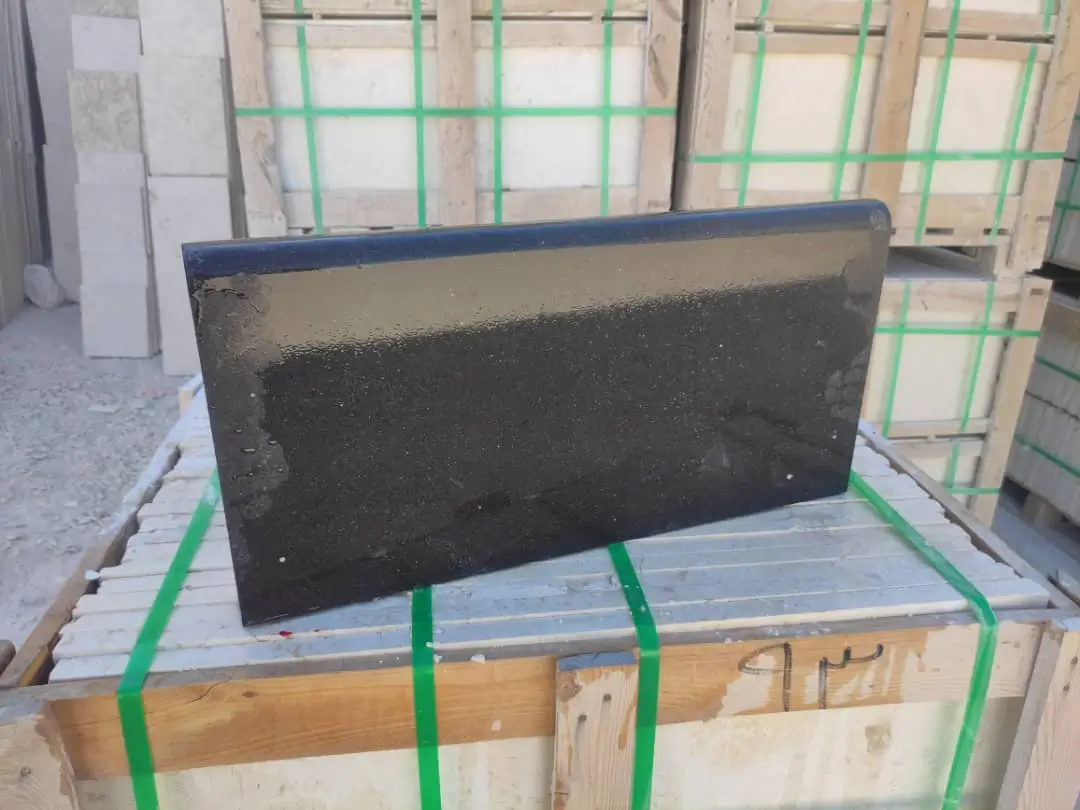
Travertine bullnose pool coping is a factory-profiled piece with one or two edges finished to a continuous convex radius — typically a full bullnose (both top and front faces curved) or a half bullnose (top face only). The profile is cut and honed during fabrication, not applied as a surface treatment, which means the radius geometry is consistent and structurally integrated into the stone. This matters because travertine’s natural open-pore structure, if exposed on a raw cut edge, absorbs water aggressively and can delaminate under freeze-thaw cycling in colder regions. A properly profiled and sealed bullnose edge seals those open pores along the most water-exposed face of the coping.
Square-edge coping, on the other hand, delivers a crisp 90-degree arris. It’s cut to dimension with no edge shaping beyond standard sawing and, where specified, a chamfer of 1–3 mm to prevent chipping. The structural cross-section of both profiles can be identical — the difference is entirely in the exposed edge geometry and the downstream installation implications that flow from it. According to ASTM C1527 travertine dimension stone standards, travertine coping for wet-environment applications should meet specific absorption and flexural strength thresholds regardless of edge profile — a baseline both bullnose and square-edge pieces must satisfy before edge geometry even enters the conversation.
Slip Resistance: Bullnose vs Square-Edge at the Pool’s Edge
Your pool coping is the transition zone between wet feet and the deck surface — and that transition is where slip incidents concentrate. Travertine bullnose pool coping, when finished with a brushed or tumbled texture, leaves an open, textured face, and it is that finish which governs performance against the ANSI A326.3 minimum wet DCOF of 0.42 — the current threshold widely cited for pool-area surfaces. The bullnose radius itself adds a secondary benefit: it guides the foot through a smooth arc rather than presenting a sharp corner that can catch a wet step unexpectedly.
Square-edge coping introduces a different dynamic. The 90-degree edge is geometrically stable and visually precise, but a wet foot landing on or near that arris experiences a concentrated pressure point rather than a gradual surface transition. This isn’t a disqualifying limitation — properly textured square-edge travertine in a brushed or sandblasted finish performs well on the COF scale — but it does mean your finish specification carries more weight. The PHTA pool deck safety standards provide guidance on acceptable surface friction values for coping and deck materials, and both profiles can meet those thresholds when the surface finish is correctly specified. Pairing a honed or polished face with a square-edge profile in a pool environment is a specification error that no amount of maintenance corrects after installation.
- Brushed travertine on either profile leaves an open, textured face — wet DCOF test report on request
- Tumbled finish adds micro-texture that outperforms honed in wet-surface slip resistance
- Bullnose radius distributes foot contact across a curved transition, reducing edge-point loading
- Square-edge requires more precise finish specification to achieve equivalent wet safety ratings
- Polished or honed finishes are unsuitable for the top surface of pool coping in either profile
Water Management and Drainage Slope Requirements
The profile you select changes your drainage geometry requirements more than most installation guides acknowledge. Travertine coping around pool perimeters with a bullnose profile naturally directs sheet flow back toward the pool face — the radius acts as a passive deflector. This means your deck can achieve adequate drainage with a 2% slope away from the pool (the standard minimum) because the coping itself handles the waterline edge. You still need to maintain that slope through the deck field, but the bullnose buys you some tolerance at the coping joint.
Square-edge coping requires more exacting slope execution. Without the radius to redirect flow, water hitting the pool edge can pond at the mortar joint or migrate beneath the coping if your slope execution is even slightly inconsistent. For square-edge installations, a 2–3% deck slope executed with tighter tolerance — within ±0.5% across the coping run — is the practical field target. Pay close attention to the underside of the coping overhang as well: square-edge pieces without a drip kerf can allow water to migrate along the underside of the stone and saturate the mortar bed from below over time. Specifying a saw-cut drip kerf 15–20 mm from the pool-face edge on square-edge coping adds meaningful protection against this failure mode.
Building Code, Load Requirements, and Structural Specification
Edge profile is a visual and performance choice, but the structural specification beneath it is where building standards govern most directly. Pool coping, regardless of profile, is typically classified as a hardscape element bearing live loads from foot traffic, furniture, and occasional maintenance equipment. Most jurisdictions require coping to be mechanically secured — either mortar-set to a concrete bond beam or adhered with polymer-modified mortar systems — and the bond beam itself must meet structural concrete specifications that vary by local code adoption of ACI 318 or equivalent standards.
Thickness is the first structural variable to confirm against your jurisdiction’s adopted code. Travertine bullnose pool coping in 2-inch (50 mm) nominal thickness is the most common specification for residential applications and handles typical residential loading without issue. For commercial or semi-public pools where the coping may bear heavier point loads — pool lifts, starting blocks, equipment staging — 3-inch (75 mm) material is the defensible specification, and some jurisdictions’ commercial pool codes require it explicitly. Freeze-thaw regions add another layer: the bond beam and substrate must be designed to accommodate thermal cycling, which means expansion joints in the coping run at maximum 10–12 foot intervals rather than the 15–20 foot spacing sometimes used in warmer climates. Seismic zones introduce lateral movement requirements that affect both the mortar system and joint width — a 3/8-inch minimum joint filled with an ASTM C920 compliant sealant is appropriate for moderate seismic exposure zones.
- Minimum coping thickness: 2 inches (50 mm) for residential, 3 inches (75 mm) for commercial applications
- Bond beam concrete should meet 3,000 PSI minimum compressive strength at 28 days
- Expansion joints required at 10–12 foot intervals in freeze-thaw climates
- ASTM C920 sealant in coping joints provides the flexibility seismic and thermal movement demands
- Polymer-modified mortar bed (ANSI A118.4 or better) recommended for wet-environment adhesion
- Verify local AHJ requirements for pool deck and coping mechanical fastening before specifying
Choosing Travertine for Pool Coping: Material Grades That Matter
Not all travertine performs equally in pool coping applications, and the grade distinction matters more for coping than for field tile because coping pieces face a more aggressive exposure profile. The stone is simultaneously exposed to UV radiation on its top face, water saturation at its pool-face edge, chemical contact from pool water chemistry, and mechanical stress from thermal cycling. For travertine for pool coping, you should be specifying filled-and-honed or unfilled-brushed material — not polished, and ideally not open-vein unfilled stock unless you’re committing to a rigorous annual sealing program.
The distinction between filled and unfilled travertine is particularly important for coping. Unfilled travertine retains its natural voids — the cross-cut or vein-cut channels that give the material its characteristic texture. In a pool coping application, those voids trap moisture, pool chemicals, and debris. In freeze-thaw regions, trapped water in open voids expands and causes spalling at the surface. Filled travertine, where the voids are grouted with a compatible cementitious or epoxy fill, eliminates this failure mode and extends performance life significantly. At Citadel Stone, we quality-check fill consistency on every coping shipment because an incompletely filled piece looks correct on delivery but fails within two seasons in demanding conditions. You can review our travertine coping profiles to understand how fill grade and edge profile options are specified together as a system rather than as independent choices.
Installation Variables That Change the Outcome
The choice between travertine bullnose pool coping and square-edge coping affects installation sequencing in ways that aren’t obvious from a product spec sheet. Bullnose pieces have a defined orientation — the radius must face the pool — which means your setting crew needs to maintain consistent directional placement across the full perimeter. On rectangular pools, this is straightforward. On freeform or radius pools, bullnose coping requires mitered corner pieces or purpose-fabricated radius cuts, and those cuts need to be ordered from the fabricator before installation begins — not field-cut on site with a standard wet saw.
Square-edge coping is dimensionally simpler to install. Corners are cut at 45 degrees with standard equipment, and there’s no directional constraint beyond maintaining consistent overhang at the pool face — typically 1 to 1.5 inches beyond the bond beam edge. The tradeoff is that square-edge installation exposes the quality of your mortar bed work more directly: any unevenness in the bed reads as a visible plane deviation along the sharp top arris, whereas the bullnose radius forgives minor leveling inconsistencies at the edge because the eye follows the curve rather than the line. Your installation crew’s experience level should factor into this choice more than most project managers admit.
Cross-Application Perspective: Travertine in Interior Wet Environments
The performance characteristics that make travertine a durable choice for pool coping translate directly to travertine tile bathrooms and other interior wet applications — but with some important modifications to the specification. Interior applications eliminate the UV degradation factor and reduce thermal cycling stress, which makes a wider range of finishes viable. Honed travertine tile works well in bathroom floor applications where a slip-resistant texture is achieved through the stone’s natural micro-roughness rather than mechanical brushing. The same filled-grade specification applies: bathroom floor tile in travertine should be filled to prevent grout hazing in the open voids and to resist soap and shampoo residue buildup that accelerates staining in porous unfilled material.
The edge profile logic carries over to interior environments as well — bullnose-profiled travertine tile is the standard specification for shower curbs, vanity edges, and step nosings in travertine tile bathrooms, for exactly the same reasons it performs well at the pool edge: the radius sheds water, prevents chipping at exposed edges, and provides a comfortable tactile transition. The Natural Stone Institute’s guidance on travertine properties and outdoor suitability covers absorption and porosity benchmarks that apply equally to interior wet environments — the same material characteristics that determine pool performance also govern bathroom durability.
Sealing and Maintenance: Side-by-Side Reality Check
Maintenance requirements diverge meaningfully between the two profiles, and understanding that divergence before installation is more useful than discovering it at year three. Travertine bullnose pool coping seals more efficiently than square-edge because the radius profile has no sharp recesses — the penetrating sealer coats the entire exposed geometry in a single application pass. Plan on a quality impregnating sealer applied before installation (to the top and pool-face surfaces), then a second application 30 days after the mortar has fully cured. After that, biennial resealing is the standard maintenance interval for travertine coping around pool environments in normal use.
Square-edge coping introduces a sealing challenge at the underside overhang. The 90-degree junction between the pool-face and the underside of the coping is a water trap, and penetrating sealer applied from the top surface doesn’t reliably reach that junction. Seal the pool-face and underside surfaces separately, and brush-apply sealer into the overhang junction directly. This adds time but prevents the chronic moisture migration that causes mortar-bed delamination over time. Citadel Stone ships coping pieces warehouse-sealed on the top and face surfaces when requested — confirm this at the time of ordering so the pieces arrive ready for the bed preparation phase rather than requiring a full day of pre-installation sealer application on site.
- Pre-installation sealing: top and pool-face surfaces before setting, both profiles
- Post-cure sealing: 30 days after installation, once mortar has fully outgassed
- Biennial resealing: standard maintenance interval for pool-environment travertine
- Square-edge: brush-apply sealer to overhang junction separately — roller application misses this surface
- Bullnose: single-pass sealing covers entire radius in one application efficiently
- Use a penetrating impregnating sealer rated for calcium carbonate stone — avoid topical film sealers that trap moisture beneath the surface
Expert Summary
The decision between travertine bullnose pool coping and square-edge profiles comes down to three convergent factors: the water management geometry your deck drainage can support, the visual language of the pool design, and the installation capability of your setting crew. Bullnose is the more forgiving specification — it manages waterline shedding passively, guides wet foot traffic through a safe radius transition, and tolerates minor installation leveling variations better than square-edge. Square-edge delivers architectural precision and modern clean lines, but demands tighter drainage slope execution, a drip-kerf detail on the overhang, and finish specification that compensates for the sharper edge geometry at the waterline.
Both profiles rely entirely on the same structural foundation: a properly cured concrete bond beam, a polymer-modified mortar bed, correctly spaced expansion joints, and a filled-grade travertine blank that meets ASTM C1527 absorption thresholds. Get the substrate right and either profile performs for decades. Neglect the bond beam specification or skip expansion joints to save time, and neither profile will rescue the installation from early failure. Material selection is the last mile — the structural decisions beneath it determine the outcome. As your project moves toward material confirmation, it’s worth reviewing how travertine for pool coping compares against alternative materials: porcelain versus travertine at the pool edge covers key performance trade-offs between those two material families that often inform the final specification. For families weighing edge profiles, Citadel Stone offers bullnose travertine coping selected for its smooth waterline finish and slip-reducing surface texture.