

Your fabrication slab selection guide starts not at the showroom but at the specification sheet — because the gap between a countertop that looks stunning on day one and one that performs for twenty years comes down to decisions most buyers make too quickly. Material density, absorption rate, flexural strength, and finish compatibility all interact in ways that only become obvious after installation. Understanding those interactions before you commit to a fabrication slab is what separates a confident specification from an expensive correction.
What Fabrication Slabs Actually Are
Fabrication slabs are large-format natural stone panels — typically 105 to 130 inches long and 55 to 75 inches wide — cut directly from quarried blocks and processed to a specific thickness, usually 2 cm or 3 cm nominal. They’re the raw input for countertops, vanities, feature walls, flooring, and custom architectural elements. The slab format preserves the stone’s natural veining across the full surface, which is why it remains the preferred choice for high-visibility interior applications where continuity of pattern matters.
What distinguishes fabrication-grade slabs from dimensional tile or paving material is the processing precision required. Flatness tolerance, edge consistency, and thickness uniformity all need to hold within tighter windows because a CNC fabrication machine leaves no room for variation when it’s routing sink cutouts or profiling edges. At Citadel Stone, we inspect every incoming slab shipment for thickness deviation, surface pit density, and natural fissure depth — details that affect not just aesthetics but structural performance under fabrication stress.
You’ll encounter two main thickness standards in fabrication work. The 2 cm slab handles most interior vertical and horizontal applications with appropriate substrate support. The 3 cm slab carries its own structural load more effectively, which matters when you’re spec’ing unsupported overhangs or commercial countertop runs that need to span extended distances without continuous backing.
Granite vs Marble: The Performance Comparison That Matters
The granite countertops vs marble countertops debate comes up constantly, and the honest answer is that neither material is universally better — they serve different performance profiles. Granite is an igneous rock with interlocking crystal structure, which gives it compressive strength in the 19,000 to 28,000 PSI range and an absorption rate typically below 0.4%. That makes it highly resistant to etching from acidic substances, thermal shock from hot cookware, and surface abrasion from daily use.
Marble is a metamorphic calcium carbonate stone, and that chemistry creates a fundamentally different performance envelope. Its visual character — those deep flowing veins and translucent surface depth — comes directly from the same crystalline structure that makes it reactive to acids. Even a brief contact with lemon juice, vinegar, or wine creates a surface etch that’s chemically distinct from a scratch. You’re not breaking the stone; you’re dissolving a micro-layer of calcite. That’s manageable with proper sealing and maintenance protocols, but it requires an honest client conversation before specification.
- Granite delivers superior abrasion resistance — typically rated at 6 to 7 on the Mohs hardness scale versus marble’s 3 to 4
- Marble’s lower thermal conductivity keeps surface temperatures more consistent, which some bakers actively prefer for pastry work
- Granite’s tight crystal structure makes resealing intervals longer — typically every 3 to 5 years versus marble’s recommended annual application
- Marble’s calcite base reacts with acidic cleaners, so your maintenance program must specify pH-neutral products only
- Granite’s colour variation is more predictable lot-to-lot; marble’s veining pattern shifts significantly even within the same quarry block
According to Natural Stone Institute granite durability specifications, granite’s interlocking mineral structure accounts for its high resistance to freeze-thaw cycling and chemical abrasion — performance characteristics that make it particularly well-suited to kitchen and high-traffic applications where daily surface stress is constant.
Marble Countertop Prices and What Drives Them
Marble countertops prices vary more widely than most buyers expect — and understanding the cost drivers helps you spec smarter rather than just cheaper. Book-matched pairs of Calacatta Gold or Statuario Venato can reach $150 to $250 per square foot installed in premium markets, while commercial-grade Carrara white runs $50 to $90 per square foot for the same installation. The gap isn’t arbitrary — it tracks directly to veining exclusivity, quarry origin, and the rejection rate during block selection.
Freight distance is a significant cost variable that rarely gets explicit attention during early project budgeting. Natural stone slabs are heavy — a 3 cm slab bundle of ten pieces can exceed 2,800 lbs — and truck delivery from a distribution warehouse to your fabrication shop adds real cost per mile. Projects distant from major stone distribution hubs absorb proportionally higher freight, which shifts the material-to-labor cost ratio in ways that affect overall project budgets. Factor freight into your cost-per-square-foot calculation early rather than discovering it as a line-item surprise once slabs are already allocated.
- Slab book-matching requires sequential block cuts — the premium reflects the quarry processing and sorting required to produce matched pairs
- Vein consistency and background colour uniformity command higher quarry premiums because they require selective block grading
- Jumbo slab format (130″ × 77″ or larger) costs more per slab but reduces seam count on large surfaces — a value engineering decision worth running the numbers on
- Warehouse availability at the time of your purchase window affects price — slabs in stock ship immediately, while back-ordered material adds wait time and sometimes price volatility
Cost of Granite Slab: Budgeting Accurately
The cost of granite slab material is only one component of your total project number, and it’s frequently the one that gets underestimated. Raw slab cost at the yard ranges from $40 to $200 per square foot depending on origin, grade, and colour rarity — but fabrication labor, edge profiling, cutouts, and delivery can add another $35 to $80 per square foot on top of that. Exotic origins like Blue Bahia or Antique Brown command premiums that reflect both rarity and import logistics rather than any structural performance advantage over domestic alternatives.
Labor market conditions affect your total installed cost more than most specifiers account for. Fabrication rates differ meaningfully across markets — a complex waterfall edge profile that costs $12 per linear foot in one area may run $22 in another where skilled stone fabricators are in short supply. When you’re value-engineering a project, adjusting edge profile complexity is often a more effective cost lever than switching primary material. A clean eased edge on premium granite frequently outperforms an elaborate ogee on mid-grade material both aesthetically and budget-wise.
You’ll get more accurate numbers if you treat granite slab cost as a three-part equation: material price at the yard, fabrication labor including any CNC programming time for unusual cutouts, and delivered freight from warehouse to site. Citadel Stone can provide current warehouse pricing and freight estimates to your fabrication location, which gives you a real baseline before you commit to client proposals.
Quartzite and Dolomite: The Spec Confusion Worth Resolving
Here’s what often gets overlooked in fabrication slab selection guides: the material labelled “quartzite” at a stone yard is not always true quartzite. True quartzite is a metamorphic rock derived from sandstone, with quartz content above 90% and hardness approaching 7 on the Mohs scale. It’s genuinely resistant to etching and outperforms marble in acid resistance. Dolomitic marble, sometimes sold under quartzite trade names, has similar aesthetics but a calcite/dolomite mineral base that behaves closer to marble under acid exposure.
The practical test is straightforward: apply a drop of muriatic acid (diluted) to an inconspicuous slab edge. True quartzite shows no reaction. Dolomitic marble fizzes visibly. This matters enormously when your client is spec’ing a kitchen countertop based on what they believe is quartzite’s acid resistance, only to find an etching problem after installation. Request a mineralogy certificate or petrographic analysis on any exotic slab where the true identity is commercially ambiguous.
- True quartzite hardness: 6.5 to 7 Mohs — handles acidic cleaning products without surface degradation
- Dolomitic marble hardness: 3.5 to 4 Mohs — requires the same acid-avoidance protocols as standard marble
- White quartzite varieties like Taj Mahal or White Macaubas are genuine quartzite — confirmed by their non-reactive acid test
- Fantasy Brown, often marketed as quartzite, is actually a dolomitic marble — a beautiful material, but spec it accordingly
ASTM natural stone fabrication and quality testing standards provide the testing framework that allows you to verify mineral composition and physical properties independently of trade labelling — a safeguard worth using on any high-value specification where material identity affects long-term performance expectations.
Finish Selection and Its Fabrication Implications
Your finish choice does more than determine how a slab looks — it directly affects fabrication complexity, sealing requirements, and daily maintenance. Polished finishes amplify veining and colour depth but require more aggressive sealing protocols because the microscopic surface pores that remain even after polishing are easier for liquids to penetrate than on honed surfaces. That sounds counterintuitive until you understand that polishing creates directional surface scratches at the micro scale that channel liquids toward open pores.
Honed finishes deliver a matte to low-sheen surface that actually shows etching less on marble — the etch disrupts a glossy reflective surface dramatically, but on a honed surface the visual difference is minimal. The trade-off is that honed surfaces absorb spills faster because the topographic openness is higher. You’ll need to seal honed marble countertops more frequently — every 12 months is a realistic maintenance interval.
- Leathered finish: created by brushing the polished surface with diamond-tipped tools — adds tactile texture and hides fingerprints better than polished or honed
- Brushed finish: similar to leathered but lighter texture — works particularly well on granite to reveal mineral colour without full polish reflectivity
- Polished granite: easier to clean than polished marble because its lower absorption rate means surface contamination stays topical rather than penetrating
- Flamed finish: thermal processing that opens the surface significantly — rarely used for countertops but relevant for thick flooring slabs in commercial applications
Thickness, Substrate, and Structural Considerations
The 2 cm versus 3 cm decision is fundamentally about whether the slab needs to carry load independently or whether it transfers load to a substrate. For countertop applications on standard cabinet boxes, 3 cm granite or quartzite can span up to 18 to 24 inches unsupported — relevant for island overhangs and breakfast bar extensions. Push that span beyond 18 inches with 2 cm material and you’re introducing flexural stress that may not show as immediate failure but accelerates microcracking along natural fissure lines over time.
You can review Natural Stone Institute fabrication standards for detailed guidance on span limitations and support requirements by material type and thickness — their technical resources cover the engineering basis behind these specifications rather than just the rulebook outcome. Understanding the why helps you make better judgment calls on non-standard applications.
Substrate compatibility is equally important. Mesh-backed 2 cm slabs on plywood decking perform differently than the same material on steel-reinforced concrete, particularly in environments with floor deflection. Fabrication slabs installed on substrates with more than L/360 deflection tolerance will eventually telegraph movement as surface cracking — a field problem that traces back to substrate specification, not stone quality. Confirm the structural engineer’s deflection numbers before finalising material thickness.
Sourcing, Logistics, and Project Timeline Planning
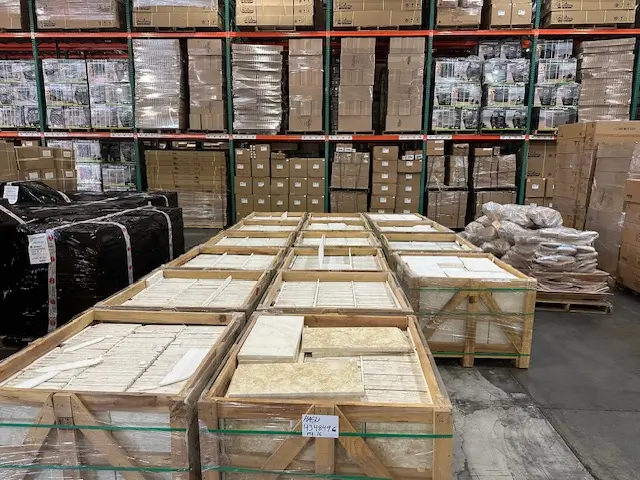
Browse our fabrication slab collection to see current warehouse inventory across granite, marble, quartzite, and dolomite options — knowing what’s in stock before you finalise your specification saves you from the common problem of selecting a material only to discover it’s on a 10-week import backorder. Warehouse availability is genuinely one of the most practical variables in project scheduling, and it deserves attention early rather than as an afterthought.
Slab allocation timing is a detail that separates experienced specifiers from those who’ve learned the hard way. Natural stone lots are finite — once a specific quarry block run is exhausted, the precise veining character of that material is gone permanently. You should tag and allocate your slabs physically at the warehouse as soon as material selection is finalised, even if the project timeline extends another six weeks. Truck delivery can be scheduled to align with your installation window, but allocation protects your material from being sold to another buyer in the interim.
- Book-matched pairs must be pulled from the same block — allocate both leaves simultaneously to guarantee veining continuity
- Request that warehouse staff photograph your allocated slabs in standing rack position so you can verify veining orientation before fabrication begins
- Confirm truck access at your delivery address before scheduling — 53-foot flatbed trailers have specific turning radius requirements that affect many residential and urban commercial sites
- Lead times from warehouse stock typically run 1 to 2 weeks; imported material that requires a new order can take 8 to 14 weeks depending on origin country and shipping schedules
Sealing, Maintenance, and Long-Term Performance
The single most undervalued step in any fabrication slab installation is the initial sealing protocol, and it’s consistently the one that gets rushed or skipped when project schedules tighten. Penetrating impregnator sealers — the correct product category for countertop stone — work by filling the capillary pore structure below the surface, not by coating it. That means application timing matters: the stone needs to be clean, dry, and at ambient temperature above 60°F for the sealer chemistry to penetrate and cure correctly.
Apply the first coat generously, allow 5 to 10 minutes of dwell time, and buff off the excess before it hazes. A second coat applied perpendicular to the first — think of it as cross-hatching the pore coverage — delivers meaningfully better protection than a single heavy application. For marble and limestone countertops, this two-coat initial protocol extends your protection window from roughly 6 months to 18 months before reapplication is needed.
- Test sealer effectiveness annually with the water bead test — drops should bead for at least 4 minutes; if they absorb within 2 minutes, reseal immediately
- Avoid silicone-based cleaners — they leave a residue that blocks sealer penetration on the next application cycle
- Granite in kitchen applications should be assessed for sealing necessity — some tight-grained granites like Black Absolute are effectively highly resistant and don’t benefit from sealing
- Never use vinegar, bleach, or citrus-based cleaners on marble or limestone — pH-neutral stone soap is the only safe daily maintenance product
Getting Your Fabrication Slab Specification Right
Getting your fabrication slab selection right means treating material choice, thickness specification, finish selection, and sourcing logistics as a connected system rather than separate decisions. The materials that deliver 20-year performance aren’t necessarily the most expensive ones — they’re the ones specified with accurate knowledge of their physical properties, maintained with the right products, and installed on substrates that meet the structural requirements the stone’s thickness demands. Your specification is only as strong as the weakest link in that chain.
As you finalise your material choices, it’s worth knowing that related quality and sourcing considerations extend to other aspects of stone project specification. Understanding how to identify and avoid material defects before fabrication begins is as important as selecting the right slab in the first place — spotting common fabrication stone issues covers the specific defect types to watch for during slab inspection and allocation. Marble and granite blocks from quarries across the Mediterranean and Middle East widen the fabrication slab choices at Citadel Stone.
Related reading: stone fabricator · Custom Stone Fabrication: A Complete Overview · granite fabrication services.