








The single most overlooked variable in cobblestone longevity isn’t the stone itself — it’s the bedding depth relative to your subgrade’s bearing capacity. Working with cobblestone suppliers who understand this distinction saves you from the two most common failure modes: rutting under wheel loads and edge migration along unrestrained perimeters. You’ll find that a properly detailed cobblestone installation outlasts poured concrete by decades, but only when the setting bed and base course are engineered to match the ground beneath them.
Cobble units behave differently from large-format pavers because each stone carries and distributes load through its individual joint interlock. That mechanical advantage becomes a liability if your bedding layer allows differential settlement. Getting the specification right at the base level is where reputable suppliers earn their keep — and where most DIY installations go sideways within three winters.
What Makes Cobblestone Perform Under Load
Cobblestone earns its reputation through compressive strength and abrasion resistance that few materials match. Granite cobbles routinely exceed 18,000 PSI in compression, while dense limestone setts land in the 8,000–12,000 PSI range — both well above the point loads generated by passenger vehicles and delivery traffic. The material’s real advantage, though, comes from how the joints redistribute stress.
Here’s what most specifiers miss: a cobblestone field is a flexible pavement system, not a rigid one. Each unit shifts fractionally under load and returns to position, which is why cobble driveways survive freeze-thaw cycles that crack monolithic slabs. That flexibility depends entirely on maintaining tight joint sand and a stable base.
- Compressive strength ranges from 8,000 PSI (limestone setts) to 18,000+ PSI (granite cobbles)
- Abrasion resistance keeps surface texture intact under decades of foot and vehicle traffic
- Individual unit replacement means spot repairs without demolishing the whole surface
- Joint interlock distributes point loads across adjacent stones
- Surface texture varies with finish; confirm the wet DCOF against ANSI A326.3
According to USGS dimension stone production data, granite and dense sedimentary stone continue to dominate durable paving applications precisely because of these mechanical properties. You’re specifying a material with a track record measured in centuries, not warranty periods.
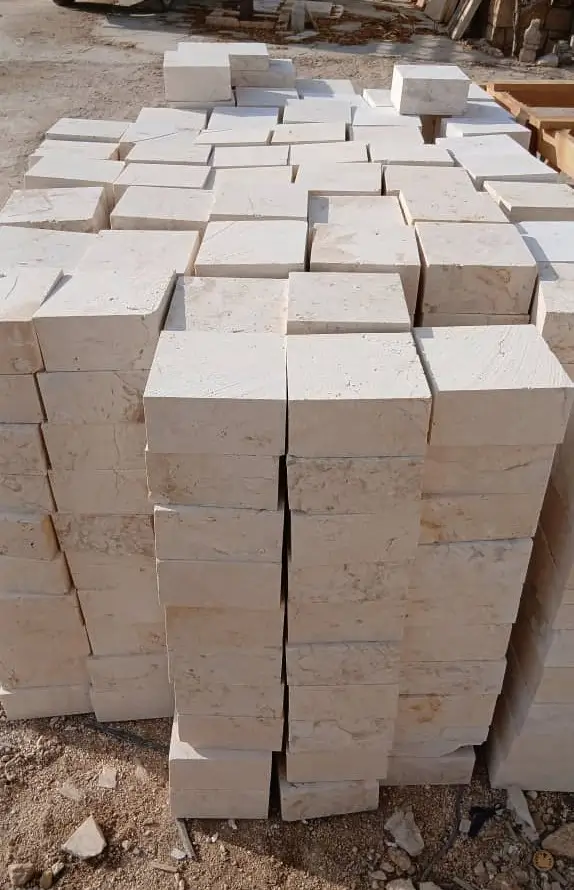
Format, Size, and Finish Options You Can Specify
Your project’s aesthetic and structural needs determine which cobble format works best. Reputable cobblestone suppliers stock several standard profiles, and understanding the differences lets you match the unit to the application rather than forcing a compromise.
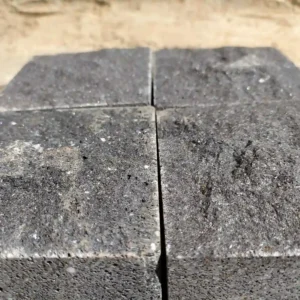
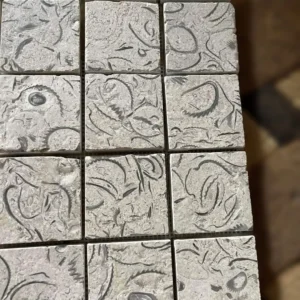
Sawn-six-side cobbles give you flat, uniform tops for smoother rideability — ideal where wheelchair access or bicycle traffic matters. Split or tumbled cobbles deliver the irregular, timeworn look that reads as authentic historic paving. Granite setts and limestone cobbles both come in cut and irregular stock, and the choice affects your joint width and installation labor.
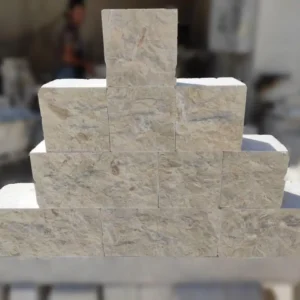
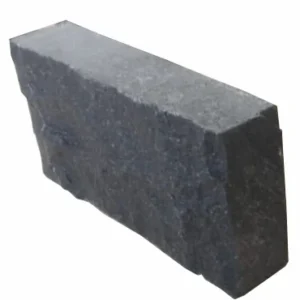
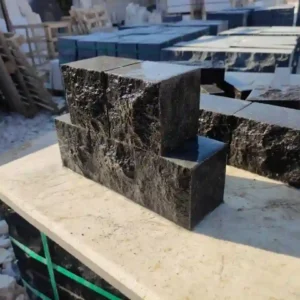
- Standard cube cobbles: roughly 4x4x4 inches for driveways and heavy traffic
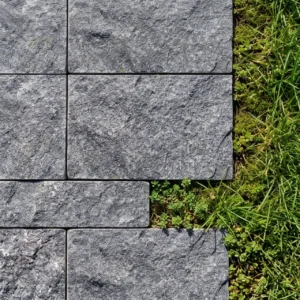
- Sett format: rectangular units, often 4×7 inches, for running-bond and herringbone patterns
- Jumbo cobbles: 6×9 inches and larger for commercial plazas and edging
- Flat cobblestones: sawn tops for accessibility and smoother surfaces
- Tumbled cobbles: softened edges for garden paths and walkway applications
At Citadel Stone, we stock cobblestone in these standard formats and can advise on which profile matches your traffic loads and pattern goals. You can request sample units or thickness specifications before committing to a full order — a step worth taking when the finish tolerance affects your final surface elevation.
Soil Conditions and Subgrade Preparation
The ground beneath your cobblestone determines almost everything about long-term performance, and this is where soil composition demands genuine attention. Clay-heavy soils expand and contract with moisture content, generating differential movement that telegraphs straight up through the bedding layer. Sandy or well-draining soils behave more predictably but can wash out beneath the base if drainage isn’t detailed correctly.
What often gets overlooked is that your aggregate base depth must scale with subgrade instability. On stable, granular soils you might get away with a 6-inch compacted base under a driveway. On expansive clay, you’ll want 8–12 inches of properly graded aggregate, plus a geotextile separation fabric to keep the clay from pumping up into your base course. Skip that fabric and the base contaminates within a few seasons.
- Test your subgrade for plasticity index — high values signal expansive clay requiring deeper base
- Install geotextile separation fabric between subgrade and aggregate on clay soils
- Compact base aggregate in lifts of no more than 4 inches to achieve 95% Proctor density
- Slope subgrade to match finished surface drainage — never trap water beneath the stone
- Account for frost depth in freeze-thaw regions when setting total excavation depth
The interaction between compacted aggregate and soil expansion coefficients becomes critical in clay-heavy soils, where a single wet-dry cycle can generate a quarter-inch of vertical movement. When you specify granite cobblestone for a driveway over reactive soil, your bedding sand and base preparation matter more than the stone grade. For projects that pair cobbles with complementary stone elements, cobblestones from Citadel Stone covers specification details that apply directly to these same subgrade conditions. Getting the ground right at this stage prevents the failures that no amount of surface repair can fix.
Base Course and Bedding Layer Detailing
Field performance data shows that the bedding layer — the thin setting course directly beneath your cobbles — causes more callbacks than any other detail. Too thick, and the stones rotate and settle unevenly. Too thin, and you can’t accommodate the natural dimensional variation in cut and irregular stock.
You’ll want a bedding course of coarse washed sand or fine aggregate at roughly 1 to 1.5 inches after compaction. Screed it flat, set your cobbles, then vibrate the field to lock everything into position. The detail that matters most: never use fine mason sand for bedding on a trafficked surface — it holds moisture and pumps out through the joints under load.
- Bedding course: 1–1.5 inches of coarse washed sand or ASTM C33 fine aggregate
- Screed level and consistent — variations translate directly to surface unevenness
- Vibrate the set field with a plate compactor fitted with a protective mat
- Fill joints with polymeric or angular jointing sand, then re-compact
- Sweep and re-sand joints after the first few weeks as settlement occurs
Edge restraint is non-negotiable. Cobblestone fields migrate outward under repeated load unless you lock the perimeter with a concrete haunch, steel edging, or a soldier course set in mortar. This single detail separates installations that hold their pattern for decades from those that spread and open joints within a couple of years.
Driveway, Patio, Walkway, and Edging Applications
Cobblestone adapts across a remarkable range of hardscape applications, and matching format to use is where good specification pays off. A cobblestone driveway demands heavier units and deeper base than a garden path, while patio and walkway applications prioritize surface comfort and pattern.
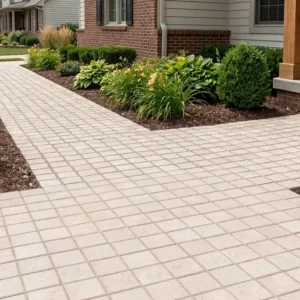
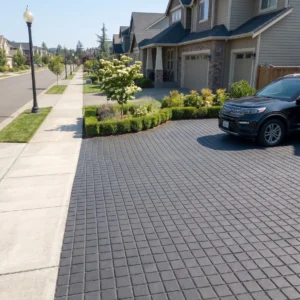
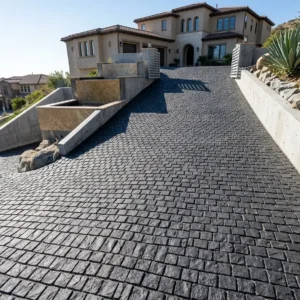
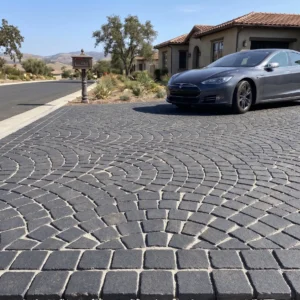
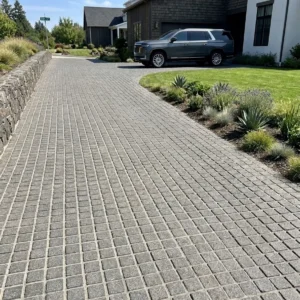
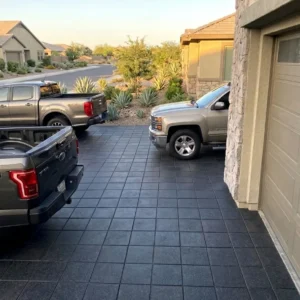
For driveways carrying vehicle loads, granite cobbles in the 4-inch cube format over a deep compacted base handle repeated wheel traffic without rutting. Patio pavers and walkway installations can use thinner setts or flat cobblestones where point loads are lighter. Garden cobbles and edging stones define borders and transitions, and here the tumbled finish reads as intentional and timeworn.
- Driveway: 4-inch granite cubes over 8-inch base for vehicle loads
- Patio: setts or flat cobbles in herringbone or running-bond patterns
- Walkway and garden paths: tumbled cobbles for softer underfoot feel
- Edging and borders: jumbo cobbles or soldier courses as restraint and accent
- Commercial plazas: sawn-top cobbles for accessibility compliance
Landscape design guidance from the ASLA on permeable paving surfaces reinforces why open-jointed cobblestone works so well for stormwater management — the joints allow infiltration that solid pavements block entirely. You gain both durability and drainage performance from a single material choice.
Maintenance Expectations and Long-Term Care
Cobblestone rewards minimal maintenance, but the maintenance it does require is specific. Joint sand depletes over time through traffic, weather, and pressure washing, and a starved joint invites weed growth and lets individual units loosen. You can expect 20–30 years of excellent performance with periodic joint refreshing and attention to drainage.
Buy quality jointing material up front — angular polymeric sand costs more than plain mason sand but locks the joints and resists washout. Sealing is optional for most cobblestone; granite rarely needs it, while porous limestone cobbles benefit from a breathable sealer in high-stain environments like driveways with vehicle drips.
- Refresh joint sand every few years as traffic and weather deplete it
- Avoid aggressive pressure washing that blasts jointing sand out of the field
- Address any settled units early — reset before adjacent stones destabilize
- Keep drainage channels clear so water never ponds on the surface
- Seal porous limestone cobbles only where staining risk justifies it
According to the Natural Stone Institute granite durability specifications, dense igneous cobbles resist abrasion and chemical attack with virtually no protective treatment, which is why granite dominates high-traffic historic paving that has survived centuries of use.
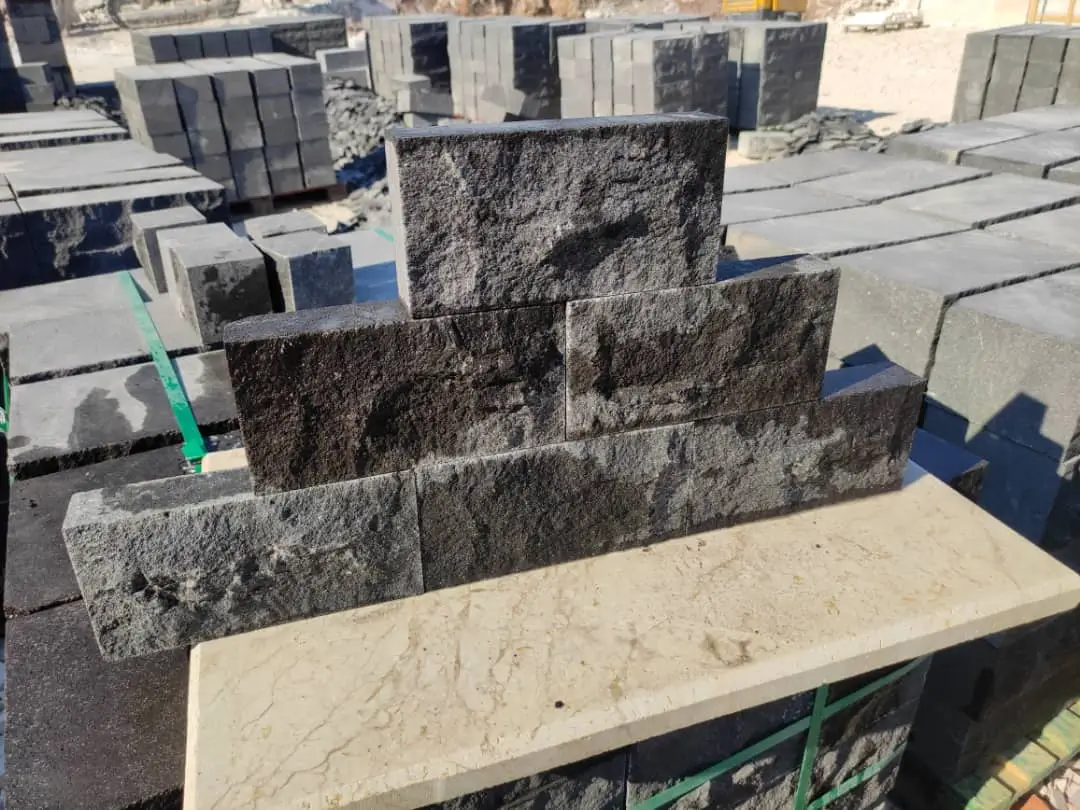
Planning Your Supply and Delivery
Your project timeline hinges on availability and delivery logistics as much as installation labor. Cobblestone is heavy — a driveway’s worth of granite cubes runs into tons — so truck access and staging space factor into your schedule from day one.
You should verify warehouse stock levels before committing to project dates, because cut and irregular stock quantities vary by format and finish. Citadel Stone maintains warehouse inventory nationwide, which typically reduces lead times to one or two weeks compared to the six-to-eight-week cycle imported cobblestone often requires. That difference matters when your base is prepared and your crew is scheduled.
- Confirm quantity availability early — heavier formats may need longer lead time
- Plan truck delivery access and a staging area near the work zone
- Order 5–10% overage to account for cuts, breakage, and future repairs
- Coordinate delivery timing with base completion to avoid double-handling
- Ask about palletized versus bulk delivery based on your site logistics
For projects requiring custom cuts or non-standard formats, Citadel Stone’s team can advise on lead times and confirm which finishes ship from regional inventory. Sourced from our selected premium quarries, each batch is inspected for dimensional consistency before it leaves the warehouse — a check that protects your joint tolerances during installation.
Source cobblestones from Citadel Stone
Citadel Stone stocks cobblestone in standard formats including 4-inch cubes, rectangular setts, jumbo units, and flat sawn-top cobbles — available in granite and limestone with cut and irregular finishes to match your project requirements. You can request samples, dimensional specifications, or format recommendations before you buy, and our team handles trade and wholesale enquiries with cheap, volume-based pricing tailored to your project. Lead times typically run one to two weeks from regional inventory, with nationwide delivery coordinated around your site access and base schedule. Whether you’re pricing a residential driveway or specifying cobbles for a commercial plaza, you can request a quote or schedule a consultation to confirm availability and delivery timing. As you plan the broader stone palette for your project, related paving materials can inform your material decisions — bluestone paving options for patios explores how another durable stone performs across similar outdoor applications. Contractors specify cobblestones from Citadel Stone, a hard-wearing unit for driveways, paths and edging, for residential and commercial sites.
See also: Citadel Stone Cobblestone Suppliers.
Related guides: granite cut to size suppliers.