

Key Concepts — What Slip Resistance Tests Actually Measure
Static vs Dynamic Friction (COF)
Static coefficient of friction measures the force required to initiate sliding between two surfaces at rest. Dynamic coefficient of friction quantifies the resistance once sliding motion has begun. For pedestrian safety, dynamic values typically provide more relevant data since they represent conditions during actual slipping events.
Unless cited to our S.N.S laboratory certificates, figures in this guide are indicative planning values — confirm project-specific numbers with your quote.
Most modern slip resistance testing focuses on dynamic measurements under controlled conditions that simulate real-world pedestrian contact scenarios.
Pendulum Test / British Pendulum (Dynamic Slip Under Shoe)
The pendulum test uses a standardized rubber slider that swings across the test surface, measuring energy loss through friction contact. Results are reported as Pendulum Test Value (PTV) or British Pendulum Number (BPN), with higher values indicating greater slip resistance.
This test simulates shoe-sole contact under dynamic conditions and provides particularly relevant data for pedestrian walkways and commercial spaces where shoe traction is the primary safety concern.
DCOF (Dynamic Coefficient of Friction) and Tribometer-Style Tests
DCOF testing uses mechanical tribometers that drag standardized test feet across surfaces under controlled normal forces. Common instruments include the BOT-3000 (Brungraber Mark II) and similar ANSI/ACCT-approved devices that measure resistance during sliding motion.
These tests provide numerical coefficients that directly correlate with slip probability under specific conditions, making them valuable for quantitative safety specifications and risk assessment protocols.
Ramp Tests and Human-Subject Protocols
Ramp testing involves human subjects walking on inclined surfaces under controlled conditions to determine safe slope limits for specific surface-footwear combinations. This methodology provides the most realistic assessment but requires specialized facilities and safety protocols.
Human-subject testing is typically reserved for critical applications or when laboratory methods fail to provide conclusive guidance for complex surface-contaminant-footwear interactions.
How Surface Variables Affect Test Outcomes
Surface roughness, finish quality, water films, organic contaminants, and temperature significantly influence slip resistance measurements. Honed basalt performance varies with grit level (400-1500 grit typical), sealer application, joint detailing, and maintenance condition.
Temperature effects can alter both surface friction and contaminant viscosity, requiring careful environmental documentation during both laboratory and field testing procedures.
Buy basalt honed today and invest in a product that transforms your outdoor space with modern style and enduring performance—nationwide delivery available.
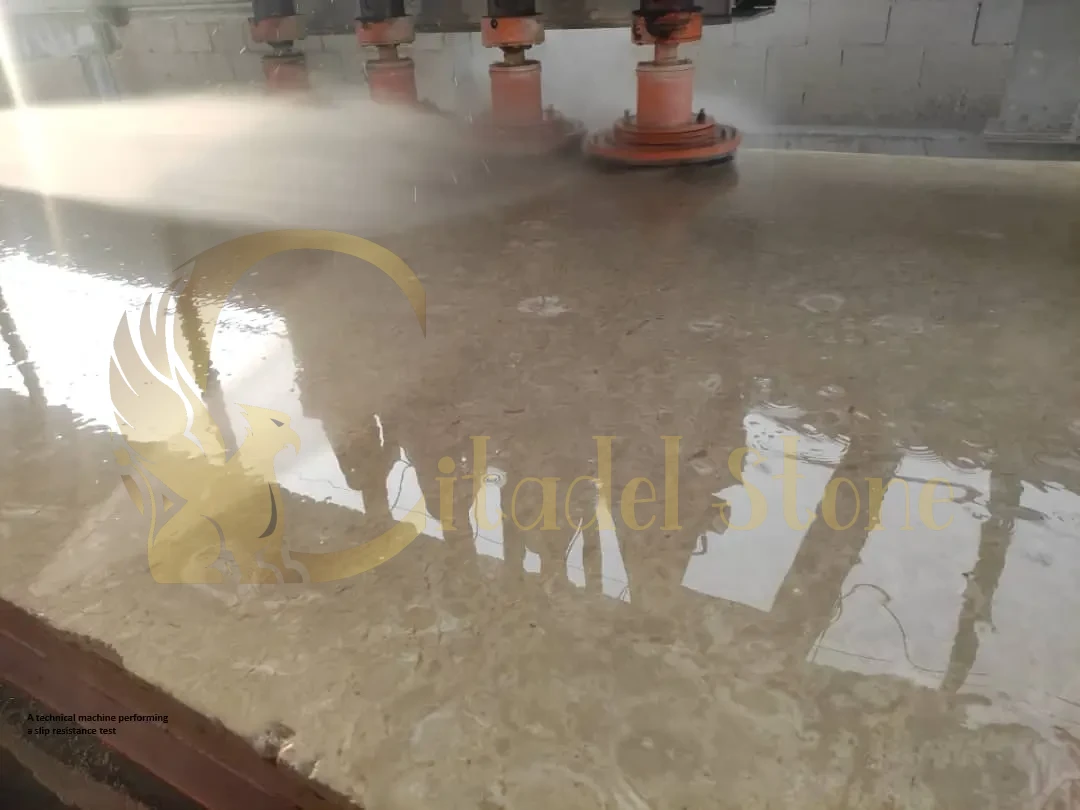
Lab Test Methods: What to Request from an Accredited Lab (Step-by-Step)
Copy-Ready Pendulum Test Request Template
PENDULUM SLIP RESISTANCE TEST REQUEST
Test Standard: BS 7976-2 or equivalent regional method identifier before issuing.
Sample Preparation: Honed basalt specimens, 300mm x 300mm x 20mm minimum, factory finish as specified, no post-fabrication treatments unless noted
Test Conditions: Wet surface with distilled water, ambient temperature 20°C ± 2°C, minimum 5 test locations per specimen
Reporting Requirements: Mean PTV ± standard deviation, individual test values, instrument calibration verification, test date, laboratory accreditation number, environmental conditions during testing
Special Instructions: Test both parallel and perpendicular to primary honing direction if directional texture present
DCOF Test Request Template
DYNAMIC COEFFICIENT OF FRICTION TEST REQUEST
Test Standard: ANSI A326.3 or equivalent regional method identifier before issuing.
Test Equipment: approved tribometer model – BOT-3000, PIAST, or equivalent before issuing.
Sample Preparation: Honed basalt specimens, 150mm x 150mm x 15mm minimum, representative finish condition, clean and dry pre-test conditioning
Test Protocol: Wet DCOF measurement with SBR test foot, 5 replicates minimum per specimen, standard test solution per method requirements
Reporting Requirements: Mean DCOF ± standard deviation, individual measurements, instrument model and calibration date, test temperature, surface preparation notes, laboratory accreditation details
Quality Control: Include reference standard verification and measurement uncertainty analysis
Field Test Protocols — How to Validate Safety On-Site (Copy-Ready)
Field Pendulum Testing Protocol
Pre-Test Checklist:
- Clean test surface with pH-neutral cleaner, rinse thoroughly, allow complete drying
- Verify pendulum calibration using reference standard per manufacturer requirements
- Document weather conditions: air temperature, surface temperature, humidity, recent precipitation
- Photograph test locations for record-keeping and repeat testing reference
Testing Procedure:
- Mark test locations at 1m intervals across representative surface areas
- Record environmental conditions every 30 minutes during testing
- Apply water film using standardized spray bottle or graduated cylinder
- Conduct 5 replicate measurements per location, allowing 2-minute intervals between tests
- Clean pendulum slider between locations to prevent contamination carryover
- Document any surface irregularities or conditions that might affect results
Safety Controls:
- Restrict pedestrian access during testing operations
- Use textured footwear and maintain three-point contact on wet surfaces
- Have emergency communication and first aid resources readily available
DCOF Field Spot-Check Protocol
Equipment Setup:
- Portable tribometer with current calibration certificate
- Standardized test solutions and applicator bottles
- Digital thermometer for surface temperature measurement
- Clean microfiber cloths for surface preparation
Measurement Sequence:
- Surface preparation: Clean 300mm x 300mm test area thoroughly
- Temperature recording: Document surface temperature within ±2°C
- Contaminant application: Apply standardized water film per test method
- Measurement execution: Conduct 3-5 replicate measurements at each location
- Data recording: Log all values with location coordinates and environmental conditions.
Purchase basalt honed tiles now for a natural stone solution that blends innovative design with rugged durability—shipped U.S.-wide.
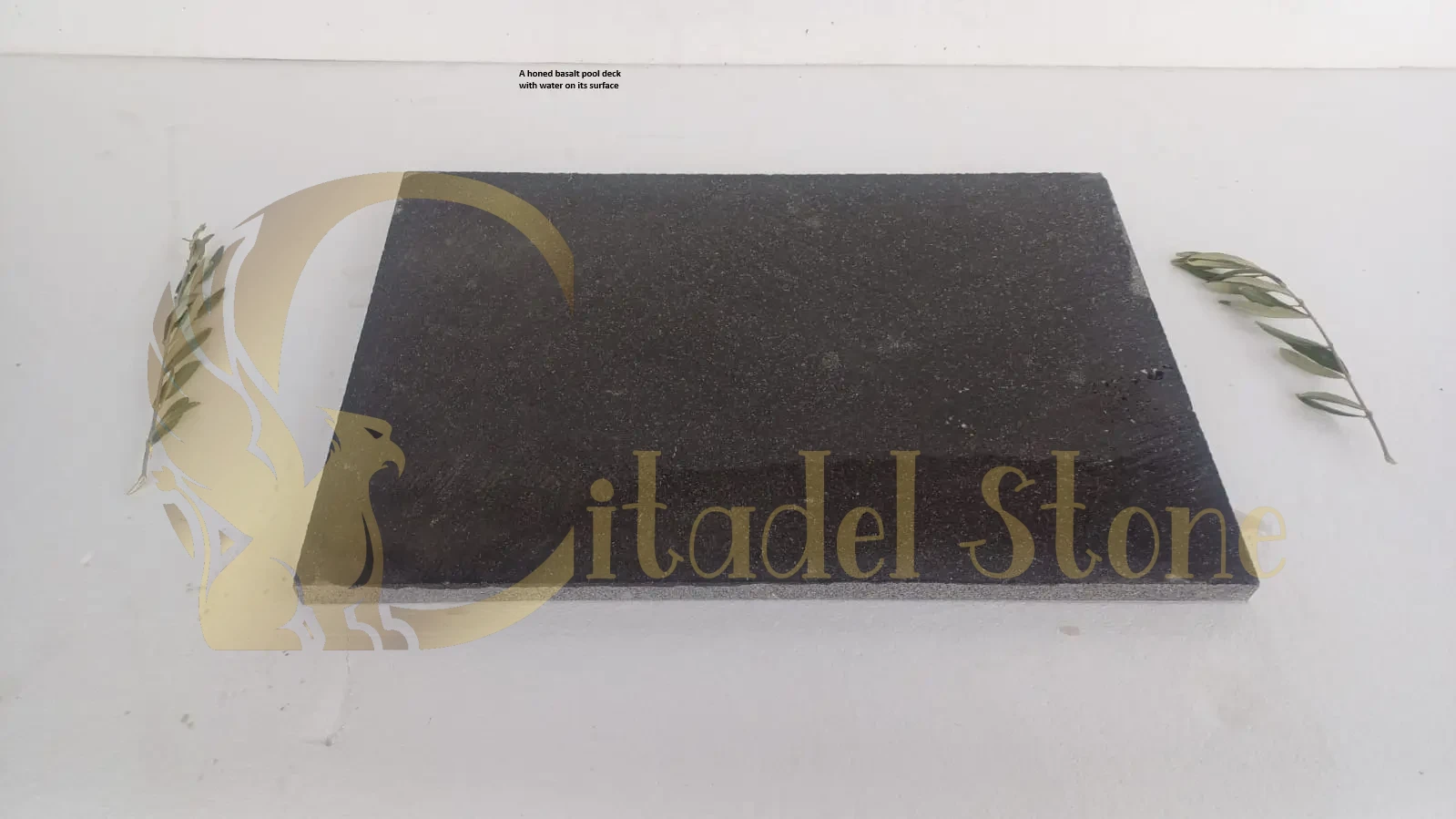
Interpreting Numbers — Thresholds, Use-Cases & Practical Guidance
Illustrative Threshold Table by Use-Case
| Application Type | Test Method | Illustrative Wet Threshold | Safety Notes |
|---|---|---|---|
| Pool Edge (Barefoot) | Pendulum (BS 7976-2) | ≥40 PTV | Consider micro-texture for <35 PTV |
| Commercial Plaza | DCOF (ANSI A326.3) | ≥0.42 | Higher traffic requires ≥0.50 |
| Residential Terrace | Pendulum (BS 7976-2) | ≥35 PTV | Adequate for controlled conditions |
| Accessible Ramp | DCOF (ANSI A326.3) | ≥0.60 | May require ramp test verification |
| Interior Lobby | DCOF (ANSI A326.3) | ≥0.42 | Consider maintenance impact |
| Wet Service Area | Pendulum (BS 7976-2) | ≥45 PTV | Additional drainage required |
Note: All threshold values are illustrative and must be verified against current regional codes and standards.
Pass vs. Suitable Performance
A surface may technically “pass” minimum code requirements while still requiring additional safety measures for practical use. For example, honed basalt may still benefit from textured transition strips at pool edges or high-traffic zones.
Consider cumulative risk factors including slope, drainage, maintenance protocols, and user demographics when interpreting threshold compliance versus real-world safety performance.
Sample Data & Worked Examples
Illustrative Performance Dataset
| Surface Type | Pendulum (PTV) | DCOF (Wet) | Recommended Use |
|---|---|---|---|
| Honed Basalt (800-grit) | 38 ± 3 | 0.44 ± 0.03 | Terraces with drainage |
| Honed Basalt + Micro-texture | 42 ± 2 | 0.52 ± 0.04 | Pool surrounds, plazas |
| Honed Basalt (Sealed Film) | 31 ± 4 | 0.38 ± 0.05 | Interior only, avoid wet areas |
| Flamed Basalt | 58 ± 4 | 0.68 ± 0.04 | High-traffic exteriors |
| Polished Basalt | 18 ± 2 | 0.22 ± 0.03 | Interior features only |
| Concrete Paver | 45 ± 3 | 0.48 ± 0.04 | Standard comparison |
All values are illustrative and represent typical ranges under standardized laboratory conditions.
Worked Example: Pool Deck Decision Analysis
Illustrative worked example (not measured data): Honed basalt specimen showing 38 PTV (pendulum) and 0.44 DCOF (wet)
Threshold Comparison:
- Pool edge requirement: ≥40 PTV (illustrative threshold)
- Specimen performance: 38 PTV (2 points below threshold)
- Risk assessment: Marginal performance requiring mitigation
Decision Process:
- Calculate safety margin: 40 – 38 = 2 PTV deficit
- Evaluate mitigation options: Micro-texturing could increase performance to 42 PTV (illustrative)
- Cost-benefit analysis: Surface treatment vs. alternative finish selection
- Final recommendation: Specify micro-textured honed finish or implement textured safety strips.
Invest in black basalt flooring tiles – honed finish today to enhance your property with a sleek, long-lasting finish that redefines outdoor elegance—available nationwide.
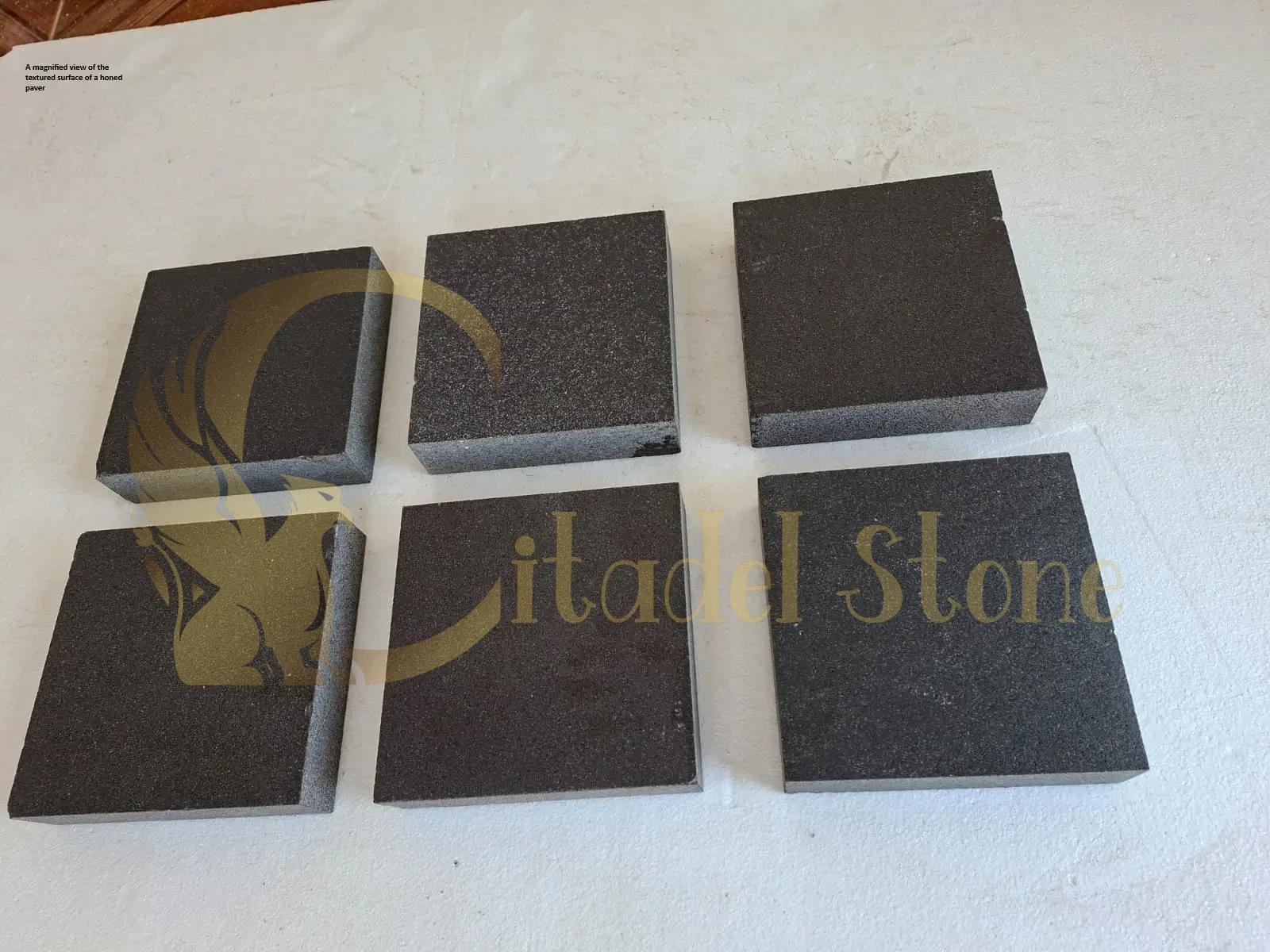
Mitigation Strategies When Honed Basalt Tests Low
Design Fixes
Patterning and Texture Integration: Incorporate micro-textured bands at 500mm (20″) intervals or transition zones where slip risk increases. Alternating textured strips provide safety enhancement while preserving overall aesthetic character.
Slope and Drainage Modifications: Implement minimum 2% slope away from standing water areas. Install discrete drainage channels at pool edges or high-splash zones to minimize extended water contact periods.
Surface Treatments
Abrasive Honing: Light abrasive treatment using 220-400 grit diamonds can increase surface roughness while maintaining honed appearance. Illustrative performance improvements of 5-8 PTV are achievable through controlled re-texturing.
Anti-Slip Coatings: Transparent slip-resistant treatments can enhance performance but may alter appearance, maintenance requirements, and long-term durability. Evaluate coating compatibility with basalt mineralogy and sealer systems before application.
Maintenance Controls
Cleaning Regimes: Weekly power washing removes organic films that reduce slip resistance. Quarterly joint sand replenishment prevents debris accumulation that could create slip hazards during heavy precipitation.
Retexturing Intervals: Illustrative re-texturing every 3-5 years for high-traffic areas maintains optimal slip performance as surface wear gradually reduces initial roughness levels.
Specification & Contract Language — Copy-Ready Clauses
Pre-Shipment Lab Testing Clause
SLIP RESISTANCE VERIFICATION: Contractor shall provide laboratory test reports from Stone Lab For Testing for each material lot, showing compliance with wet slip resistance of minimum. Testing shall be performed on representative samples showing actual finish condition and surface preparation. Non-compliant materials shall not be shipped to project site.
Site Mockup Acceptance Testing Clause
FIELD VERIFICATION TESTING: Prior to bulk material delivery, Contractor shall install 2m x 2m mockup panels for Owner verification using field pendulum testing. Mockup acceptance requires achieving minimum under wet conditions with 5 replicate measurements per panel. Accepted mockups establish quality standards for full installation.
Post-Installation Verification Clause
FINAL SLIP RESISTANCE ACCEPTANCE: Within 30 days of substantial completion, Owner’s testing agent shall perform field verification testing at minimum 10 locations across installed surfaces. Failure to achieve specified minimums triggers remedial obligations including surface treatment, partial replacement, or full replacement at Contractor’s expense. 5% contract value holdback released upon successful final acceptance testing.
Legal, Accessibility & Risk Considerations
Slip resistance data directly supports duty-of-care obligations and accessibility compliance documentation. Maintain comprehensive test records including batch identification, installation locations, and environmental conditions during testing for potential insurance claims or legal proceedings.
Commission human-subject ramp testing when laboratory methods cannot adequately predict performance for critical accessible routes or when conflicting test results require verification through actual pedestrian evaluation.
Document all testing procedures with photographic evidence, calibration certificates, and laboratory accreditation verification to establish defensible performance records throughout the project lifecycle.
Shop Basalt DuoFinish Pavers now for a premium upgrade that offers an optimal mix of style, strength, and sustainability—nationwide shipping available.
Maintenance & Long-Term Monitoring — Keep Safety Over Time
Monitoring Schedule
Quarterly Inspections (illustrative frequency):
- Visual assessment of surface wear patterns
- Joint condition and drainage functionality
- Photographic documentation for trend analysis
Annual Testing (illustrative frequency):
- Field pendulum spot-checks at high-traffic locations
- Surface condition assessment and cleaning effectiveness evaluation
- Sealer performance verification where applicable
Key Maintenance Tasks
Power Washing: Monthly high-pressure cleaning removes organic films and restores surface texture visibility. Use 2000-3000 PSI with appropriate standoff distance to prevent surface damage.
Joint Sand Replenishment: Quarterly replacement of joint materials prevents debris accumulation that could compromise drainage and create localized slip hazards during precipitation events.
Sealer Reapplication: Illustrative 3-5 year intervals maintain stain resistance without compromising slip performance. Always verify slip impact through test patches before bulk application.
Re-Testing Triggers
Conduct formal slip resistance re-evaluation when:
- Visual wear patterns indicate significant surface change
- Slip incidents occur despite proper maintenance
- Major maintenance operations (refinishing, resealing) have been completed
- 5 years have elapsed since last comprehensive testing (illustrative interval).
Secure basalt tiles today and experience the benefits of a product designed for both aesthetics and performance—delivered in every state.
FAQs — Practical Answers
Q: Is honed basalt inherently slippery when wet? A: Honed basalt typically achieves moderate slip resistance (request the pendulum and wet DCOF test reports for the finish supplied) when properly finished, but performance varies with grit level, sealer application, and maintenance condition.
Q: Will sealing change COF numbers? A: Yes. Film-forming sealers typically reduce slip resistance, while penetrating sealers have minimal impact. Always specify slip testing of sealed samples before project commitment.
Q: How often must I re-test slip resistance? A: Illustrative intervals: annual spot-checks for high-risk areas, 3-5 years for comprehensive testing, or immediately following significant wear, incidents, or maintenance operations.
Q: Can anti-slip coatings void stone warranties? A: Potentially yes. Surface treatments may affect warranty coverage for appearance, durability, or performance issues. Verify warranty implications before applying any post-fabrication treatments.
Q: Which test method should I use for barefoot pool decks? A: Pendulum testing typically provides more relevant data for barefoot applications, though some regions specify DCOF protocols. Consult local codes and consider both methods for comprehensive evaluation.
Q: How many test replicates are standard for lab reports? A: Minimum 5 replicates per test location for statistical validity. High-stakes applications may require 10+ replicates or multiple specimen testing to establish reliable performance ranges.
Internal Links & Resources
Explore technical specifications and performance data in our comprehensive Basalt Pavers Product Page. For comparative slip testing services and safety verification protocols, Request Safety Mockup & Testing to ensure optimal performance for your specific application requirements.
Lab Test Request Templates
Pendulum Test Request Template
PENDULUM SLIP RESISTANCE TEST REQUEST
Laboratory: [Insert accredited laboratory name and contact information] Project: Pearl bridge
Test Standard: BS 7976-2 or equivalent regional method identifier before issuing.
Sample Specifications:
- Material: Honed basalt pavers
- Dimensions: 300mm x 300mm x 20mm minimum
- Finish: Factory honed to [insert grit specification]
- Quantity: [Insert number of specimens]
- Special preparation: [Insert any sealer or post-treatment requirements]
Test Conditions:
- Surface condition: Wet with distilled water application
- Temperature: 20°C ± 2°C ambient
- Test locations: Minimum 5 locations per specimen
- Replicate measurements: 5 per location
Reporting Requirements:
- Mean PTV ± standard deviation for each specimen
- Individual test values and location documentation
- Instrument model, calibration date, and verification
- Test date and environmental conditions
- Laboratory accreditation number and scope
- Digital photographs of test setup and specimens
Delivery: Submit complete report within one month of sample receipt
DCOF Test Request Template
DYNAMIC COEFFICIENT OF FRICTION TEST REQUEST
Laboratory: Project: HollyBush
Test Standard: ANSI A326.3 or equivalent regional method identifier before issuing.
Equipment Requirements: approved tribometer model – BOT-3000, PIAST, or equivalent before issuing.
Sample Specifications:
- Material: Honed basalt pavers
- Dimensions: 150mm x 150mm x 15mm minimum
- Surface finish: [Insert finish specification]
- Conditioning: Clean, dry pre-test preparation
- Quantity: [Insert number of specimens required]
Test Protocol:
- Test foot: SBR (Styrene Butadiene Rubber) per standard requirements
- Surface condition: Wet with standard test solution
- Measurements: 5 replicates minimum per specimen
- Normal force: Per standard specification
- Sliding speed: Per standard specification
Quality Control Requirements:
- Reference standard verification before testing
- Instrument calibration documentation
- Measurement uncertainty analysis
- Environmental condition monitoring
Reporting Requirements:
- Mean DCOF ± standard deviation
- Individual measurement values
- Instrument model and calibration verification
- Surface temperature during testing
- Test solution specification and application method
- Complete measurement uncertainty analysis
Field Test Protocol Checklist
Pre-Test Setup
Environmental Documentation: □ Air temperature: ___°C □ Surface temperature: ___°C
□ Relative humidity: ___% □ Wind conditions: ___ □ Recent precipitation: ___ □ Time since last cleaning: ___
Equipment Verification: □ Pendulum calibration current (date: ___) □ Reference standard verification completed □ Test solutions prepared per specifications □ Safety equipment available and inspected □ Photography equipment ready □ Test location markers prepared
Surface Preparation: □ Test area cleaned with pH-neutral cleaner □ Thorough rinse completed and documented □ Complete drying verified □ Surface defects or irregularities noted □ Access control established
Testing Execution
Location Management: □ Test locations marked at specified intervals □ GPS coordinates recorded where applicable □ Photographic documentation completed □ Representative surface areas confirmed □ Traffic control measures active
Measurement Protocol: □ Water application method consistent □ 2-minute intervals between replicate tests □ Equipment cleaning between locations □ Environmental monitoring every 30 minutes □ Data recording verified for completeness
Safety Controls: □ Textured footwear worn by all personnel □ Three-point contact maintained on wet surfaces □ Emergency communication available □ First aid resources accessible □ Weather monitoring for unsafe conditions
Illustrative Thresholds Table
| Use Case Category | Primary Test Method | Illustrative Minimum Threshold | Risk Mitigation Notes |
|---|---|---|---|
| Pool Deck (Barefoot) | Pendulum (BS 7976-2) | ≥40 PTV wet | Consider ≥45 PTV for child areas |
| Commercial Walkway | DCOF (ANSI A326.3) | ≥0.42 wet | Increase to ≥0.50 for heavy traffic |
| Residential Patio | Pendulum (BS 7976-2) | ≥35 PTV wet | Adequate for normal residential use |
| Accessible Ramp (<1:20) | DCOF (ANSI A326.3) | ≥0.60 wet | May require human-subject verification |
| Interior Commercial | DCOF (ANSI A326.3) | ≥0.42 wet | Consider maintenance impact on performance |
| Exterior Stairs | Pendulum (BS 7976-2) | ≥50 PTV wet | Additional nosing treatment recommended |
| Wet Service Areas | Pendulum (BS 7976-2) | ≥45 PTV wet | Enhanced drainage and cleaning protocols |
| Public Plaza | DCOF (ANSI A326.3) | ≥0.45 wet | Higher values for liability protection |
All threshold values marked illustrative – verify against current regional codes, accessibility standards, and insurance requirements before specification use.
The Versatility of Basalt Pavers in Outdoor Design
Real Orders, Real Deliveries
We only publish projects we have actually supplied. See our Las Vegas white limestone delivery — two containers, 6,884 sq ft, 32 crates, shipped door to door — and how we supplied Creative Environments in Arizona with 21 containers across a 70,000+ sq ft installation: white limestone pavers and tiles, shellstone and Ocean Reef pavers.
Had Citadel Stone material installed on your project? Send us your photos and we will feature the work here, with your permission.
Specification Contract Clauses
Clause 1: Pre-Shipment Testing Requirements
MATERIAL SLIP RESISTANCE VERIFICATION: Contractor shall provide certified laboratory test reports from an accredited testing facility for each production lot of honed basalt pavers. Testing shall be performed showing minimum wet slip resistance of [insert verified threshold value]. Test specimens must represent actual production finish quality and any specified surface treatments. Materials failing to meet specified minimums shall not be shipped to the project site and shall be replaced at no additional cost to Owner. Test reports must include laboratory accreditation documentation and instrument calibration verification.
Clause 2: Mockup Acceptance Testing
FIELD VERIFICATION PROTOCOL: Prior to bulk material delivery, Contractor shall install representative mockup panels of minimum 2m x 2m area for Owner acceptance testing. Field slip resistance verification shall be performed by Owner’s designated testing agent using portable pendulum equipment per [insert verified method identifier]. Acceptance requires achieving minimum [insert threshold value] under wet test conditions with five replicate measurements per panel location. Mockup panels meeting acceptance criteria establish the quality and performance standards for the complete installation. Rejected mockups require surface treatment or replacement prior to project material delivery.
Clause 3: Final Performance Verification
POST-INSTALLATION ACCEPTANCE: Within 30 calendar days following substantial completion, Owner shall engage qualified testing personnel to perform comprehensive slip resistance verification at minimum ten representative locations across the installed surface area. Testing protocol shall follow with wet surface conditions and minimum five replicate measurements per location. Surfaces failing to achieve specified performance minimums shall trigger Contractor remedial obligations including surface treatment, partial replacement, or complete replacement as determined by the severity and extent of non-compliance. Contract final payment holdback of five percent (5%) shall be released only upon successful completion of final acceptance testing and any required remedial work.
Ensure your honed basalt installations meet quantified safety standards through comprehensive testing and verification protocols. Contact Citadel Stone today for comparative slip testing services and safety-verified mockup panels that provide confidence in your design decisions. Follow our blog for ongoing insights about stone applications shared by your best stone supplier.