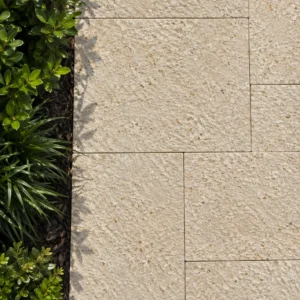
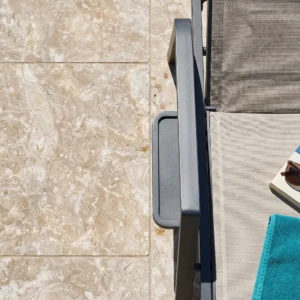
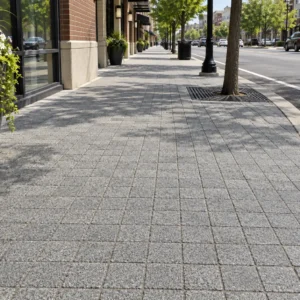
Thickness drives the structural conversation before anything else, and 30mm granite enters that conversation with a meaningful advantage over most sedimentary alternatives. At 3cm nominal, 30mm granite pavers carry point loads that thinner formats simply cannot distribute — and when you’re comparing them directly to travertine at the same nominal thickness, the differences run deeper than compressive strength alone. You need to understand how each material behaves at the base interface, at the joint, and through seasonal movement cycles before you commit a specification.
Material Character: What You’re Actually Specifying
Granite is an igneous rock formed under enormous pressure and heat, which gives it a tightly interlocked crystalline structure with very low absorption. Travertine, by contrast, is a sedimentary calcium carbonate stone — specifically a form of limestone deposited by mineral-rich spring waters. Its defining characteristic is the open-pore or void structure left by gas escape and organic material during formation. Those two formation stories translate directly into two very different performance profiles at 30mm thickness.
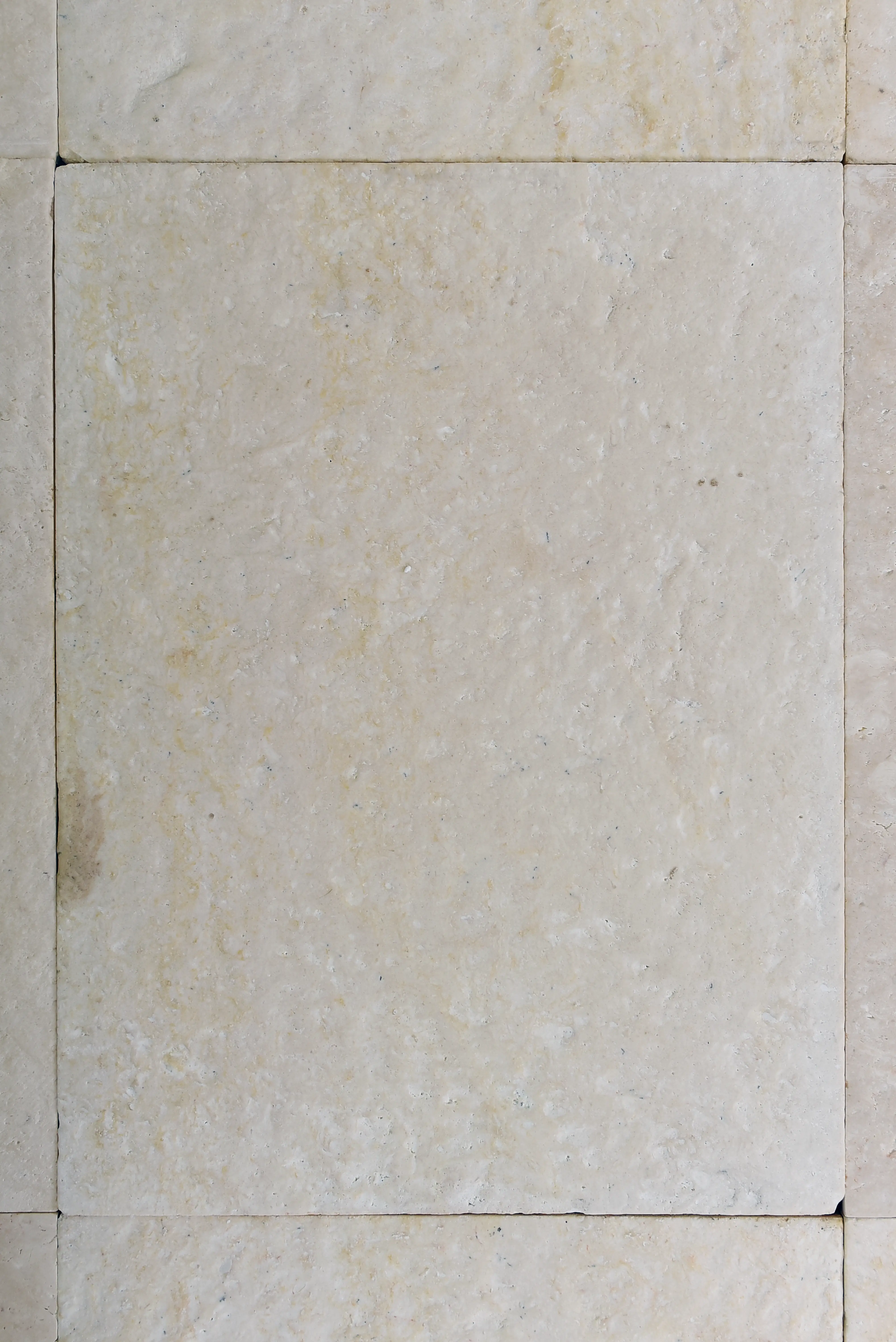
Any 30mm granite paver comparison should begin with absorption. Granite’s crystalline density means moisture uptake is minimal — a property verified through ASTM C97 testing, with the test report available on request from your supplier. Travertine at the same thickness absorbs considerably more moisture, and in filled-and-honed form, that behaviour depends heavily on the quality of the fill material and the sealing schedule you maintain. Understanding this distinction tells you a great deal about which material suits your drainage conditions, your freeze-thaw exposure, and your maintenance commitment.
- Granite: igneous, crystalline, very low absorption, consistent colour through its full depth
- Travertine: sedimentary calcium carbonate, open-pore structure, requires filling and sealing to perform reliably outdoors
- Both are available at 30mm nominal thickness — a format that opens driveway and heavy-use applications for either material
- Thermal expansion coefficients differ between igneous and sedimentary stone — request material-specific data before specifying joint spacing
According to Natural Stone Institute granite durability and application specifications, granite’s interlocked mineral structure — primarily quartz, feldspar, and mica — contributes to its standing as one of the most dimensionally stable natural stones in the dimensional stone category. That stability matters when you’re specifying 30mm stone for surfaces that need to hold tight tolerances across large plan areas.
Compressive Strength and the 30mm Format
The 30mm format is a deliberate structural choice. At this thickness, both granite and travertine move from decorative overlay territory into structural paving — capable of supporting vehicular loads when the base is correctly designed. The critical variable isn’t the stone’s compressive strength in isolation; it’s the interaction between slab thickness, span across the aggregate base, and the point load profile the installation will see.
30mm granite performs well under the kind of distributed loads a vehicle exerts across a properly blinded and compacted aggregate sub-base. Its low absorption also means the base interface stays drier over time, reducing the risk of sub-base softening in high-rainfall regions. Travertine at 30mm can also carry vehicular loads, but the specification requires more careful attention to void filling, joint stability, and the sealing frequency your sealer manufacturer recommends — because moisture ingress through unsealed voids creates frost expansion risk in freeze-thaw climates.
- Request compressive strength data via ASTM C170 from your supplier — never rely on an unverified figure
- Flexural strength (ASTM C880) is the more relevant metric for pavers spanning an aggregate base — ask for this test report specifically
- Span-to-thickness ratio is a calculation your engineer or installer performs on-site — not a generic rule of thumb
- For driveway applications, confirm your base depth with a geotechnical assessment of the sub-grade, not a standard depth recommendation
The ASTM C615 granite dimension stone quality standards outline the testing regime that governs granite’s classification as a dimension stone — a framework worth referencing when you’re writing a project specification that needs to survive a contractor substitution challenge.
Finish Options and Surface Texture
Finish selection shapes the visual result, the texture underfoot, and the maintenance requirements — in roughly that order of decision-making. Both granite and travertine offer a wide range of finishes at 30mm, and the finish affects how each material reads in its landscape setting.
Granite is commonly available in flamed, bush-hammered, honed, and polished finishes at this thickness. A flamed finish opens the surface texture by thermal shock, leaving a matte, slightly roughened profile. A bush-hammered finish creates a mechanically worked texture with consistent micro-relief. Honed granite gives you a smooth, low-sheen surface with a refined aesthetic. Each finish changes how the stone handles surface water — an important consideration for slope design. For guidance on wet-surface testing, the current standard is ANSI A326.3, measured wet; the relevant test report is available on request.
Travertine finishes tend toward honed or tumbled in outdoor applications. A tumbled finish opens the edges, softens the profile, and leaves an open, matte texture that reads as aged and informal. Honed travertine with a filled surface reads cleaner and more contemporary. The finish also interacts with the void structure — a tumbled travertine surface exposes more of the natural pitting, while a filled-and-honed surface conceals it until the fill requires renewal.
- Flamed granite: matte, open texture — suited to exposed outdoor applications where surface water is a design consideration
- Bush-hammered granite: mechanical texture with consistent depth — a popular choice for contemporary landscape projects
- Honed granite: smooth, refined — typically specified for covered outdoor areas or interior-to-exterior transitions
- Tumbled travertine: soft, rustic profile — pairs well with planted borders and informal garden layouts
- Filled-and-honed travertine: cleaner face — requires a disciplined sealing schedule to maintain void fill integrity
Landscape Design and Aesthetic Integration
Stone selection rarely happens in a vacuum. The material decision intersects with the planting palette, the architectural character of the building, and the design tradition the landscape draws from. This is where granite and travertine genuinely diverge in character — not in structural performance, but in visual language.
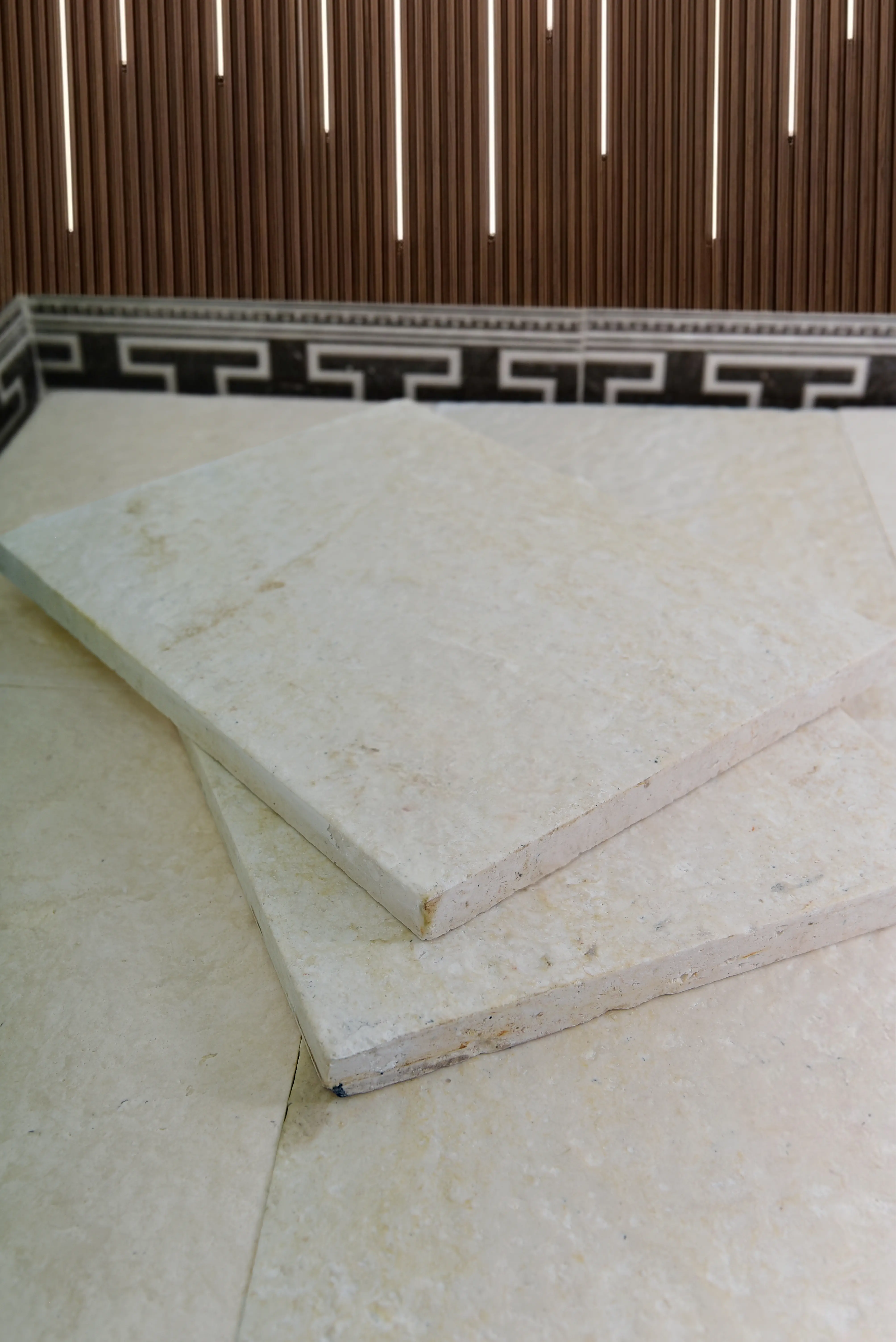
Granite carries a strong, assertive presence. Its crystalline surface catches light differently across the day, and darker granite tones — charcoal, silver-grey, black — read as deliberately modern against clean architectural lines and minimal planting. A flamed dark granite courtyard with low ornamental grasses and steel-edged planting beds is a coherent design statement. Travertine speaks a warmer, older language. Its buff, ivory, and walnut tones integrate naturally with Mediterranean-influenced gardens, terracotta planting pots, clipped hedgerows, and warm-rendered walls.
For projects drawing on desert xeriscaping traditions, both materials have a place — but they create different effects. Granite holds its colour through intense UV exposure with minimal shift, while travertine can lighten slightly over extended outdoor exposure. In tropical or lush planted settings, travertine’s warm tones blend easily with dense foliage, while a lighter-toned granite can feel stark unless the planting softens the edges. There’s no universally correct answer — the design tradition you’re working within should drive the palette decision, not the other way around.
- Modern minimalist landscapes: flamed or bush-hammered granite in dark tones tends to read cleanly
- Mediterranean or colonial revival gardens: travertine’s warm palette integrates without effort
- Desert xeriscaping: granite holds colour better in sustained UV; travertine pairs warmly with terracotta and ochre planting
- Tropical or lush planted settings: travertine’s warmth reads better against dense green; granite benefits from softening planting at the edges
- Contemporary minimalist interiors extending to outdoor spaces: honed granite or filled-and-honed travertine both support a clean indoor-outdoor transition
Thermal Behaviour and Surface Temperature
Surface temperature at peak solar exposure can vary significantly between granite and travertine even when both are specified in a light tone — a detail that specifiers consistently underestimate. Granite’s density means it absorbs and retains heat efficiently — a property that works well in cooler climates where thermal mass is an asset in the shoulder seasons, but becomes uncomfortable in full-sun pool decks in hot climates where barefoot use is expected.
Travertine’s open-pore structure moderates surface temperature more effectively in high-UV conditions. The Natural Stone Institute travertine properties and outdoor suitability resource confirms that travertine’s absorption characteristics contribute to its surface-temperature behaviour in exposed outdoor settings — a reason it remains widely specified for pool surrounds in hot climates. Granite’s thermal mass makes it better suited to shaded outdoor rooms, covered terraces, and landscape zones where direct solar gain is managed by the built environment.
The specification should account for the orientation of the surface, the expected solar exposure hours per day, and the intended use — barefoot circulation requires different surface-temperature management than a service access path or a driveway.
Sealing and Maintenance Compared
The maintenance conversation is where the two materials genuinely separate for long-term ownership. Granite at 30mm is highly resistant to staining by virtue of its low absorption, and in many outdoor applications, a penetrating impregnator sealer applied on the interval your sealer manufacturer recommends is sufficient. The crystalline surface doesn’t require the same frequency of attention as a porous sedimentary stone.
Travertine demands a more disciplined approach. The open-pore structure — even when filled — presents pathways for moisture, biological growth, and staining agents unless sealed consistently. You can expect good, long-term performance from outdoor travertine where drainage is designed in, the sealer is reapplied on schedule, and the fill in honed surfaces is renewed when it shows wear. Skip that maintenance cycle, and travertine will show it faster than granite will.
- Granite: highly resistant to staining, lower maintenance frequency in sealed outdoor installations
- Travertine: requires consistent sealing schedule — the interval is set by your sealer manufacturer’s product data, not a generic rule
- Both materials benefit from pH-neutral cleaning products — avoid acid-based cleaners on travertine, which will etch the calcium carbonate surface
- Biological growth (algae, lichen) affects both materials in shaded wet conditions — factor drainage slope and shade into your specification
- Chip and edge repair is more visually disruptive in polished or honed granite than in tumbled travertine, where edge variation is part of the aesthetic
For projects where you’re supplying stone to a client with a long-term maintenance team, provide a written maintenance protocol with the specification. It’s a professional deliverable that prevents the most common maintenance failures — and it’s the step most project handovers skip entirely. Explore our calibrated stone paving range for a reference point on how travertine is specified at this thickness alongside granite alternatives.
Installation Considerations at 30mm
Both materials at 30mm nominal thickness are heavier and more demanding to handle than their 20mm counterparts. The site logistics plan needs to account for this before the first delivery arrives. Offloading typically requires mechanical assistance — a forklift or telehandler at the point of delivery, and careful planning of where loaded pallets can safely sit without bearing on sensitive sub-grade areas.
Access constraints may affect delivery scheduling — particularly on sites with restricted turning circles or weight-limited access roads. Delivery arrangements are confirmed before the shipping date, and lead times are quoted with the order. Citadel Stone cuts 30mm granite to order at our selected quarries, which means specified dimensions and quantities are matched to the production run rather than pulled from a retail stock allocation.
The setting bed specification differs between the two materials. Granite’s very low absorption means it bonds readily to cement-based adhesives without pre-wetting in most conditions — check your adhesive manufacturer’s guidance for high-temperature installations where open time is shortened. Travertine’s absorption can draw moisture from the adhesive quickly in hot, dry conditions, so back-buttering and adjusting working time to the ambient temperature is important. According to USGS granite production and construction use statistics, granite remains one of the most widely used dimension stones in US construction — a reflection of its broad applicability across installation types.
- 30mm stone is significantly heavier per pallet than 20mm — confirm safe working loads at your drop zone before delivery
- Joint width and movement joint spacing should be calculated from your material’s actual thermal expansion data — request this from your supplier
- For granite, use a polymer-modified cement adhesive rated for the slab weight and thermal load of the installation
- For travertine, pre-wetting or back-buttering in hot, dry conditions prevents premature adhesive skinning
- Expansion joints at perimeter and at regular internal intervals are non-negotiable in large-format 30mm installations — work this into your joint plan before laying starts
Cost and Value Considerations
The price relationship between 30mm granite and travertine varies with tone, finish, and source region. Broadly, both occupy the premium natural stone tier, and the cost difference between them at 30mm is often smaller than buyers expect — particularly when you factor in the long-term maintenance cost differential.
Travertine’s lower per-unit price in some supply scenarios is offset by the sealing and maintenance programme it requires over its service life. Granite’s higher upfront cost in certain formats tends to be recovered through lower intervention frequency. That said, a well-maintained travertine installation can deliver decades of service life in appropriate conditions — and its aesthetic warmth commands a design premium that granite in a similar tone cannot replicate. The value calculation should be lifecycle-based, not unit-price-based.
The 30mm granite paver comparison becomes especially useful here: specifying the wrong material for the application is always more expensive than the price differential between the two materials at point of purchase. A travertine driveway that suffers sub-base moisture damage because the void fill wasn’t maintained costs significantly more to address than the margin saved at the stone supply stage.
Making the Right 30mm Granite Specification
The decision between 30mm granite and travertine pavers at this thickness comes down to three converging factors: your site’s drainage and moisture conditions, your client’s or your own maintenance commitment, and the design language the landscape needs to speak. Granite gives you dimensional stability, very low absorption, and a resilient surface that performs well under demanding loads with relatively low maintenance. Travertine gives you warmth, a natural aesthetic that integrates with a broader range of planting traditions, and surface-temperature behaviour that suits sun-exposed settings — provided you honour the sealing schedule it needs to perform reliably.
Neither material is the correct default. The right specification is the one that matches the performance requirements of the site with the aesthetic demands of the design and the maintenance reality of the ownership model. Before comparing materials intelligently, you need test reports — ASTM C97 for absorption, ASTM C170 for compressive strength, ASTM C880 for flexural strength — and you need to request them from your supplier rather than rely on generic published ranges. As you build out your stone specification across a larger project, our 3cm stone specification guide covers the broader decision framework for projects at this thickness. Stone for nationwide projects arrives through Citadel Stone with 30mm granite thickness held consistent for level, gap-free installation.
Related reading: travertine paver thickness guide · how to choose travertine paver sizes · 16×24 travertine layout ideas.