Wholesale marble and granite purchasing decisions hinge on factors most buyers never fully evaluate before the first truck rolls in — slab thickness tolerances, bundle consistency, and the gap between nominal dimensions and actual yield. You’re not just buying stone; you’re buying a supply chain outcome, and the variables that determine whether your project finishes on budget are set before material ever leaves the quarry. Understanding those upstream decisions is what separates a smooth multi-material project from one that stalls at the layout stage.
What Wholesale Actually Means in Stone Supply
The term wholesale marble and granite gets used loosely, and that ambiguity costs buyers. Wholesale in natural stone supply has three distinct tiers: quarry-direct, importer-distributor, and regional stone yard — and the price, quality consistency, and lead time differ significantly across all three. Quarry-direct pricing is real, but minimum order quantities often start at full container loads, which means 600–800 square feet per material type minimum. That works for large commercial projects; it doesn’t work for a mixed residential renovation where you need 200 square feet of statuary marble and 150 square feet of absolute black granite.
Importer-distributors buy container loads and break them into smaller lot sizes, which is where most mid-scale wholesale buyers operate. The trade-off is a markup over quarry-direct pricing — typically 15–25% — but you gain lot flexibility and access to pre-cleared domestic inventory. According to USGS dimension stone production and use data, dimension stone imports have remained a dominant share of US supply, which means most wholesale buyers are purchasing through importer channels whether they realize it or not. Knowing which tier you’re actually operating in shapes every negotiation and timeline decision you’ll make.
Marble Grades and What They Mean for Your Order
Marble grading isn’t standardized the way lumber grading is, and that creates real problems for wholesale buyers who assume a quoted grade maps cleanly to a specific quality benchmark. In practice, grades vary by country of origin, quarry operator, and the distributor’s own internal classification. You’ll encounter designations like Commercial, Standard, Select, and First Choice — but none of these are regulated terms under a single governing body.
What matters practically is understanding the specific defect tolerances within each grade. Commercial-grade marble typically allows for filled voids up to 2 mm, hairline cracks sealed with epoxy, and color variation across slabs in the same bundle. Select or Premium grades restrict those variables significantly — typically no filled cracks, consistent veining direction within a bundle, and tighter thickness tolerances (usually ±1 mm versus ±3 mm for commercial). The Natural Stone Institute marble grades and technical specifications provide a useful technical framework for understanding these distinctions. Your application determines which grade is actually necessary — over-specifying Premium grade for a utility space wastes budget, while under-specifying Commercial for a high-visibility reception floor creates installation headaches you won’t discover until the slabs are unwrapped on site.
- Commercial grade: filled voids acceptable, ±3 mm thickness, color variation within bundle expected
- Select grade: no filled cracks, ±1–2 mm thickness, consistent veining direction per bundle
- Premium grade: bookmatched pairs available, zero visible repairs, tightest dimensional tolerance
- Grade labeling varies by origin country — always request the supplier’s written defect tolerance criteria, not just the grade name
Granite Specification Depth: Beyond Color Selection
Most buyers approach granite wholesale as a color selection exercise and then backfill the technical specifications. That’s the wrong sequence. Your structural application — whether you’re specifying countertop slabs, exterior cladding, or pavers — determines the performance requirements, which then filters the viable granite options. Compressive strength under ASTM C615 for granite dimension stone sets a minimum of 19,000 PSI, but quarry output varies considerably around that floor, and for high-traffic paving applications you want material consistently above 25,000 PSI.
Water absorption is the other metric that gets glossed over in marble granite wholesale sourcing conversations. Granite absorption typically runs 0.1–0.4%, which is excellent compared to marble’s 0.2–1.5% range. But within granite, that spread matters for exterior applications in freeze-thaw regions. Higher-absorption specimens — even within the granite classification — experience more microcracking cycles over a decade of seasonal exposure. Request absorption test data alongside compressive strength data for any granite you’re specifying for exterior use. Per ASTM C615 granite dimension stone quality standards, these parameters are measurable and verifiable — insist on documentation before committing to a large wholesale order.
Sourcing Logistics: Bundles, Containers, and Lead Times
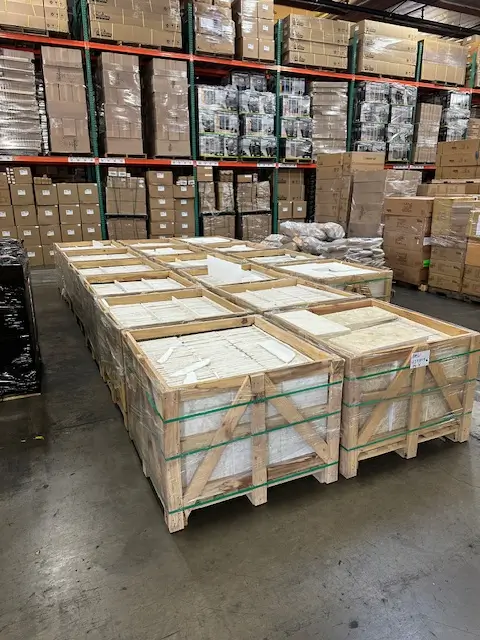
Your lead time calculation for wholesale marble and granite procurement needs to account for three distinct phases, and most buyers only plan for one. Phase one is production and curing at the quarry — polished slabs require 48–72 hours of curing after surface finishing before they’re dimensionally stable enough to bundle safely. Phase two is container loading, customs clearance, and ocean freight — typically 6–8 weeks from Italy or Brazil, 4–5 weeks from Turkey, and 8–10 weeks from India depending on current port conditions. Phase three is warehouse receiving, quality inspection, and staging for outbound delivery.
At Citadel Stone, we maintain warehouse inventory across stock granite and marble lines specifically to compress that lead time for buyers who can’t wait on import cycles. For projects with defined start dates, drawing from warehouse stock rather than placing a custom import order is frequently the right call even if it means working within available color and grade selections rather than custom-specifying. The six weeks you save often outweigh the aesthetic compromise of selecting from available inventory. For custom or bookmatched slabs, plan a minimum 12-week procurement window from order placement to on-site delivery, and build buffer into that timeline for customs delays and warehouse receiving backlogs.
- Standard warehouse stock lead time: 1–2 weeks from order confirmation to truck delivery
- Custom import order lead time: 10–14 weeks minimum from quarry selection to delivery
- Bookmatched slab orders require sequential bundle reservation — once a bundle ships, matching the sequence later is nearly impossible
- Confirm warehouse stock levels before finalizing project timelines — available quantities can shift between quote and order placement
Subgrade and Soil Conditions That Affect Stone Performance
The material selection conversation in marble granite wholesale sourcing rarely covers what’s happening below the slab, but subgrade conditions are where long-term performance is actually determined. You can specify perfectly graded granite or statuary marble and still end up with a failing installation if the subgrade wasn’t prepared for the material’s specific weight and stiffness characteristics. Stone is unforgiving compared to porcelain tile — it won’t flex, and any differential settlement in the substrate translates directly into cracked slabs or failed joints.
Expansive clay soils are the most problematic subgrade condition for large-format stone installations. Clay expands when wet and contracts when dry, and that volumetric cycling creates point loads at slab edges and corners — exactly where marble and granite are most vulnerable to fracture. In regions where expansive clay is common, a minimum 6-inch compacted aggregate base is table stakes, and many specifiers move to 8–10 inches with a geotextile separation fabric between native soil and base material. Sandy or loose subgrades present a different problem: they’re prone to migration under load cycling, which creates voids beneath slabs over time. Caliche — the dense calcium carbonate hardpan found in arid zones — sounds like ideal bearing material but often has irregular surface topography that requires significant grading before a level slab bed is achievable. The point is that the right wholesale stone specification starts with a subgrade assessment, not a color selection.
- Expansive clay: minimum 6-inch compacted aggregate base; consider moisture barrier below base course
- Sandy or loose soils: geotextile separation fabric mandatory; base depth increases to 8 inches minimum
- Caliche hardpan: irregular surface requires careful grading; excellent bearing capacity once leveled
- Rocky subgrades: excellent structural support but require fine aggregate leveling course for slab bedding
- Any fill material less than 2 years old should be treated as unstable and engineered accordingly
Slab Thickness and Application Matching
Thickness specification is where wholesale marble and granite orders most commonly go wrong — not because buyers choose the wrong material, but because they specify a thickness that technically meets the application requirement without accounting for the site-specific load conditions or span geometry. The standard thickness categories are 3 cm (1.25 inches) for structural countertop and cladding applications, 2 cm (0.75 inches) for lighter countertop and wall tile use, and 3 cm or greater for paving applications with vehicular or heavy foot traffic.
For exterior paving specifically, 3 cm is the practical minimum for granite pavers under pedestrian load with a compacted aggregate base. Marble in the same application requires more caution — marble’s lower modulus of rupture compared to granite means it’s more susceptible to cracking under point loads, particularly at thinner sections. The modulus of rupture for granite under ASTM C99 typically runs 2,000–2,500 PSI; for marble it runs 1,200–1,800 PSI depending on origin and grain orientation. That 30–40% strength differential is directly relevant to thickness selection for paving applications, and it’s a factor that frequently gets overlooked when buyers are comparing wholesale marble and granite pricing side by side.
Quality Inspection Protocols Before You Accept Delivery
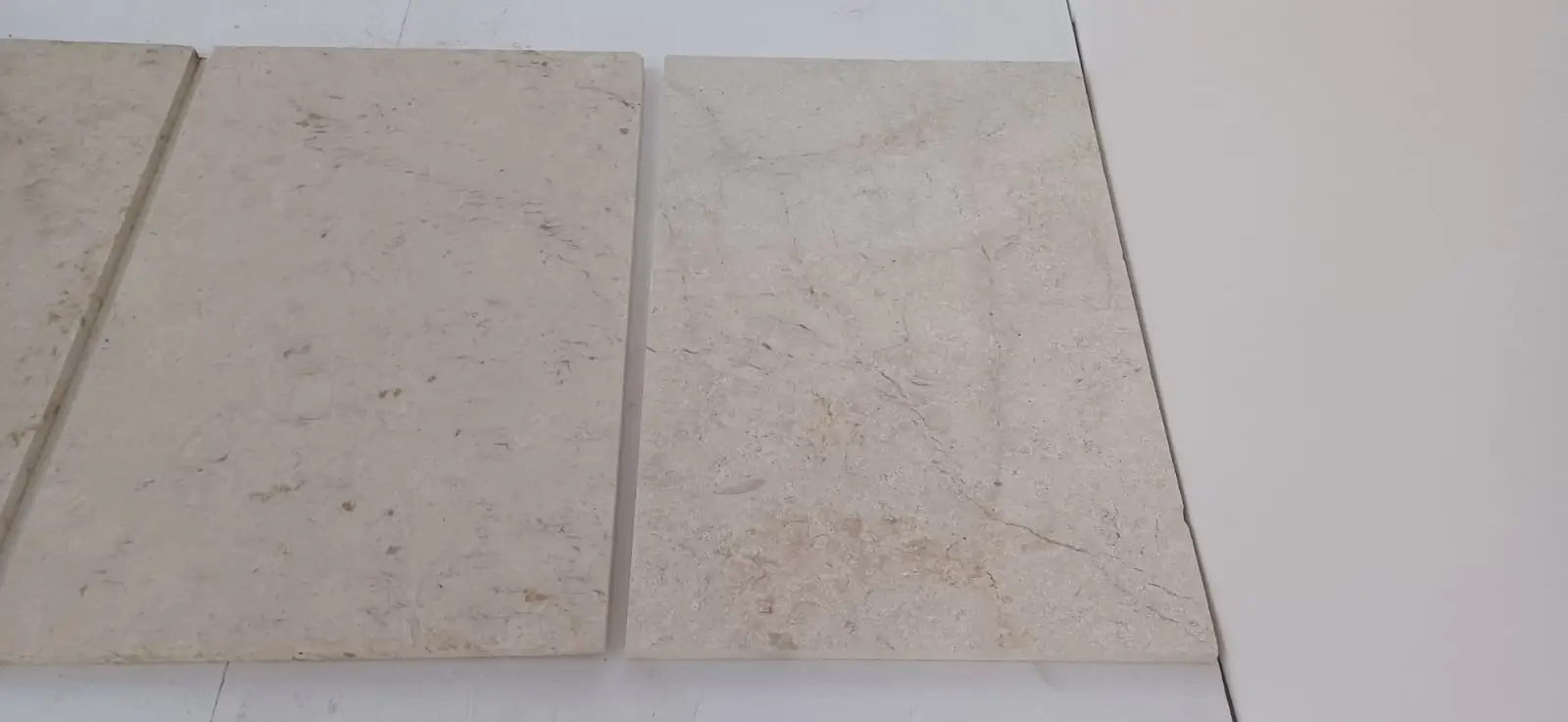
The receiving stage is your last practical opportunity to catch specification deviations before they become installed problems. Most wholesale buyers do a visual check of the top slab in each bundle and sign the delivery ticket — that’s inadequate for high-value orders. A proper receiving inspection for wholesale stone should cover thickness spot-checks across at least 10% of pieces, a visual check for edge chipping on all four sides of a sample set, and verification that the bundle count and nominal square footage matches the order documentation.
For bookmatched marble specifically, verify that bundle sequence numbers are intact and that sequential slabs from the same run are packaged together. Once you’ve accepted delivery and the truck leaves, re-sequencing or replacing slabs that don’t match is an expensive problem. Our technical team at Citadel Stone recommends photographing bundle labels and at least the top three slabs of every bundle at receiving — it creates a defensible record if quality disputes arise after the truck driver has departed. For granite orders, check for sawing marks on polished faces, which indicate insufficient buffing time at the processing facility and will telegraph through reflective finishes once installed.
- Thickness spot-check at least 10% of pieces across multiple bundles, not just the top slab
- Inspect all four edges of sampled slabs for chipping — edge damage during transit is a common issue with improperly packed bundles
- Verify bundle sequence numbers for bookmatched orders before the delivery truck departs
- Check polished faces under raking light for sawing marks or surface waviness
- Document receiving condition with photographs before signing the delivery receipt
Pricing Structure and Negotiation Leverage
Wholesale stone pricing has more flexibility than most buyers realize, but leverage points are specific and often misunderstood. Volume discounts are the most obvious mechanism, but the threshold for meaningful pricing breaks typically starts at 500 square feet per material, not the 100–200 square foot minimum orders many buyers assume. Below that threshold, you’re often paying near-retail pricing regardless of what the supplier calls the transaction.
The more effective leverage point for buyers sourcing marble granite wholesale is order timing. Suppliers managing warehouse inventory have carrying cost pressure — stone that sits in a warehouse generates no return. End-of-quarter and pre-import-arrival periods create windows where negotiating 10–15% below standard wholesale pricing on in-stock material is realistic. You can access Citadel Stone wholesale stone pricing structures that reflect these inventory realities, which is particularly useful for buyers planning projects with defined start dates who can commit to orders 4–6 weeks in advance. Mixing materials on a single order — say, combining granite pavers with marble wall cladding — also creates combined-volume leverage that single-material orders don’t generate.
Payment terms are a second negotiation dimension. Standard wholesale terms are typically net-30 or 50% deposit with balance on delivery. Early-pay discounts of 1–2% for payment at order placement are sometimes available on large orders and are worth asking for explicitly — on a $40,000 stone order, a 1.5% early-pay discount is $600 back to your project budget.
Decision Points
The specification decisions that define a successful wholesale marble and granite procurement come down to four sequential choices: material grade matched to application performance requirements, thickness matched to structural load and subgrade conditions, sourcing tier matched to project timeline, and receiving protocol matched to the risk profile of the order. Miss any one of those alignments and you’ve introduced a failure mode that no amount of expertise during installation can fully correct. Getting the sequence right — and doing it before pricing conversations begin rather than after — is what separates projects that finish on budget from ones that carry cost overruns back to the stone selection phase.
For projects that mix stone types across applications, the complexity compounds at every step: different thickness requirements, different base specifications for varying subgrade conditions, and different quality inspection criteria for marble versus granite. Planning those variables in parallel rather than sequentially is where experienced buyers earn their margins. As you build out your broader project specification, related purchasing decisions around tile and cladding elements often benefit from the same wholesale sourcing discipline — wholesale tile sourcing fundamentals covers how those principles apply across complementary material categories. Wholesale buyers using Citadel Stone can mix granite and marble slabs on one order, streamlining logistics for multi-material jobs.
Related reading: wholesale granite direct · discount granite · granite density explained.