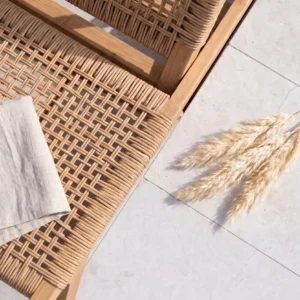
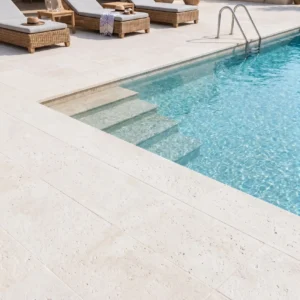
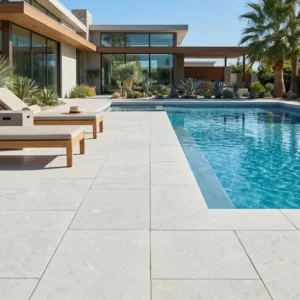
The tone decision for white limestone edging is more consequential than most specifiers realize — and it’s not purely aesthetic. The range of surface values available within the white limestone family spans from true chalk-white to warm cream and ivory, and each sits differently against gravel, mulch, concrete borders, and planted beds. Choosing the wrong finish tone locks you into a contrast ratio that either reads as harsh under direct sun or disappears completely against pale surroundings. Understanding how finish format and surface tone interact before you order is the difference between a border that defines your hardscape and one that blends into the background.
What Tone Actually Means in White Limestone
Tone in white limestone edging isn’t a single variable — it’s the combined result of mineral composition, finish processing, and surface texture. A honed white limestone and a sawn white limestone cut from the same quarry block will read as different tones in daylight because the honing process opens the surface slightly, creating micro-shadow across the pore structure. The sawn face, by contrast, catches light flatly and appears brighter. According to Natural Stone Institute limestone specifications, limestone’s calcium carbonate matrix is what gives it that characteristic warmth, but surface processing determines whether that warmth reads as cream, off-white, or near-grey in finished form.
You’ll also find that moisture dramatically shifts tone perception during and after installation. Fresh-set limestone edging tends to look two to three shades darker than its fully cured, dry appearance. This matters when you’re matching your edging to adjacent paving or gravel — never make a final color approval decision based on freshly wet samples. Let the stone dry completely under the same light conditions as your site before signing off on tone compatibility.
Mineral banding is another factor worth examining. Some white limestone varieties exhibit subtle iron or silica banding that creates natural variation in tone across individual pieces. This can be desirable as texture or disruptive as inconsistency, depending on your project’s design intent. Inspect the full range of a batch — not just the sample tile — before committing to a large edging order.

Finish Formats and Their Tonal Impact
The four primary finish formats for white limestone edging — sawn, honed, tumbled, and bush-hammered — each create a distinct tonal register that affects how the edging reads at distance and up close. Your choice of format should be driven by the contrast you want to achieve against your surrounding hardscape elements, not by finish preference alone.
- Sawn finish delivers the flattest, brightest tone — ideal when you need maximum contrast against dark mulch or red gravel beds
- Honed finish introduces a slight warmth through micro-texture and reads slightly creamier in afternoon sun, reducing glare compared to a polished surface
- Tumbled finish softens all edges and creates an aged appearance with a more variable tone across each piece — surfaces read as warmer overall
- Bush-hammered finish creates the most textured surface, scattering light inconsistently and producing a heathered appearance rather than a uniform tone
- Split-face formats expose the natural interior of the stone, revealing raw mineral color that often runs cooler and greyer than the saw-cut face
For limestone edging applications where tone consistency matters — particularly long linear runs alongside pale gravel or concrete — a honed or sawn finish gives you the most predictable result batch to batch. Tumbled formats introduce welcome variation in smaller garden borders but can look visually restless when used in runs exceeding 30 linear feet without breaks.
Comparing White Tones to Adjacent Materials
Here’s what most specifiers underestimate: white limestone edging doesn’t compete with adjacent materials in isolation — it competes with the light bouncing off them simultaneously. A true white limestone next to buff-colored concrete creates a visible contrast during low morning light but can wash into near-identical tone during midday when both surfaces are fully saturated with direct sun. The dynamic tonal relationship changes throughout the day.
Your specification should account for the dominant light exposure of the installed location. East-facing borders receive raking morning light that exaggerates tonal differences. West-facing runs get warm afternoon sun that shifts apparent tone toward gold. South-facing installations see the highest intensity and the most consistent tonal bleaching over time. For north-facing or shaded borders, you’ll want a stone with inherent warmth — an ivory or cream-toned limestone rather than a stark chalk-white — because cooler light makes pale stones look grey rather than white.
Faux stone edging products often attempt to replicate the tonal range of natural limestone through pigmented concrete mixes, but the color tends to shift significantly under UV exposure within three to five seasons. Natural white limestone edging, by contrast, develops a slight patina but holds its tonal character across decades. This distinction matters when you’re planning a long-term landscape design where edging and paving need to remain visually coherent.
Thermal Cycling and Joint Performance
Tonal appearance is one consideration — structural performance over time is another. White limestone’s thermal expansion coefficient sits at approximately 4.4 × 10⁻⁶ per °F, which means a 10-foot edging run will move roughly 1.5 mm across a 60°F temperature swing between a cold night and a warm afternoon. In regions where day-night temperature differentials regularly exceed 40°F, that cumulative movement at joints becomes a specification issue, not just a footnote.
Freeze-thaw cycling introduces a separate but compounding stress. Limestone is a sedimentary material with interconnected pore networks, and water that infiltrates those pores during wet periods expands approximately 9% when it freezes. Repeated freeze-thaw events on an inadequately sealed edging installation will gradually widen surface micro-fractures. According to USGS limestone composition data, the durability of limestone in freeze-thaw conditions is closely related to its porosity and pore structure — dense, low-absorption varieties significantly outperform high-porosity equivalents in thermal cycling environments.
For white limestone edging installed in climates with sustained freeze-thaw seasons, specify material with water absorption below 3% by weight and plan joint gaps of 6–8 mm rather than the standard 3–4 mm typically used in temperate applications. This wider joint accommodates thermal expansion without building compressive stress that causes edge spalling. Sand-set installations allow natural joint movement; mortar-set applications need properly placed expansion breaks every 12–15 feet.
- Specify water absorption ≤ 3% for freeze-thaw exposed installations
- Plan for thermal expansion joints every 12–15 feet in mortar-set edging runs
- Allow 6–8 mm joint spacing in high thermal-cycling environments rather than the standard 3–4 mm
- Apply a penetrating sealer rated for below-freezing temperatures before the first winter season
- Inspect joints after the first full freeze-thaw cycle and repack sand or caulk as needed
Format Sizing and Proportion Decisions
The sizing of white limestone edging pieces interacts with tone in a way that’s easy to overlook. Larger pieces — 12-inch by 24-inch or longer rectangular formats — present a broader unbroken surface to the eye, which amplifies tonal uniformity or variation depending on the batch. Smaller cobble-style formats distribute tone variation across more joints, creating a grout-line rhythm that breaks up any tonal inconsistency across individual pieces.
For linear driveway borders and pathway edging, rectangular formats in 4-inch by 12-inch or 6-inch by 12-inch sizes are the industry standard. These proportions create a clearly defined band that reads as intentional from a distance. Deeper edging pieces — those set with a larger face vertical — work well for retaining micro-grade changes at bed borders, but you’ll need to account for the reduced exposed face area when calculating tonal impact relative to surrounding ground cover.
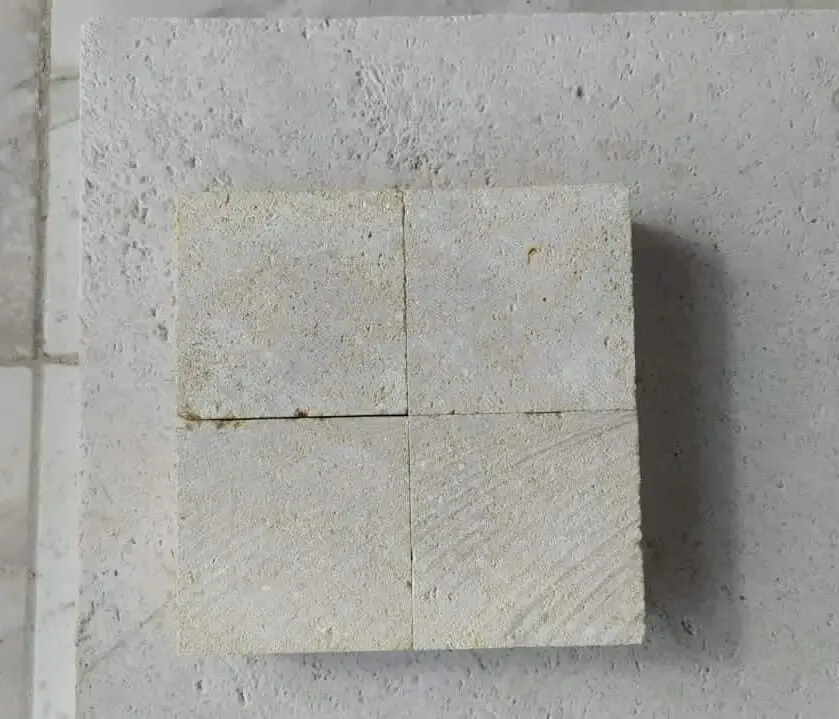
For projects using our pale limestone edging, the sawn and honed formats in the standard rectangular sizes provide the most consistent batch-to-batch tone, which is important when you’re ordering in multiple truck deliveries across an extended installation schedule. Batch variation between warehouse pulls is always possible with natural stone — ordering all material in a single delivery minimizes that risk considerably.
White Limestone Edging and Gravel Compatibility
Gravel beds represent one of the most common adjacencies for white limestone edging, and the contrast logic here requires careful thought. A bright white edging stone against silver-grey pea gravel creates a sharp, contemporary border with strong definition. The same white edging against cream or buff limestone gravel nearly disappears — the tonal match is too close to read as a distinct border element.
The most successful pairings tend to follow one of two contrast strategies: high-contrast (dark gravel against white stone) or tonal harmony with texture difference (similarly toned gravel with a distinctly different particle size and finish). Mid-range contrasts — where the edging and gravel are in the same general value range but neither match nor strongly contrast — tend to read as indecisive.
Consider also how gravel migration interacts with your edging format. Tumbled white limestone edging with its softer edges allows gravel to migrate more freely across joints. Sawn edging with clean vertical faces contains gravel more effectively when set at grade height. For high-traffic gravel paths where containment matters, a sawn-face edging set 1–2 inches above the gravel plane works significantly better than a flush-set tumbled format.
Limestone Edging Versus Faux Stone Edging
The comparison between natural limestone edging and faux stone edging products comes up frequently on larger residential and commercial projects where budget pressure is real. Faux stone edging — typically formed from pigmented concrete or fiber-reinforced polymer — offers lower upfront cost and consistent dimensions, which appeals to contractors managing tight installation tolerances. Several performance factors, however, shift the long-term value equation considerably.
- Natural white limestone edging maintains structural integrity through repeated freeze-thaw cycles; faux concrete alternatives absorb more moisture and can develop surface delamination after 5–8 years of freeze-thaw exposure
- Limestone’s compressive strength typically ranges from 8,000 to 14,000 PSI depending on variety — most faux stone edging products spec at 5,000–6,000 PSI
- Tonal consistency holds better in natural limestone over decades; pigmented concrete fades and shifts under UV, requiring resealing or replacement on a 5–7 year cycle
- White edging stone in natural limestone carries significantly higher resale value perception in finished residential landscapes
- Faux products offer easier cutting and shaping on irregular plan layouts — an honest practical advantage on complex curved borders
The decision to use natural versus faux ultimately turns on project lifespan expectations and maintenance commitment. For permanent residential installations where the landscape is meant to mature over 20+ years, natural limestone edging is the technically correct choice. For phased commercial landscape installations where materials will be revised in 10-year cycles, the lower upfront cost of faux stone edging may be economically rational.
Ordering Logistics and Warehouse Availability
Practical project planning for white limestone edging requires you to think about warehouse stock levels before finalizing your timeline. Natural stone availability fluctuates with quarry output and seasonal shipping cycles, and edging pieces in specific tonal grades — particularly the paler, low-iron white varieties — can be limited in volume compared to standard grey limestone. Confirm warehouse availability for your full quantity early; splitting an edging order across two separate stock pulls creates tonal variation risk that’s difficult to manage in the field.
Citadel Stone maintains national warehouse inventory that typically reduces lead times to 1–2 weeks compared to the 6–8 week import cycle for direct-order stone. For large projects requiring multiple pallet deliveries, confirm truck access at your site during the ordering stage — edging pallets typically weigh 2,500–3,500 lbs each, and restricted access points can complicate unloading logistics significantly. At Citadel Stone, we recommend confirming your full linear-footage requirement plus a 10–15% overage allowance before placing the order, so all material ships from the same warehouse batch and tonal consistency is maintained across the installation.
Lead time verification also matters when freeze-thaw season is approaching. Installing white limestone edging on ground that has already begun to freeze introduces base instability that undermines long-term joint performance. Ideally, edging installation completes at least four to six weeks before the first hard frost, giving the base time to settle and any joint sand or bedding mortar to fully cure before thermal cycling begins. ASLA landscape edging guidance reinforces the importance of substrate preparation in ensuring permeable and structurally stable natural stone edging and border installations that hold their position through seasonal movement.
Getting White Limestone Edging Specifications Right
Getting white limestone edging right comes down to three decisions made in sequence: tone selection relative to your adjacencies, finish format relative to your design intent, and material specification relative to your thermal environment. Rush any of those decisions and you’ll spend the next decade managing a border that doesn’t quite work visually or structurally. Take time with all three and you have a border element that defines the landscape for 25 years without intervention beyond periodic resealing.
The format and tone comparison covered here gives you the evaluation framework — but your specific site conditions, gravel palette, and hardscape adjacencies will ultimately drive the final call. For projects where the edging extends into driveway borders and heavier-use zones, additional specification considerations apply. Reviewing limestone driveway edging guidance will help you understand how material spec requirements shift when edging transitions from decorative garden borders into trafficked driveway applications. The ASTM compressive strength and freeze-thaw durability standards referenced by ASTM stone testing standards also provide a useful cross-check when evaluating material data sheets from any supplier before committing to a specification. Selected from premium quarries in Turkey and the broader Middle East region, white limestone edging pairs well with light gravel beds.
Related reading: limestone landscape blocks for borders · limestone planter care guide · limestone stepping stones guide.