Water is the Antiguan garden’s soundtrack — and its most transformative luxury per liter. A wall spout, a rill threading a terrace, a still reflecting panel doubling the sky: none demands a pool’s budget, and all run on the same stone disciplines this cluster has assembled. This is the ornamental-water repertoire, stone-first.
The repertoire, sized honestly
Four features cover the island’s wish list:
- The wall spout — clad wall, basalt or limestone surround, small basin. The entry point: courtyard-scaled, plumbing-light, sound-forward
- The freestanding fountain, which raises presence and maintenance together
- The rill — a narrow stone channel running water across a terrace, borrowing the dished-channel cutting for poetry instead of drainage
- The reflecting pool, the most demanding and the most photographed
Stone at the waterline
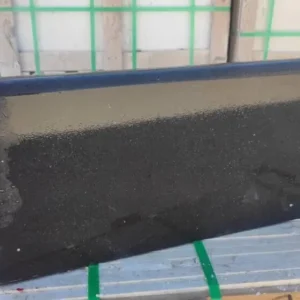
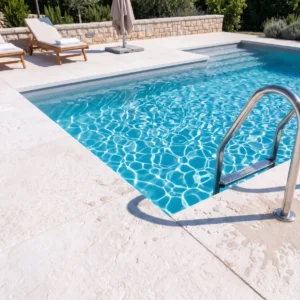
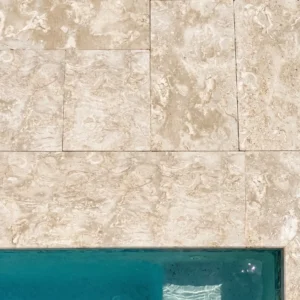
Every feature is a miniature pool edge, and the coping disciplines scale down intact: profiled rims with drips where water should release, dense low-absorption stone everywhere the wet zone reaches, textured surrounds where feet approach, and flexible sealant at every stone-to-shell junction. Dark interiors (basalt linings, dark renders) deepen reflections and disguise the inevitable mineral film; pale rims frame them — the two-tone palette finding its most photogenic assignment.
Sound design: the feature you hear first
Water features are audio architecture: a spout’s height and the basin’s depth tune the note (taller and shallower reads lively; shorter into deeper reads murmuring), rills whisper in proportion to their fall, and reflecting pools’ silence is itself the point. Site the sound where it works — masking street noise at the entrance, underscoring conversation at the dining terrace rather than competing with it — and let the stone’s mass carry the resonance render never quite matches.
Installation method matters as much as the stone itself. Industry guidance separates mortar-set work, sand-set exterior paving and pedestal systems, and stresses that drainage, movement and substrate condition drive long-term performance more than the material name does — the detailing guidance is worth reading before you specify.
The machinery, hidden honestly
Behind every serene surface sits a pump, a filter and a top-up, and the stone package hides them gracefully:
- An access panel cut as a recessed stone tray
- The reservoir under a removable grating course
- Conduit sleeved during the build
Two Antiguan specifics: size the reservoir for evaporation in the dry months, and connect top-up thinking to the property’s cistern logic rather than the mains.
Living with ornamental water
Maintenance is honest but light:
- The pump’s strainer cleared with the weekly sweep
- Mineral film on wet-line stone wiped with the neutral-cleaner routine, since dark linings forgive most of it
- Leaves out before they steep
- The whole feature drained and scrubbed at the annual service
Salt-air properties rinse the surrounds like any first-line stone, and no other stone element on the property earns comment from so little upkeep.
One caution is worth repeating, because it is the most common way a good floor gets ruined. Limestone is calcium carbonate, so mild acids attack it; the Natural Stone Institute is blunt that these stones are vulnerable to alteration by mild acids. That single fact rules out most supermarket descalers, rust removers and generic patio cleaners.
Commissioning the water moment
Order as a specials suite: surround stones, rim copings, channel units, tray covers — drawn once, cut with the main package, assembled by any competent mason-and-plumber pairing. Start with the wall spout if unsure; properties rarely stop at one feature, and the palette discipline means every later addition already matches. Water completes a stone garden the way the garden completed the house — and it ships in the same crate.
Wildlife, mosquitoes and the moving-water rule
Tropical water features carry one non-negotiable: water moves or water breeds. That means:
- Pumps sized for full turnover
- No stagnant corners in rill or basin design
- The reflecting pool’s stillness engineered as slow circulation rather than true standing water
The stone contributes smooth internal faces without mosquito-harboring texture, and tray access that makes the strainer routine effortless.
Features that grow with the garden
Water rewards phasing like everything else in stone: the wall spout this year, its basin extended to a rill when the terrace renews, the reflecting panel joining when the lower terrace builds. One palette and one supplier thread keep each addition native; sleeves and stub connections laid early keep each affordable. Gardens are verbs — the water plan should conjugate.
Water and the sound of the trade wind
An Antiguan garden is rarely silent, and that changes what a water feature has to do. On an exposed terrace the wind carries a quiet spout away entirely, while in a sheltered courtyard the same spout can dominate a conversation. Match the sound to the position: a broad, low sheet of water reads as texture behind talk, while a narrow fall from height reads as a voice competing with one. Wind also moves the water itself, so a tall thin jet on an open site will spend half its life wetting the paving beside it rather than the basin below. Where the site is genuinely exposed, keep the feature low, wide and close-coupled, and let the stone do the drama.
Scaling the feature to the space
The most common regret is not a leak but a mismatch of scale, and it runs in both directions. Four checks settle it before anything is built:
- Sit where you will actually sit, and hold a hand at the proposed water height — features are almost always drawn taller than they should be
- Measure the basin against the floor it interrupts: a bowl that reads generous on a drawing can swallow a small court
- Consider the dry state, since the feature will be off for maintenance and should still look deliberate empty
- Check the sightline from indoors, because most water features are looked at through a door far more than they are stood beside
A modest feature detailed properly beats an ambitious one squeezed in, every time.
What hard water does to pale stone
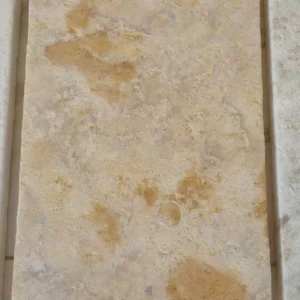
The detail nobody mentions at design stage is what the water leaves behind. Top-up water on Antiguan properties frequently carries dissolved minerals, and every evaporation cycle deposits them at the waterline. On dark basalt this reads as patina; on pale limestone it reads as a tidemark, and it needs a wipe rather than a scrub if it is caught early. Two decisions make it manageable: keep the wet-line stone in a slightly more forgiving tone or texture than the surrounding field, and set the water level so the line sits where a cloth can reach it. Owners who plan for the tidemark barely notice it; owners who did not, notice nothing else.
The details that make a water feature work
Every garden in this cluster ends better with water in it: the spout’s murmur over the courtyard, the rill stitching a terrace, the mirror doubling the stars. Stone gives the water its architecture; the island gives it the light. Start with one feature, cut with the main order — and let the garden’s soundtrack begin.