Virgin Gorda’s southwest is geology as celebrity: the giant sea-smoothed boulders of The Baths and their coastline — house-sized forms stacked by deep time into grottoes and sculpted beaches — draw the world by catamaran and give the island’s estates a setting no other address in this cluster can claim. Building among the boulders is a privilege wrapped in responsibility: the stones are the value, and everything constructed must know it. Here is the sculpted coast’s guide.
The boulders’ law: they lead
Design on this coast begins from deference: the boulder field is the masterplan, structures thread between and behind the giants rather than displacing them, terraces frame individual stones as the sculptures they are, and the cardinal sin — construction that crowds, caps or competes with the forms — is written into the island’s taste as firmly as any code. The working method maps every significant boulder at survey, designs sightlines to and around them, and treats the gaps — the natural courts and passages the field creates — as the buildable rooms they literally are.
Composing with giants
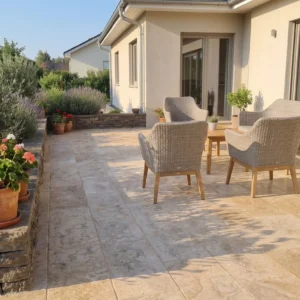
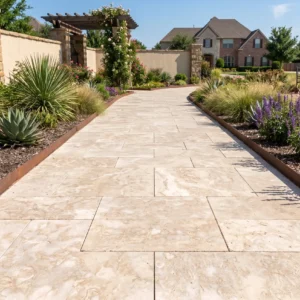
The boulder estate’s stonework plays supporting cast to lead actors: pale calibrated terraces laid as calm planes beneath the giants’ sculptural mass, the found-sculpture principles at monumental scale, junctions where built stone meets boulder handled honestly — clean margins, shadow gaps, never mortared adhesion pretending the two are one — and tonal restraint that lets the weathered forms keep their color authority. Water compounds the theater: plunge pools set among the stones on the sanctuary rules, reflecting the giants at dusk; the coast’s natural grottoes teaching every artificial echo humility.
- Let the existing boulders set the geometry and place paving in the spaces between them.
- Avoid cutting stone tight against a boulder face, since the gap is where movement and water both go.
- Use a paving tone that sits below the granite in contrast rather than competing with it.
- Keep planting low around outcrops so the rock silhouette stays legible from the house.
Grotto light and the sculpted paths
The Baths’ famous experience — squeezing through boulder passages between pools of filtered light — sets the coast’s circulation aesthetic: paths that wind rather than cut, steps fitted into natural gaps on the water-stair craft, handholds and railings mounted with jeweler’s discretion where safety asks, and lighting on the graze-and-dark rules — the giants lit low and warm, passages marked not flooded, the night coast kept theatrical. Hard surfaces stay textured throughout: sculpted coasts run wet with spray and pool splash, and barefoot traffic is the local unit of measure.
Between crowds and privacy
The coast’s celebrity brings its logistics: day-charter fleets and cruise excursions delivering crowds to the public treasures, national-park boundaries and access traditions threading the estates, and private builds designing the polite-boundary craft at landmark intensity — screening by landform and planting rather than fencing, arrival sequences that keep estate life serene above the visiting tide, and the neighborly grace of properties that share a wonder without claiming it. The reward runs both ways: the crowds validate the address daily, and the estates above the boulders hold some of the Caribbean’s most coveted ground.
North Sound estates and the resort renaissance
Beyond the boulder coast, Virgin Gorda’s North Sound runs its own register — the rebuilt resort constellation, superyacht moorings, estates ringing the protected water — and the berth-standard rules apply at Sound scale: finish tolerances for yacht-eye audiences, dock-to-villa arrival sequences, and the post-2017 engineering the rebuild standard made universal. The island’s two registers — sculpted southwest, harbored north — share supply lines and standards; the island-leg system serves both through Spanish Town’s compact logistics.
- Set terrace levels from the rock, not from the building, where an outcrop dominates a view.
- Keep hard edges away from the natural drainage lines that run between boulders.
- Choose formats large enough to hold their own beside a boulder several meters across.
- Reserve fine detail for the areas people actually touch and leave the wider field simple.
The privilege, honored
Boulder-coast projects succeed as custodianship: surveys that map the giants, designs that defer to them, construction that touches the field lightly, and finished estates where deep time remains the headline act. The territory supply guide serves the coast with its particular kit — calm-plane calibrated stone, honest-junction detailing, sanctuary-scale water packages — because the commission here is the cluster’s clearest: the site was finished millions of years ago; build worthy of it.
Touching nothing: how the boulder paths are actually built
The construction method behind Virgin Gorda’s boulder-country paths deserves its own chapter, because everything graceful about them comes from a discipline of non-contact. The granite giants are never drilled, pinned or trimmed — the value of the site is their untouched composition — so walkways thread between and over them on independent structure: stone slabs bedded on screed where the ground allows, elevated treads on discreet posts where it does not, and every junction with the rock itself made dry — scribed close, never fixed, with movement gaps that let stone and structure live their separate lives. The craft looks effortless precisely because nothing is forced: the path defers, jogs and steps because the boulders were there first and always will be.
The practical file behind the poetry: surveys map each boulder’s drip lines and shade zones because both change the walking surface’s grip life; treads in the sculpted passages are sized generous and textured honest, since grotto light flatters photographs and hides wet patches equally; handholds, where the route genuinely needs them, mount to the built structure and never to the rock; and drainage is planned around the boulders’ own shedding patterns — the giants concentrate rainwater into runnels a path must receive rather than dam. Lighting follows the non-contact rule too: low fixtures in the built elements wash the stone giants gently, and nothing is ever fastened to a surface ten thousand years in the making.
Owners briefing designers can compress all of it into one instruction: build beside, never into. The properties that honor it hold the privilege the boulders confer — and pass their surveys, since the same non-contact discipline is what conservation-minded consents increasingly require. The giants stay untouched; the path does the adapting; and the result reads as if the landscape itself laid the stones, which is the entire art.
What the granite at The Baths is telling you
The boulder landscape of Virgin Gorda is not decoration, it is the local geology in plain sight. The National Parks Trust description of The Baths records boulders as large as 40 feet in diameter within a park of just 6.91 acres, established in 1990. The formation story matters to designers: molten rock cooled slowly underground into hard crystalline granite, that layer cracked into blocks, softer volcanic material above eroded away, and weathering rounded the corners over a very long time.
- The rounded form is a weathering signature, so sharp-cut hard landscaping always reads as foreign beside it.
- Granite here is dense and slow to change, which sets a very high bar for anything placed against it.
- Scale is the dominant characteristic, and small-format paving beside a large boulder looks like a mistake.
- The boulders sit in sand and shallow pools, which is a useful cue for how ground planes should meet them.
- Protected status nearby means the visual language is familiar to everyone, and departures get noticed.
Choosing a material that answers granite without imitating it
Matching granite with granite rarely works, because a quarried, sawn face beside a naturally weathered boulder simply looks manufactured. The more reliable move is contrast in a lower register. Reference material from the Natural Stone Institute on limestone is useful here: limestone absorption ranges widely from below one percent to above ten, dolomitic varieties are denser with lower absorption and higher abrasion resistance, and all limestones are vulnerable to acids. Those properties decide which pale stone can sit outdoors beside a boulder for decades.
- Choose a dolomitic or low-absorption limestone where the paving is exposed to spray and standing water.
- Keep acidic cleaners entirely off the site specification, since one wash can etch a whole terrace.
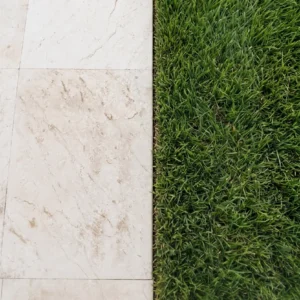
- Use a textured rather than honed surface so the paving reads as ground rather than as furniture.
- Let the paving be quieter in tone than the granite, so the boulders remain the darker, heavier element.
Working around rock that will not move
Construction beside outcrops is a sequencing problem before it is a design one. Boulders cannot be shifted, machinery cannot always get past them, and the ground between them is often shallow soil over rock. That combination rewards a layout drawn from a proper survey and punished layouts drawn from a photograph.
- Survey the outcrops in three dimensions, because the buried profile is rarely what the exposed face suggests.
- Plan machine access before the first delivery, since a boulder field can make a short haul impossible.
- Expect shallow build-ups between rocks and design falls that work with thin construction depths.
- Leave a soft joint where paving meets rock so seasonal movement has somewhere to go.
Boulder coast building that reads as if it grew there
The best work on this coast is barely visible as work. It sets levels off the rock rather than off a drawing, keeps the paving quieter than the granite, uses formats generous enough to hold the scale, and leaves the drainage lines where the landscape already put them. Our British Virgin Islands stone guide sets out the formats, finishes and lead times that suit this territory. On Virgin Gorda the boulders were always going to be the architecture, and the job is to build something worthy of standing next to them.