Off the big island’s east coast lie its two deliberate exceptions: Vieques and Culebra, the island municipalities that chose calm — no high-rises, no cruise piers, beaches the hemisphere ranks and crowds that never quite arrive. Their building culture is retreat craft: small, durable, ecology-first, barge-supplied — the small-island canon this library wrote across the Grenadines applied under a US flag. Here is the offshore guide.
The deliberate register
Both islands hold their character by choice and rule: low-rise limits, protected land at extraordinary proportion — Vieques’s former navy lands now the Caribbean’s largest wildlife refuge, Culebra’s marine reserves ringing Flamenco — and communities with the island-life instincts to defend both. Building joins on the terms-of-the-place principle: modest scale, local hiring, and projects that read as belonging — the guesthouse behind the trees, the villa that found its clearing, never the statement that announces over the ridge.
The barge economy
Everything arrives from Ceiba: the barge schedule is the islands’ supply constitution, and the domestic lane’s last leg runs on the small-island disciplines — consolidated consignments over trickled orders, crates sized for modest handling, spares landed with the first shipment, and programs that respect the crossing’s rhythm. Stone rides the leg ideally — dense, patient, weather-indifferent on the staging ground — and the one-consignment habit saves every project its second-barge regrets.
- Pallet weights matched to the ferry or barge, not to the mainland truck
- Loads split so a missed sailing never halts the whole install
- Hand-portable formats where the last hundred meters have no plant
- Consumables and fixings shipped with the stone, never ordered later
Bio-bay manners
Vieques holds the world’s brightest bioluminescent bay, and Mosquito Bay’s glow writes the strictest lighting code in this library: darkness as civic infrastructure, the dark-sky discipline at biological stakes, shore-side properties holding their light low, warm and shielded because the bay’s dinoflagellates — and the economy they anchor — depend on night staying night. The manners extend island-wide: turtle beaches on nesting rules, refuge boundaries on covenant respect, and the habitat-margin craft at every lagoon edge.
Retreat premises
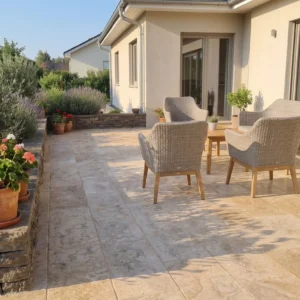
The islands’ hospitality runs small and beloved: Esperanza’s malecón bars, guesthouses on the family-operation model, villas managed for owners abroad on the absent-owner playbook, and the occasional refined retreat proving small can be world-class. Premises craft follows the register: courtyards and terraces at intimate scale, working stone under kitchens that feed a season from a barge-fed larder, hurricane honesty in every fixing — María schooled these islands hard — and the freight-justified restraint in every material decision.
- A restrained palette, since one material reads better than four at this scale
- Surfaces that a small local crew can maintain without specialist equipment
- Details that tolerate long unoccupied periods between visits
- Spare units stored on the island from day one
Flamenco’s lesson
Culebra’s crown beach carries the shared-treasure disciplines at hemisphere-ranking stakes: public access as constitution, facilities built honest and maintained visibly, the famous-beach duty of infrastructure that serves thousands without privatizing a meter — and the tank rusting photogenically at the sand’s edge as accidental sculpture and permanent reminder that these islands’ calm was defended, not given. The beach’s keeping is the island’s brand; its modest stone — paths, platforms, rinse points — is tourism infrastructure at its most honest.
Specifying the exceptions
The offshore kit is the small-island canon under domestic paperwork: barge-planned consignments, dense durable material, dark-sky fixtures, habitat manners and hurricane fixings — from the island supply page with the quiet registers respected throughout. The big island runs at big-island speed; its two exceptions chose otherwise, and building there well means choosing with them — once, in stone, deliberately.
The horses of Vieques
The first thing every visitor photographs on Vieques is not a beach: it is a horse, standing in the road, entirely unbothered. The island’s free-roaming herds — descendants of stock kept for generations, now wandering the roads, the beaches and anyone’s garden — are the place’s living signature and a genuine design constraint. Fences here are not decoration; they are the difference between a garden and a grazed lawn, and the grazing-country logic this library wrote for another island applies almost word for word, with the adjustment that a horse is taller, heavier and considerably more determined than a goat.
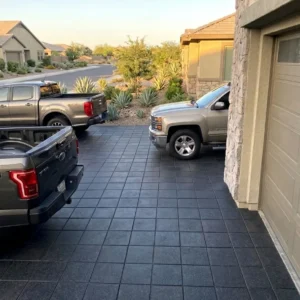
The practical craft is honest boundaries built once: masonry walls or well-founded fencing at real height, gates that latch rather than lean, and cattle-grid or gate discipline at every vehicle entrance because an open gate is an invitation the herd accepts within the hour. Planting divides the same way — the palette outside the wall chosen from what the horses have already declined, the productive and precious kept behind it — and the vehicle question sits alongside: island driving here is slow by necessity, and driveways and parking courts benefit from generous turning space so a car meeting a horse at the gate has somewhere to be patient.
The manners are cultural as much as practical. The herds are part of why the island feels the way it does, residents are protective of them, and the newcomer who complains loudly about horses has misunderstood the purchase. Build the wall, plant accordingly, drive slowly, and the animals become what they are for everyone who stays: the reason the island’s roads feel like a different century, standing in the headlights at dusk, in no particular hurry to move.
The ferry and the flight: getting materials and guests to the islands
Both islands run on connections that visitors learn to hold loosely: the passenger ferries from Ceiba, whose service history has taught residents patience and whose improvements are followed like a local sport, and the short hops from the mainland’s regional airports that arrive on small aircraft with smaller baggage allowances. Property owners plan around both. Guest logistics shape the house itself – arrival hours that skew late when a ferry slips, so the entry sequence and lighting matter more than on the big island; luggage-friendly thresholds, because everything crossed water to get here; and the guest-briefing culture that tells visitors honestly how the crossing works before they book. Materials follow the cargo barge on its own schedule, which is why the one-consignment discipline governs and why the household spares cupboard – tiles, copings, fixings, paint – is standard equipment rather than caution. The islands reward the organized and gently punish the improvizer; a well-planned property simply stops noticing the crossing, which is exactly what its owners came for.
The refuge is the neighbor
These are not ordinary small islands. The Culebra National Wildlife Refuge was established in 1909 by Theodore Roosevelt as the first federal wildlife reserve in the Caribbean set aside for native birds, and it now covers about 1,510 acres across the main island and twenty-one surrounding cays. Building near that is a matter of restraint rather than paperwork alone: light, runoff, noise and dust all travel further here than they would on a larger island, and the tolerance for them is lower.
- Runoff captured on site rather than allowed to reach the shore
- Cutting and washing stations sited away from the water line
- External lighting kept low, warm and directed downward
- Works timed to avoid the most sensitive nesting periods
How much of Vieques is simply not available
Scale is deceptive on the larger of the two. The Vieques National Wildlife Refuge covers roughly 17,771 acres, split between about 3,100 acres in the west and 14,671 in the east, transferred from Navy administration by Congress in 2001 and 2003, with parts still closed while unexploded ordnance is cleared. It is the largest refuge by land area in the Caribbean and supports sixteen federally listed species. The practical effect for a builder is that the usable land sits in a narrow band, and everything in that band is closely watched.
- Confirm land status before design, not after a concept is agreed
- Assume neighbors and agencies will see the works from a distance
- Keep laydown areas tight and reinstate them fully
- Plan access routes that do not cut across sensitive ground
Choosing island retreat stone when nothing arrives by road
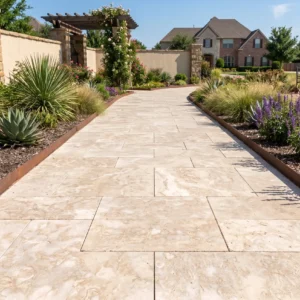
Offshore logistics reward a short specification. One stone, one finish, one joint, cut to list on the mainland, palletized for a ferry and labeled for the room it belongs to. Every decision that removes a site operation removes a risk, because there is no builders merchant a short drive away and no second attempt in the same week.
- Cut to list so no saw needs to run on the island
- Order a documented surplus, since a part load is expensive to chase
- Choose finishes that hide the small marks of hand-carried handling
- Write the maintenance method for whoever is actually on the island
Our Puerto Rico stone supply guide sets out the formats, finishes and lead times that suit this island. On an island this small the delivery plan is the design.