Why Tile Count Starts With More Than Math
Getting your travertine tiles count wrong at the ordering stage is one of the costliest mistakes a pool area project can make — not because the math is complicated, but because most estimates skip the variables that actually drive waste. The basic formula is straightforward: divide your total square footage by the tile size, then add a waste factor. But the waste factor is where most projects unravel, and it shifts significantly depending on your layout pattern, pool shape, and edge treatment decisions.
Understanding how each variable compounds against the others is what separates a tight, well-managed order from a frantic reorder mid-installation. A reorder mid-project rarely matches your original batch perfectly — travertine’s natural color variation means warehouse pulls from a different lot can shift the palette noticeably. You’ll want your full quantity confirmed before a single tile is set.
Calculating Your Base Square Footage
Your pool area isn’t a single rectangle — break it into zones and calculate each one separately. The main deck, the step landings, the coping run, and any integrated spa surround each have distinct dimensions and cut demands. Measure each zone’s length and width in feet, multiply to get square footage, then sum all zones for your gross area.
Here’s a practical benchmark: a standard residential pool deck typically runs 600–900 square feet depending on setback depth. Add a 4-foot perimeter deck on a 16×32-foot pool and you’re looking at roughly 640 square feet before you account for coping. Coping is usually priced and ordered separately by linear foot, but if you’re using travertine pavers 24×24 as field tile and matching coping pieces, integrate that footage into your total early.
- Measure each zone independently — don’t estimate from a rough perimeter sketch
- Account for raised bond beams, step risers, and spa surrounds in the total
- Subtract permanent fixtures (built-in planters, equipment pads) from gross area
- Convert all measurements to decimal feet before multiplying — avoid rounding at this stage
Tile Size, Coverage, and Format Selection
The format you select changes your coverage yield per tile and your cut waste profile dramatically. A 12×12-inch travertine tile covers 1 square foot, so 640 square feet requires 640 tiles before waste. A 16×16 covers 1.78 square feet per tile, and 24×24 covers 4 square feet per tile — meaning fewer pieces, fewer joints, and a cleaner visual field, but more material lost per cut at pool edges and curves.
Travertine tiling in a 24×24 format is popular for contemporary pool decks precisely because of that expansive, uninterrupted aesthetic. According to Natural Stone Institute travertine properties and outdoor suitability, travertine’s open-pore structure and thermal mass characteristics make larger formats particularly effective around water features — the material absorbs and redistributes heat more evenly across wider surface areas, reducing hot spots on barefoot surfaces. That’s a real performance advantage with 24×24 tiles, not just an aesthetic one.
- 12×12 tiles: high cut frequency, manageable waste at ~10–12% for straight layouts
- 16×16 tiles: balanced format, waste typically 12–15% with curve cuts
- 24×24 tiles: fewer cuts overall but each cut wastes more material — budget 15–18% for irregular pool shapes
- Mixed formats (border + field): calculate each format’s area independently before summing
Waste Factors That Change Your Travertine Tiles Order Quantity
The standard 10% waste allowance is a starting point for a simple rectangular room. Pool areas routinely exceed it. Here’s how to think through your actual waste factor before finalizing an order.
Layout pattern is the first multiplier. A straight grid on a rectangular deck runs close to 10% waste. A diagonal (45-degree) pattern on the same deck can push waste to 18–22% because every perimeter cut creates a right triangle offcut that can’t be reused. A running bond pattern falls in between at roughly 12–15%. Your tile travertine layout choice is a budget decision as much as a design one.
- Straight grid layout: 10–12% waste allowance
- Running bond / offset: 12–15% waste allowance
- Diagonal / 45-degree pattern: 18–22% waste allowance
- Curved pool edges: add a further 3–5% on top of the base pattern waste
- Irregular lot shapes with multiple angles: consider 20–25% to be safe
Thickness also affects how cuts behave. A 1¼-inch travertine tile snaps cleanly on a wet saw; a 2-inch nominal paver takes more passes and produces more fractured offcuts. For pool decks spec’d at 2-inch thickness for structural reasons, increase your waste allowance by an additional 2–3%.
The Complete Tile Quantity Formula
Put all the variables together into a single calculation sequence. Start with your net square footage, apply your waste multiplier, then divide by the coverage area of one tile in the format you’ve selected.
For a worked example: a 750-square-foot pool deck with a diagonal travertine tiling pattern in 24×24 format. Net area = 750 sq ft. Waste factor for diagonal = 20%, so multiply by 1.20 = 900 sq ft required. Each 24×24 tile covers 4 sq ft, so 900 ÷ 4 = 225 tiles. Round up to the nearest full case quantity — if your tiles are sold in boxes of 4, that’s 57 boxes (228 tiles). Order from one warehouse pull to maintain color consistency across the full layout.
- Step 1: Calculate net square footage by zone and sum
- Step 2: Select your waste multiplier based on pattern and edge complexity
- Step 3: Multiply net area by (1 + waste fraction) to get required coverage area
- Step 4: Divide required coverage area by individual tile square footage
- Step 5: Round up to the nearest full case quantity
- Step 6: Confirm total with your supplier before placing the order
How Design Style Affects Your Tile Selection and Quantity
Your landscape design approach should influence format and finish selection before the quantity calculation even begins — because those choices feed directly into your waste factor. A modern minimalist pool surround with clean sightlines favors large-format travertine tiles in a straight grid, which minimizes grout lines and simplifies the quantity math. A Mediterranean or Tuscan-influenced design often incorporates a contrasting border tile and a field tile with a tumbled finish, meaning two separate tile orders with two separate waste calculations.
Tropical planting schemes tend to pair with warmer ivory and walnut travertine tones in a randomized or versailles pattern — and the versailles pattern (four-piece modular layout combining 16×16, 16×8, 8×8, and 8×16 pieces) is one of the most calculation-intensive formats you’ll encounter. Each piece size requires its own coverage ratio and waste factor, and the pattern repeat must be planned around your pool’s exact dimensions to avoid awkward partial pieces at the perimeter. For complementary guidance on choosing between travertine formats for pool environments, browse our travertine tiles selection to see the available sizes and finishes before finalizing your layout plan.
- Modern minimalist: large-format straight grid — simplest quantity math, lowest waste
- Mediterranean / Tuscan: border + field split — calculate each separately
- Tropical / resort style: versailles pattern — most complex, requires pattern-specific waste factors
- Transitional / traditional: running bond in a neutral ivory — moderate complexity, predictable waste
Coping and Step Tile Quantities
Coping tiles and step tiles consume travertine at a different rate than field tiles and must be calculated independently. Pool coping typically uses a bullnose or double-bullnose edge piece, available in widths of 12 or 16 inches and lengths matching your field tile format. Measure your pool’s full perimeter in linear feet — for a standard 16×32-foot pool, that’s 96 linear feet of coping. If your coping piece is 16 inches wide and 24 inches long, you’ll need one piece per 2 linear feet, so 48 pieces plus a 10% waste factor = 53 pieces minimum.
Step risers and treads present a separate calculation. Each tread should be measured individually — a 48-inch-wide step tread in 24×24 format requires two tiles per tread, but the cut line for a radius step creates a curved front edge that wastes nearly half of each tile. Factor at least 25–30% waste for curved step nosings specifically, because ASTM C1527 travertine dimension stone specifications set minimum thickness requirements for step treads that limit how thinly you can recut offcuts for use as riser infill.
Ordering Logistics and Warehouse Lead Times
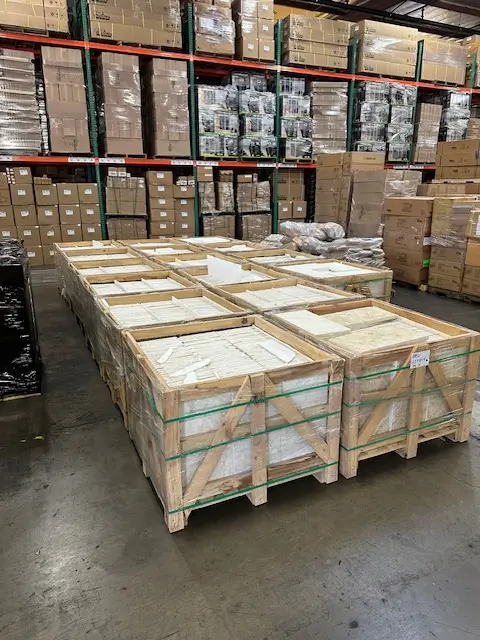
Your tile count must be finalized before you place the order — not after. Travertine is a natural material, and each quarry pull produces a unique color batch. Warehouse inventory at any given time reflects a mix of current and prior pulls. If you order 200 tiles today and come back for 30 more in six weeks, there’s a meaningful chance the new lot reads warmer, cooler, or more veined than your original batch. The difference may be subtle at the slab stage and obvious once grouted and sealed across a full pool deck.
At Citadel Stone, we pull from inventory by lot where possible and flag any cross-lot mixing risk before your order ships. Lead times from our warehouse typically run 5–10 business days for stocked formats, which gives your installation crew a reliable schedule. If you’re ordering travertine pavers 24×24 in volume — say, 300-plus pieces — confirm availability and lot consistency before scheduling your installation crew’s start date. A truck delivery for large pool deck orders usually arrives on pallets; verify your site has adequate access for a full-size delivery vehicle before confirming the ship date.
- Order your full quantity from a single lot to maintain color consistency
- Confirm warehouse stock levels before committing to an installation start date
- Allow 5–10 business days for standard stocked formats in most regions
- Large orders (300+ pieces) may require a dedicated truck delivery — confirm site access early
- Store delivered tiles flat and under cover until installation — travertine should acclimate to site conditions for 24–48 hours before setting
Slip Resistance, Finish Selection, and Quantity Adjustments
The finish you specify affects both safety performance and how the tile cuts during installation. A tumbled finish on travertine creates an irregular surface texture with natural micro-relief — it’s the preferred choice for wet pool decks because the texture provides grip even when saturated. A honed finish is smooth and flat, which reads beautifully in modern pool designs but requires a slip-resistant sealer to meet safe wet COF (coefficient of friction) thresholds. A brushed finish falls between the two.
Tumbled tiles have slightly irregular edges and thickness variation compared to precision-cut honed tiles. That irregularity means your wet saw operator will need to make small trim cuts more frequently to maintain consistent joint spacing — add 2–3% to your waste factor when specifying tumbled format specifically. Per PHTA ANSI pool deck stone and coping safety standards, wet pool decks should achieve a minimum static coefficient of friction of 0.60 — tumbled travertine consistently meets this threshold without additional treatment, while honed surfaces require a penetrating grip sealer applied before use.
- Tumbled finish: natural grip, slight edge variation — add 2–3% waste over your base factor
- Honed finish: precise cuts, consistent thickness — base waste factor applies, but budget for slip-resistant sealer
- Brushed finish: moderate texture, good consistency — base waste factor applies
- Filled vs. unfilled: filled travertine has voids grouted at the factory — specify filled for outdoor pool use to prevent standing water in the pores
Finalizing Your Travertine Tiles Specification
Accurate travertine tile quantity estimation is a sequential process — base area, pattern-adjusted waste, format coverage, and logistics confirmation each build on the last. Rushing through any stage creates the conditions for a costly mid-project reorder or a color mismatch that’s visible across the full pool deck. Take the time to measure each zone precisely, match your waste factor to your actual pattern and edge conditions, and confirm lot availability before your installation crew is scheduled.
As you finalize your travertine tiling specification, it’s worth understanding how the material stacks up against other pool deck options on a performance and installation basis. For a clear side-by-side look at the decision, comparing pavers and travertine for pool decks offers useful technical context for projects where the material choice is still open. Travertine tiles from Citadel Stone ship in filled and honed formats, selected for consistent color across full pool-area layouts.
Related reading: tile flooring travertine · modern pool tile ideas · outdoor travertine pool pavers.