The stone fabrication industry overview that most buyers encounter barely scratches the surface — it lists stone types and finishes without explaining why two slabs cut from the same quarry block can perform completely differently depending on how they move through the fabrication chain. Understanding where tolerances get set, where they get lost, and what happens between the quarry face and your project site is what separates specifications that hold up from ones that generate callbacks.
What Stone Fabrication Actually Involves
Stone fabrication is the industrial and craft process of transforming raw quarried blocks into finished architectural and hardscape elements. It covers everything from primary block cutting and gang-sawing through surface finishing, edge profiling, drilling, templating, and quality inspection. The stone fabrication industry is far broader than kitchen countertops — it encompasses paving slabs, cladding panels, pool coping, stair treads, custom carved elements, and monumental work.
What’s less commonly discussed is how the fabrication sequence itself affects material performance. Cutting direction relative to the stone’s natural bedding plane, the speed and pressure of diamond tooling, and the water cooling regimen during sawing all influence micro-fracture development in the slab. A slab cut across the grain in a dense limestone will behave differently under flexural load than one cut parallel to it — even at identical nominal thickness.
Your specification needs to account for this, particularly when sourcing from stone fabrication shops that serve both residential and commercial markets simultaneously. The tolerance standards applied to a residential countertop job and a commercial exterior cladding panel are not the same, and not every shop has the in-house calibration infrastructure to shift cleanly between them.
Quarry to Block: The Upstream Supply Chain
The stone fabrication industry workflow begins long before any blade touches stone. Quarry operators extract dimension stone in primary blocks — typically 6 to 10 cubic meters — which are then evaluated for color consistency, veining pattern, structural integrity, and absence of bedding plane separation. Blocks that pass visual and tap-test inspection move to secondary processing facilities, where gang saws or wire saws slice them into slabs or billets at specified thicknesses.
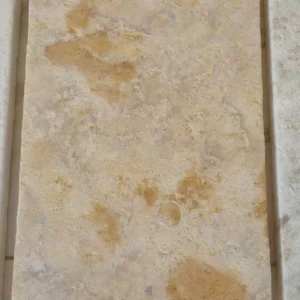
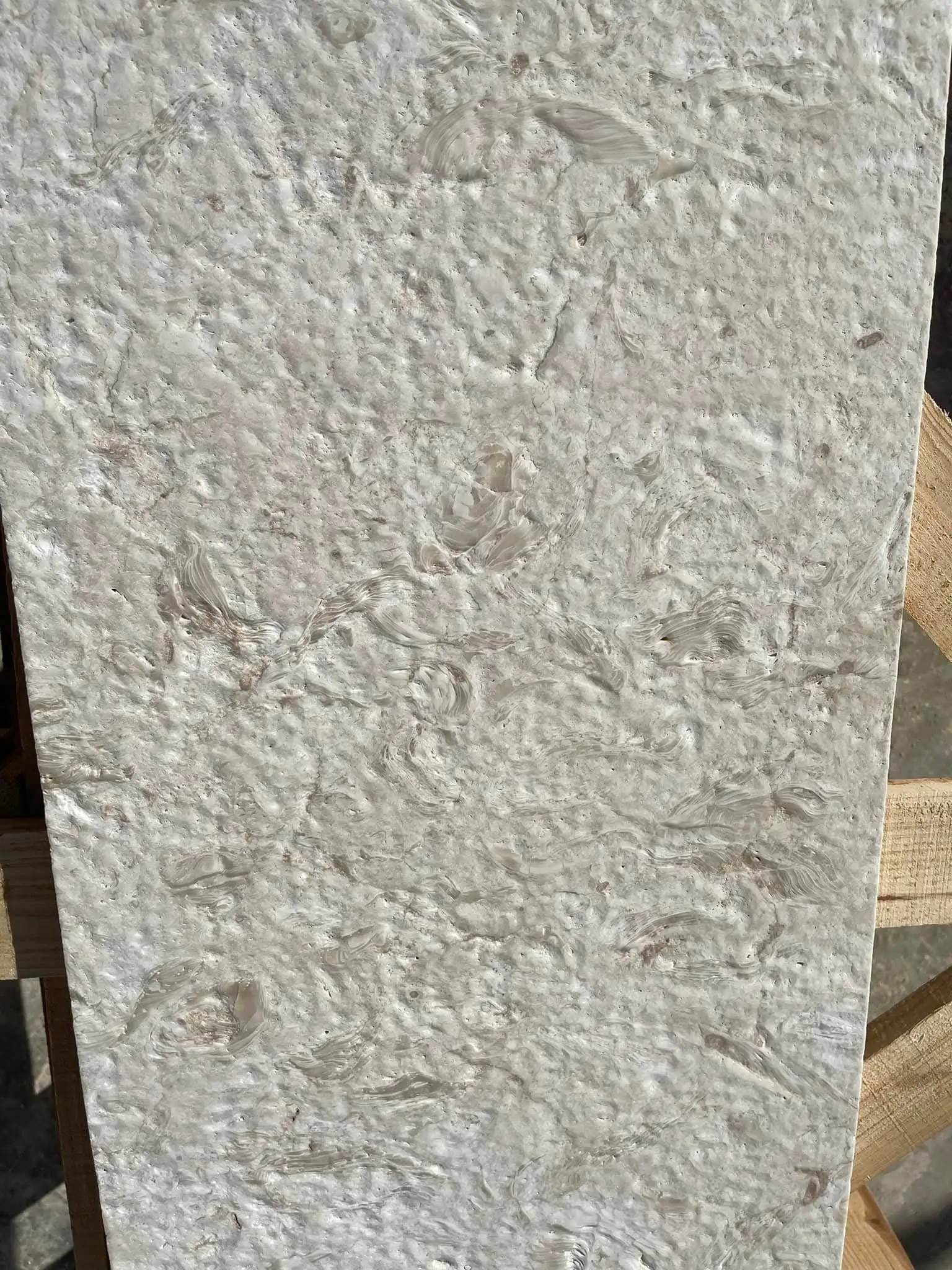
Here’s what most buyers don’t realize: the journey from quarry face to fabrication shop involves multiple handling transfers, each of which introduces risk. Blocks loaded onto flatbed trucks at the quarry face are vulnerable to vibration-induced micro-cracking over long hauls, particularly in stone with naturally occurring fissures like some travertine and shell limestone varieties. Receiving facilities should document block condition on arrival, but in practice this rarely happens with the rigor it deserves.
- Primary block extraction typically uses drill-and-blast or wire saw methods depending on stone type and deposit formation
- Block grading at the quarry determines which material qualifies for architectural specification grades versus fill or aggregate
- Transit from quarry to processing facility can span thousands of miles, with temperature and humidity exposure affecting some porous stone varieties
- Secondary processing facilities often operate under different quality management systems than the quarry, creating documentation gaps
- Slab thickness tolerances at this stage typically run ±2mm, which accumulates through the fabrication chain if not recalibrated
According to USGS dimension stone production data, the United States processes millions of tons of dimension stone annually through a distributed network of quarries, processing plants, and fabrication facilities — making supply chain transparency genuinely difficult to achieve without direct supplier relationships.
Inside Stone Fabrication Shops: What Separates Them
Not all stone fabrication shops are created equal, and the operational differences between them directly affect what arrives on your project site. The critical variables are tooling quality, calibration frequency, and the skill level of the hand-finishing team. CNC bridge saws and waterjet cutting systems have standardized much of the primary cutting work, but the finishing sequence — honing, polishing, bush-hammering, sandblasting, or flaming — still relies heavily on operator judgment and equipment maintenance discipline.
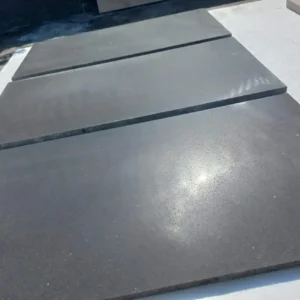
Fabrication of granite presents a useful benchmark for evaluating shop capability. Granite is an unforgiving material — its high quartz content accelerates blade wear, and any deviation in cutting pressure or coolant flow shows up immediately as a surface irregularity. Shops that consistently produce clean, flat granite work with tight dimensional tolerances are usually running well-maintained equipment with disciplined calibration cycles. Shops that tolerate waviness in granite slabs will produce worse results in softer, more variable stones.
- CNC processing centers should hold dimensional tolerances of ±0.5mm for precision architectural work
- Waterjet cutting is preferred for intricate profiling and interior radius work where blade kerf causes material loss
- Calibration equipment — planer or calibrating machine — ensures slab thickness uniformity critical for tile and paver installations
- Edge profiling options range from eased and beveled to ogee, bullnose, and custom carved profiles requiring hand work
- Quality inspection should include both dimensional checks and visual grading under consistent standardized lighting
Prospective fabricators should be asked for their calibration records and rejection rate data. A shop producing less than 2% rejection on finished pieces is operating at a high standard. Anything above 5% suggests either incoming material quality issues or process discipline problems — either way, the risk lands on your project.
Surface Finishes and Their Functional Implications
Surface finish selection in the stone fabrication industry is often treated as a purely aesthetic decision, but finish type has direct performance consequences that your specification must address. The roughness profile of a finished stone surface affects slip resistance, water shedding behavior, staining susceptibility, and long-term maintenance burden — all of which vary significantly between finish types.
Polished finishes achieve their reflective quality through a progressive sequence of diamond abrasive pads, typically running from 50 grit through 3000 grit or higher. The process closes surface pores and densifies the top layer of the stone, which reduces absorption but also reduces friction coefficient. For exterior paving applications, polished finishes consistently produce static coefficient of friction (SCOF) values below the 0.6 threshold that safety standards require for wet pedestrian surfaces — meaning polished finishes should be specified only in protected interior applications.
- Honed finish: matte surface with moderate pore exposure — balanced between aesthetics and slip resistance for interior floors
- Bush-hammered: mechanically textured surface that produces high COF values suitable for exterior pedestrian traffic and pool surrounds
- Sandblasted: uniform texture with moderate roughness — good for exterior wall cladding and accent paving
- Flamed: thermal spalling finish used primarily on granite — produces aggressive texture with excellent slip resistance
- Tumbled: edge-worn and surface-softened finish produced by barrel tumbling — appropriate for informal paving and accent applications
The Natural Stone Institute fabrication standards provide finish specifications and performance guidance that responsible fabricators reference when making finish recommendations. If your fabricator can’t articulate the performance implications of your finish choice beyond aesthetics, that’s a gap worth addressing before committing to a specification.
Ground Conditions and Subgrade Impacts on Stone Performance
Here’s where the stone fabrication industry overview intersects with something most fabricators don’t discuss but field performance absolutely requires: what the stone sits on. The most precisely fabricated slab will fail prematurely if the subgrade beneath it moves. And subgrade movement is far more common than the average spec document acknowledges.
Expansive clay soils present the most significant challenge for exterior stone paving. Clay-heavy subgrades swell when wet and contract when dry, generating vertical movement of 20 to 50mm in severe cases — easily enough to crack a 30mm granite or limestone paver, particularly at unsupported edges. Sandy subgrades offer better drainage but poor load distribution, leading to localized settlement under concentrated point loads. Rocky or caliche subgrades create the opposite problem: excellent stability but near-zero drainage, which traps moisture under the slab and accelerates freeze-thaw damage in cold-climate installations.
- Expansive clay subgrades require compacted granular base material of 150–300mm minimum depth before setting bed installation
- Sandy subgrades need geotextile separation layers to prevent aggregate migration over time
- Rocky subgrades require positive drainage engineering to prevent subsurface water accumulation
- Caliche formations in arid regions are stable but impermeable — drainage design is the critical variable
- Organic soils and filled ground are incompatible with rigid stone paving without deep compaction or structural slab intermediary
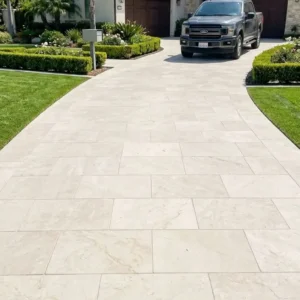
Fabricators who supply exterior stone for large-scale projects — particularly natural stone paving for commercial plazas and institutional walkways — should understand these subgrade realities. The stone fabrication industry workflow that ignores site conditions produces product specifications that look excellent on paper but generate avoidable field failures. When specifying stone thickness, always factor in the soil bearing capacity of the substrate, not just the traffic loads you’re designing for.
Stone Fabrication Industry Workflow: From Slab to Finished Piece
The production sequence in a well-organized fabrication facility follows a defined workflow that controls quality at each transfer point. Understanding this sequence helps you ask better questions and interpret delivery schedules more accurately. A complete fabrication of granite countertop or limestone cladding panel moves through templating, slab selection, cutting, edge profiling, finishing, quality inspection, and packaging — each stage with its own lead time and dependency chain.
Templating deserves particular attention because it’s where dimensional errors either get caught or get locked in. Digital templating using laser measurement tools has largely replaced physical cardboard templating in high-production shops, but the fundamental principle is the same: the template must capture every critical dimension, including sink cutouts, appliance clearances, and support corbel locations, before any cutting begins. Errors at the template stage multiply through every downstream operation.
- Slab selection should involve the customer or designer when color matching across multiple pieces is critical
- Primary cutting uses bridge saws or CNC centers depending on profile complexity
- Edge profiling follows primary cutting and is often the longest manual labor step in the sequence
- Surface finishing is performed before or after profiling depending on finish type and shop workflow
- Final inspection should include dimensional verification, surface quality check, and packaging integrity review
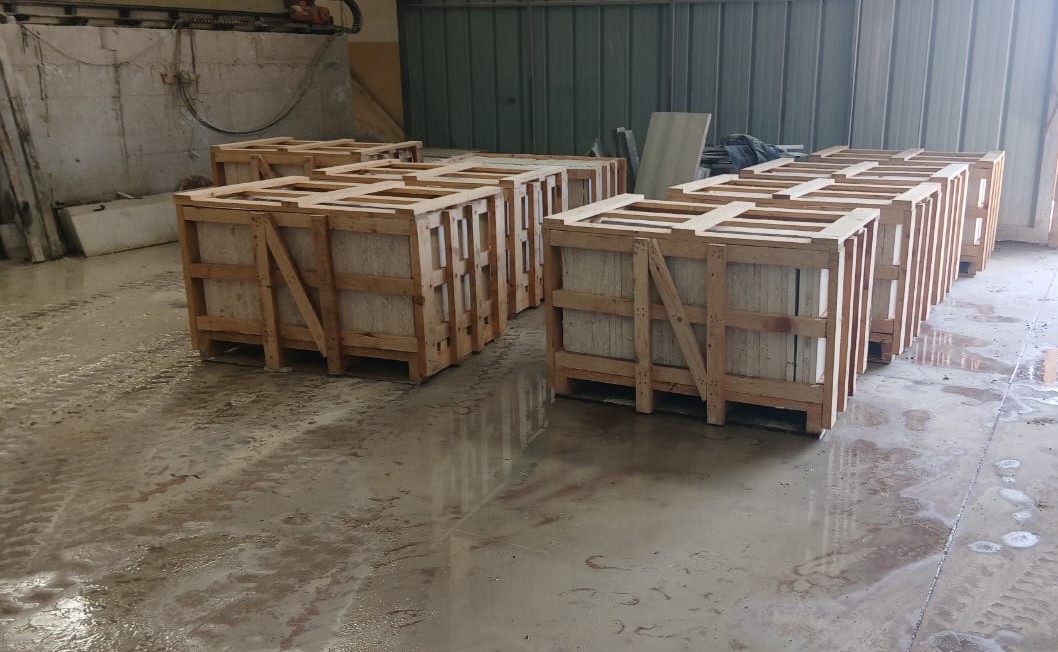
- Crating and protective packaging for truck delivery must prevent vibration damage during transport
Lead times from order to delivery vary significantly based on warehouse slab availability and shop workload. Stock material in a fabricator’s warehouse typically allows 5 to 10 business day turnarounds. Custom-sourced material requiring quarry procurement can extend timelines to 8 to 12 weeks. Build those windows into your project schedule with buffer — compressed fabrication timelines are the single most common cause of quality shortcuts at busy shops.
Quality Standards and Testing in Fabrication
The stone fabrication industry operates against a framework of ASTM standards that define acceptable dimensional tolerances, strength thresholds, absorption rates, and surface finish parameters for different stone types. Your specification should reference these standards explicitly rather than relying on a fabricator’s self-defined quality language.
For dimensional stone used in structural and paving applications, ASTM natural stone fabrication and quality testing standards provide the baseline performance requirements your project specification should reference. Key metrics include modulus of rupture for structural applications, compressive strength for paving, and absorption coefficient for exterior installations subject to moisture exposure. A fabricator who’s unfamiliar with the relevant ASTM designation for the stone type they’re processing is operating without a calibrated reference framework.
- ASTM C615 governs granite dimension stone quality — minimum compressive strength 19,300 PSI
- ASTM C568 covers limestone dimension stone with three classification grades based on absorption and strength
- ASTM C1527 specifies travertine dimension stone requirements including void fill standards
- ASTM C629 applies to slate and defines cleavage plane separation resistance requirements
- Abrasion resistance testing (ASTM C241) is critical for flooring and paving applications subject to foot or vehicle traffic
Request test certificates for the specific material batch you’re purchasing, not just a general product specification sheet. Material properties vary between quarry zones and even between extraction seasons — a certificate from three years ago may not reflect the current production’s actual performance characteristics. At Citadel Stone, we perform warehouse-level quality checks on incoming material and can provide batch-specific documentation on request.
Ordering, Logistics, and Project Coordination
Getting the right stone to the right site at the right time requires more coordination than most project timelines allow. The stone fabrication industry supply chain involves multiple handoffs — quarry, processing plant, warehouse, fabrication shop, and final delivery — and each handoff is an opportunity for schedule slippage or material substitution.
For large commercial projects, securing material reservations early is essential. Warehouse slab inventory in popular stone types can move quickly during peak construction seasons, and fabrication of granite or limestone at commercial volumes often requires booking shop capacity weeks in advance. Confirm with your supplier whether the material is held in domestic warehouse stock or requires import procurement — that distinction alone can mean the difference between a 2-week and a 10-week lead time.
Truck delivery logistics require coordination on your end as well. Confirmed site access dimensions, crane or forklift availability for offloading crated stone, and a dry covered staging area are all necessary if the material will sit on site before installation. Stone delivered and left uncrated on an exposed site is vulnerable to surface staining, edge chipping, and absorption of subgrade moisture — particularly for porous materials like travertine and shell limestone. Citadel Stone coordinates truck delivery scheduling to match your site’s receiving capacity, which reduces handling damage risk considerably. To get a clearer picture of what our production sequence involves, review our stone fabrication process before finalizing your order timeline.
Selecting the Right fabrication services for Your Project
The stone fabrication industry is highly fragmented — from large-scale automated production facilities handling thousands of square feet per week to small artisan shops producing custom carved elements by hand. Neither end of the spectrum is inherently superior; the right partner depends entirely on what your project demands. A commercial plaza paving project needs throughput capacity and tight dimensional consistency. A custom fireplace surround with hand-carved relief work needs artisan skill and design collaboration capability.
The questions that separate strong fabrication services from average ones are practical and specific. Ask about their quality rejection rate, their calibration maintenance schedule, their ability to provide material batch documentation, and their experience with the specific stone type you’re specifying. A shop that produces excellent granite work may not have the tooling or experience to handle shell limestone or soft travertine — those stones require different blade selection, different coolant management, and different finishing approaches.
- Request a factory tour or portfolio review before committing to a fabrication services for significant projects
- Verify that the shop’s equipment is appropriate for your stone type — hard igneous stones and soft sedimentary stones require different tooling
- Confirm quality inspection procedures and what documentation you’ll receive with the finished material
- Understand their subcontractor relationships — some shops outsource edge profiling or surface finishing to third parties
- Clarify warranty and defect resolution procedures before signing a fabrication agreement
- Check warehouse capacity to confirm your material can be stored properly between fabrication completion and delivery
Your fabricator’s communication practices during production are also a reliable indicator of their overall professionalism. Stone fabrication shops that proactively flag material variation during slab selection or contact you when a tolerance issue arises mid-production are operationally mature. Shops that ship first and notify you of problems only after delivery have a fundamentally different quality culture — one worth avoiding on high-visibility projects.
What Strong Stone Fabrication Specifications Require
The stone fabrication industry overview that serves professionals well is one that connects upstream material quality to downstream installation performance — without losing sight of the human and operational factors in between. Quarry geology, processing consistency, fabrication precision, logistics execution, and subgrade suitability all work in sequence, and a failure at any link produces a result that’s worse than the sum of its parts.
Specifying natural stone fabrication work well means asking specific questions at every stage: Where was this block quarried, what’s the batch test data, what finishing sequence will be applied, what are the dimensional tolerances, and how will the material be packaged and delivered? Those questions aren’t excessive — they’re the minimum diligence that high-performance stone installations require. The stone fabrication industry has the capability to produce extraordinary results consistently; your job as specifier or project manager is to engage that capability deliberately rather than assuming it happens by default.
As you think through your project’s full scope, related stonework techniques can add significant value to a finished installation. The custom stone carving techniques and applications resource covers how carved stone elements integrate with fabricated components to create architecturally complete natural stone installations. Modern fabrication shops blend CNC precision with hand finishing, and Citadel Stone integrates both approaches depending on the material type and the tolerance requirements of each project.
Related reading: Slab Fabrication vs Prefab Countertops Compared · Common Fabrication Stone Defects and How to Avoid Them · Choosing Fabrication Slab Material: A Buyer’s Guide.