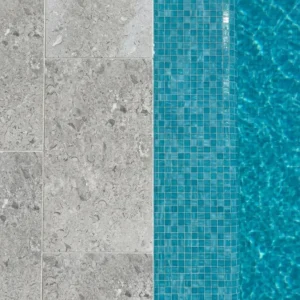
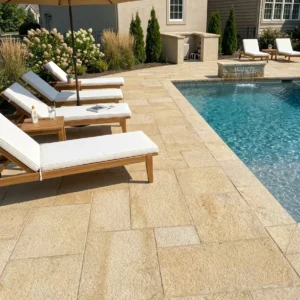
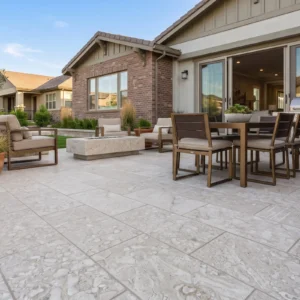
Slip resistance is the specification variable that separates a functional slate outdoor tile installation from a liability. Across thousands of square feet of exterior slate work, the finish choice — cleft, honed, or brushed — determines your Coefficient of Friction (COF) outcome more than any other single decision. ANSI A326.3 sets 0.42, the ANSI A326.3 wet DCOF threshold for pedestrian surfaces, and natural cleft slate carries pronounced texture, which is why specifiers keep returning to it for terraces, pool surrounds, and covered walkways. The real complexity starts when you layer climate performance variables on top of surface finish — and that’s where this slate outdoor tile guide focuses.
Understanding Slate Slip Resistance: Finish Types and COF Ranges
Your finish selection dictates real-world traction far more than stone color or thickness. Natural cleft slate — the surface produced by splitting along the foliation plane — delivers the highest traction because the micro-ridges left by splitting act as mechanical grips underfoot. You’ll typically see wet COF values of 0.72–0.80 on natural cleft surfaces, which comfortably exceed the minimum threshold for exterior use even in wet conditions.
Honed slate, by contrast, has been ground to a smooth matte surface. It looks refined and reads well in contemporary design language, but wet COF drops to the 0.55–0.65 range. That’s borderline for uncovered exterior applications — workable on a covered porch, marginal on an open patio, and genuinely problematic on a pool deck. Under ANSI A326.3 the 0.42 threshold is a floor, not a target, which means honed slate in wet exterior conditions requires either a grip additive sealer or a finish upgrade.
- Natural cleft finish: wet COF 0.72–0.80 — best choice for open exterior use
- Brushed or sandblasted finish: wet COF 0.65–0.75 — good balance of aesthetics and traction
- Honed finish: wet COF 0.55–0.65 — suitable for covered or semi-sheltered areas only
- Polished finish: not recommended for any exterior application — wet COF typically below 0.50
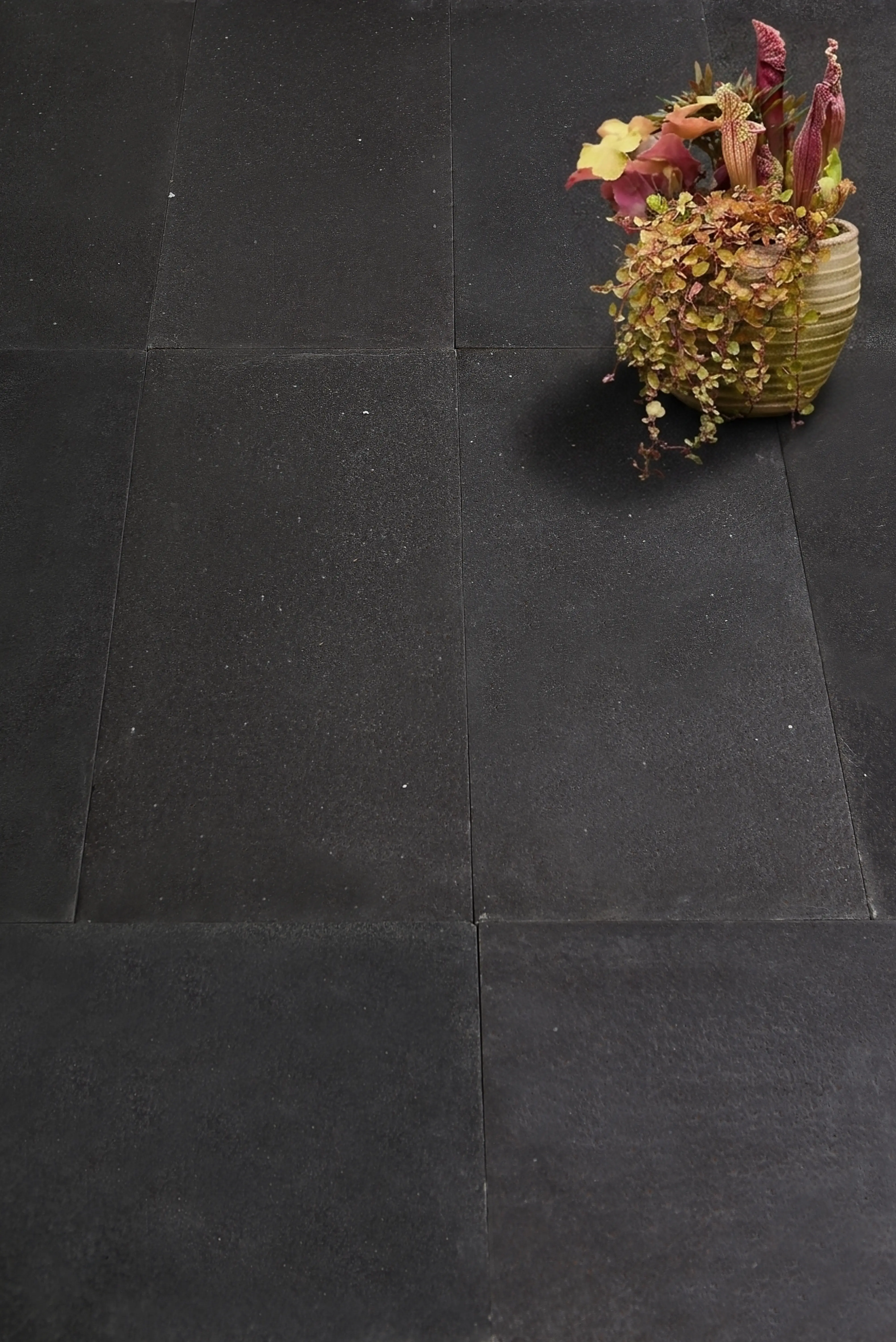
Slate Outdoor Tile and Climate Fit: What the Numbers Actually Mean
Climate fit for a slate outdoor tile project isn’t just about aesthetics matching your environment — it’s a performance specification that determines how long the installation actually lasts. Slate is a metamorphic rock with a strong foliated structure, which gives it excellent compressive strength (typically 10,000–14,000 PSI) but a directional vulnerability: it can delaminate along those same foliation planes under sustained freeze-thaw cycling if the tile is installed at insufficient thickness or if water infiltrates the joint system.
The absorption rate is the climate-fit metric you need to pin down before any other specification decision. Per slate metamorphic rock properties and durability for paving, true slate has low porosity by sedimentary-rock standards, with absorption rates generally between 0.1% and 0.4% by weight — but this varies meaningfully by quarry source and slate grade. Verify the specific absorption figure for your material against the project’s expected freeze-thaw cycle count. In regions experiencing more than 50 freeze-thaw cycles annually, you want absorption below 0.25% and a minimum tile thickness of 3/4 inch. Drop below that thickness threshold and you’re accepting delamination risk regardless of how well the substrate is prepared.
- Absorption rate below 0.25%: suitable for high freeze-thaw exposure regions
- Absorption rate 0.25–0.40%: acceptable in moderate climates with fewer than 50 annual freeze-thaw cycles
- Absorption rate above 0.40%: restrict to interior or sheltered applications
- Minimum thickness for exterior use: 3/4 inch nominal for pedestrian loads; 1 inch for heavy-use or vehicular-adjacent areas
Sourcing and Grade Selection for Exterior Projects
Not all slate is created equal, and the quarry of origin matters more than most project specs acknowledge. Slate sourced from selected quarries in the Middle East tends to exhibit tight, consistent foliation with lower absorption profiles — qualities that translate directly to better outdoor durability. Domestic slate from established quarries also performs well, though the cleft texture can be coarser, which actually benefits traction but requires more attention to grout joint planning for level installations.
At Citadel Stone, we inspect material at the warehouse before dispatch and reject tiles showing excessive surface delamination, edge crumbling, or visible mica concentration — all early indicators of below-grade stock. You should ask any supplier for the ASTM C629 test data for the specific batch you’re ordering, not just the product line’s published spec sheet. Per ASTM C629 slate dimension stone technical specifications, tests should include modulus of rupture, compressive strength, and absorption — and you want results from the actual production run, not a historical average. Batch variation in slate is real, and a 15% swing in absorption rate between production runs is not unusual.
- Request ASTM C629 test data specific to your batch, not just the product spec sheet
- Inspect tiles for lamination consistency before installation begins
- Reject tiles with visible micro-cracks along the cleft face — these propagate under thermal stress
- For our exterior slate tile options, Citadel Stone provides material data sheets with absorption values and compressive strength per shipment
Base Preparation: What the Substrate Does to Your Performance Outcome
The base system beneath your slate outdoor tile installation carries more responsibility than most specifications give it credit for. Slate’s relative rigidity compared to softer natural stones means substrate deflection — even minor flexion from an under-engineered base — transmits directly to the tile face as surface cracking or joint failure. Your compacted aggregate base needs to be a minimum of 4 inches in light pedestrian applications and 6 inches where any loaded vehicle adjacency exists.
For mortar-set installations, a 1-inch minimum bed over a concrete substrate is standard, but what often gets overlooked is the curing window. Setting slate outdoor tile on a mortar bed that hasn’t reached full cure before thermal cycling begins — typically 28 days at standard temperatures — is the scenario most likely to produce early joint failures. Plan your installation calendar around the cure window, not the project deadline.
- Compacted aggregate base: 4-inch minimum for pedestrian areas, 6-inch minimum for heavy-use zones
- Mortar bed: 1-inch minimum over concrete substrate
- Cure period: full 28 days before exposure to freeze-thaw cycling
- Slope to drain: minimum 1/8 inch per foot — never install slate outdoor tile in a flat or negative-slope condition
- Expansion joints: every 10–12 linear feet in uncovered exterior conditions
Wind, Storm, and Severe Weather: The Mechanical Stress Factors
Severe weather introduces mechanical stresses that even well-specified slate installations need to account for explicitly. Wind-driven rain is the most consistently underestimated variable — at sustained wind speeds above 50 mph, rain penetrates horizontal joint systems at angles that static drainage calculations don’t anticipate. This matters for slate outdoor tile installations because the joint mortar or polymeric sand performs differently under hydrostatic pressure from wind-driven water than under gravity-fed drainage conditions.
Edge restraint integrity becomes critical in storm-prone areas. Where slate tiles meet garden edges, transition strips, or raised perimeter elements, the mechanical connection needs to withstand both lateral wind load and the impact energy from wind-driven debris. Hail impact testing data confirms that natural cleft slate — due to its layered crystalline structure — absorbs impact energy better than brittle ceramic alternatives, but tiles with pre-existing micro-delaminations are significantly more vulnerable. This is another reason why warehouse-level visual inspection before installation matters: tiles that look acceptable in calm conditions may fail under a single hail strike if internal delamination is present.
- Use full-coverage mortar bed setting in storm-prone environments — no back-buttering shortcuts
- Polymeric sand joint fill performs better than traditional sand under wind-driven rain penetration
- Perimeter edge restraint should be mechanically anchored, not just bedded in mortar
- Joint width minimum 1/4 inch in open exterior applications to allow thermal and storm-load movement
- Inspect joint integrity annually after any storm event producing sustained winds above 60 mph
Sealing Slate Outdoor Tile: What Works and What Doesn’t
Sealing protocols for slate outdoor tile differ from standard concrete or ceramic maintenance because slate’s foliated structure means a surface sealer can trap moisture between layers if it creates a fully impermeable film. You want a penetrating impregnator sealer — one that occupies the pore structure without blocking vapor transmission — rather than a topical film sealer. Topical sealers on slate look good for one season, then begin to peel at the foliation plane, especially in freeze-thaw regions where sub-surface moisture pressure is cyclical.
Resealing frequency depends on traffic and exposure. In high-foot-traffic covered applications, every two years is a defensible maintenance cycle. In open exterior high-UV environments, the penetrating sealer degrades faster — plan for annual reapplication in the most exposed areas. Citadel Stone’s technical team consistently recommends water-based penetrating sealers over solvent-based formulations for slate specifically, because solvent carriers can slightly soften the clay mineral binders in some slate varieties, accelerating the foliation process you’re trying to prevent.
Thickness, Load Rating, and Sizing Decisions
Slate outdoor tile sizing decisions involve three intersecting variables: structural load, thermal expansion accommodation, and visual scale relative to the space. Larger format tiles — 24×24 inches and above — require a flatter substrate tolerance (no more than 1/8 inch deviation over a 10-foot run) and a thicker nominal tile, typically 1 inch, to resist point load cracking at unsupported edges. Smaller formats — 12×12 or 16×16 — are more forgiving of minor substrate variation but create more joint lines to seal and maintain.
Thermal expansion for slate runs approximately 5.0–6.0 × 10⁻⁶ per °F, which is moderate — lower than concrete but higher than granite. For a 24-inch tile with a 100°F seasonal temperature swing, that translates to roughly 0.014 inches of movement per tile. Across a 20-foot run, you’re accumulating over 1/8 inch of total expansion, which is exactly why the 10–12 foot expansion joint spacing recommendation exists. Compressing that joint spacing to 15 feet to reduce visible interruption is a common field shortcut that produces joint blow-out failures within 3–5 years.
- Large format (24×24+): requires 1-inch thickness and substrate flatness within 1/8 inch per 10 feet
- Standard format (12×12 to 18×18): 3/4-inch thickness adequate for most pedestrian loads
- Thermal expansion: 5.0–6.0 × 10⁻⁶ per °F — account for in joint spacing calculations
- Do not exceed 12-foot panel runs without an expansion joint
Ordering, Logistics, and Lead Time Planning
Your project timeline needs to account for the full supply chain from warehouse to installation — not just the installation duration itself. Citadel Stone maintains national warehouse inventory on core slate profiles, which typically reduces lead times to 1–2 weeks for standard sizes compared to the 6–8 week cycle when material ships direct from quarry. That difference can be project-critical when you’re working against a seasonal installation window. Verify stock levels against your required square footage before committing your installation crew’s schedule — a partial shipment that holds up 30% of the installation is expensive in both labor cost and schedule impact.
Truck delivery for large slate orders requires site access planning that residential and commercial projects handle differently. A standard flatbed truck delivering palletized slate needs a turning radius and offloading zone that smaller residential lots often don’t accommodate without advance staging. Confirm your delivery access conditions with the supplier before the order is placed — unloading delays at the truck are charged back to the project in most supply agreements. Order a 10% overage on cut-to-size work and 7% on standard sizes to account for field cuts, breakage, and future repair stock.
Slate Outdoor Tile: Final Specification Checklist
Every specification decision in a slate outdoor tile project connects back to two foundational variables: absorption rate and surface finish. Get those right for your climate conditions and application type, and the rest of the specification — base depth, joint spacing, sealer selection, thickness — follows logically. Cut corners on either of those foundational variables and no amount of quality mortar work or premium sealing will compensate over a 10–15 year horizon. The material science in USGS slate dimension stone production and paving use data consistently reinforces what field experience confirms: slate’s durability advantage over manufactured alternatives is real, but it’s conditional on proper specification matching to the exposure environment.
Beyond slate, your broader hardscape project may include complementary stone elements worth evaluating alongside your tile selection. For a different but related specification perspective, bluestone paving options for outdoor projects covers another high-performance natural stone category that pairs well with slate in mixed-material hardscape designs. Both materials reward precise specification work, and the investment in getting the details right upfront is always smaller than the cost of early replacement. When specifying slate for freeze-thaw exposure, Citadel Stone recommends reviewing absorption ratings and minimum thickness before finalizing your order.
Related reading: what is blue stone.