Sintered stone suppliers have multiplied rapidly over the past decade, and the comparison with natural stone edging is no longer straightforward. The critical variable most project managers overlook isn’t aesthetics or price — it’s how each material behaves at the interface between structure and landscape over a 20-year maintenance cycle. Understanding that distinction before you commit to a specification saves you from a costly material switch three years into a project.
What Sintered Stone Actually Is
Sintered stone is manufactured by compressing and heating natural mineral particles — typically feldspar, silica, and clay — under extreme pressure and temperatures above 1200°C. The process produces a dense, non-porous slab with consistent thickness and uniform surface characteristics. Sintered stone suppliers market this consistency aggressively, and for good reason: it eliminates the batch variation you encounter with quarried material.
The result is a material with water absorption rates typically below 0.1%, compressive strength in the 16,000–20,000 PSI range, and a surface hardness that resists most scratching. Those numbers are impressive on a data sheet. Field performance, however, introduces variables the data sheet doesn’t cover — edge fragility under point load, thermal cycling at thin profiles, and the way mortar bonds age beneath a material with near-zero porosity.
Natural Stone Edging — What Sets It Apart
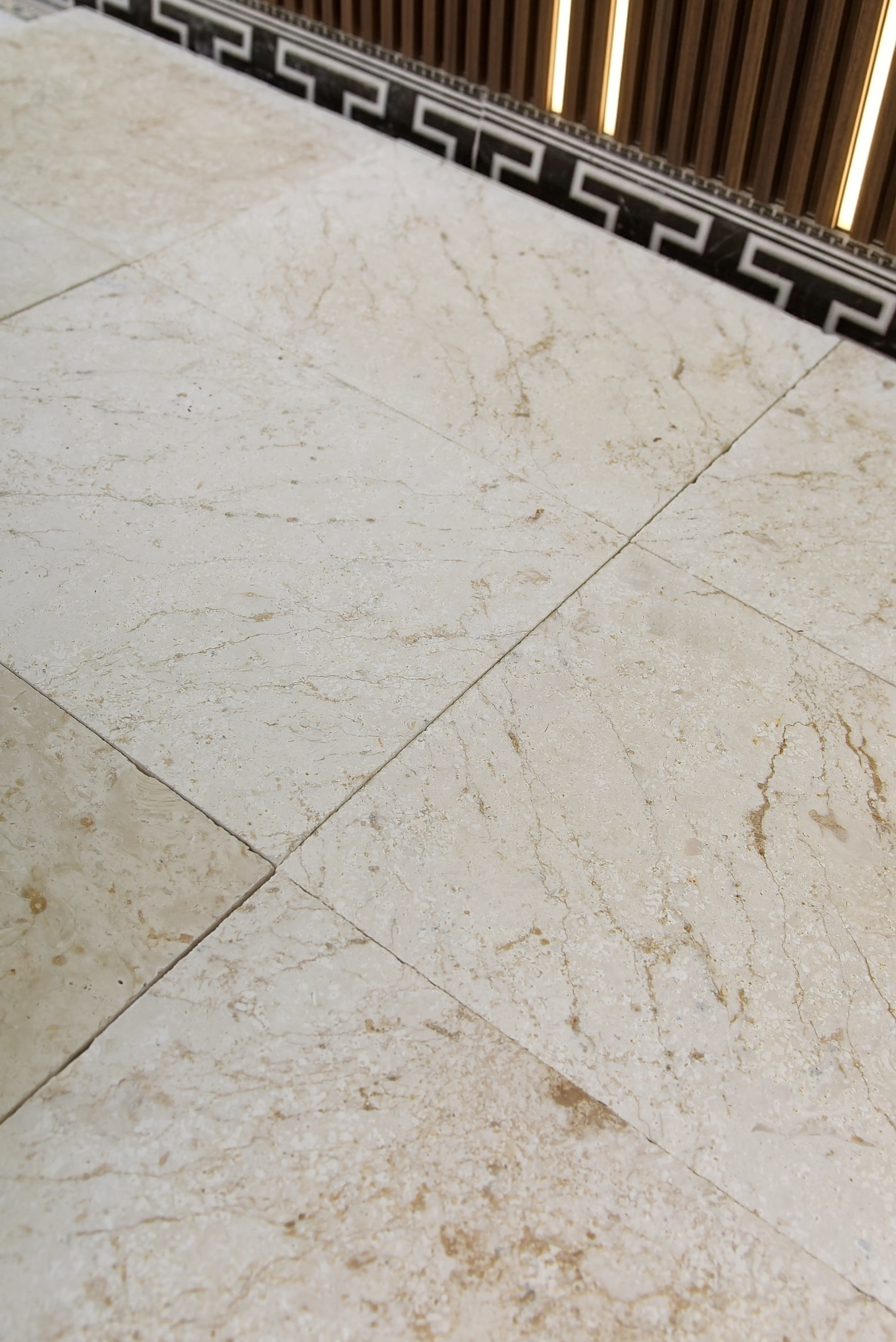
Natural stone edging — limestone, granite, and basalt being the most specified options — carries a performance profile built over geological time rather than an industrial furnace. That’s not poetic licence; it’s a practical observation about how these materials integrate with mortar, substrate movement, and moisture cycling.
- Compressive strength for dense limestone edging ranges from 8,000–14,000 PSI — sufficient for all standard edging load scenarios and significantly more forgiving under impact than sintered profiles
- Porosity in limestone edging (typically 3–8%) creates mechanical mortar adhesion that sintered stone simply cannot replicate — your bond line is stronger and more durable over time
- Natural stone edging arrives in nominal thicknesses of 2–4 inches, providing genuine structural mass rather than the 12–20mm slab profiles common in sintered stone edging applications
- Colour variation in natural stone is geological, not printed — it won’t delaminate, fade unevenly, or show edge chipping that exposes a different-coloured core
- Freeze-thaw resistance in dense limestone and granite edging meets ASTM C99 flexural standards for outdoor masonry applications
The Natural Stone Institute provides detailed technical performance data for limestone and granite edging applications, including absorption coefficients and flexural strength benchmarks. Referencing NSI limestone specifications during your specification process gives you credible third-party data to justify material selection to clients.
Sintered Stone Suppliers — The Sourcing Reality
Dealing with sintered stone suppliers introduces a supply chain dynamic that natural stone procurement simply doesn’t have. Most sintered stone originates from Spanish and Italian manufacturers — Porcelanosa, Neolith, Dekton — and reaches the market through regional distributor networks. Lead times from warehouse to site typically run 3–6 weeks for standard formats, extending to 10–14 weeks for custom dimensions or less common surface finishes.
Your project timeline needs to account for that reality. A truck delivery of sintered stone panels also requires more careful handling protocols than natural stone — edge fragility during transit is a genuine concern at 12mm profiles, and you’ll want to inspect every pallet before the truck leaves your site. Damaged edges on sintered panels aren’t field-repairable the way a chipped limestone edge can be dressed down and repointed.
Natural stone edging sourced through a national supplier like Citadel Stone carries a different logistics profile. Citadel Stone maintains warehouse inventory of limestone, granite, and basalt edging nationwide, which typically reduces lead times to 1–2 weeks — a meaningful advantage when your project schedule has limited float. The material also ships as dimensional cut stone, making truck delivery and site handling substantially more straightforward than large-format sintered slabs.
Performance Comparison — Where Each Material Leads
Comparing sintered stone suppliers’ products to natural stone edging requires honest assessment of where each material has a genuine advantage rather than a marketing one.
Where Sintered Stone Leads
- Stain resistance: near-zero porosity means oils, tannins, and iron deposits don’t penetrate — a real advantage in edging around planting beds
- Dimensional consistency: thickness tolerance within ±0.5mm across a full order, which simplifies installation with thin-set systems
- Surface uniformity: colour and texture are identical from the first piece to the last, regardless of order volume
- Scratch resistance: Mohs hardness of 6–7 provides excellent resistance to abrasive contact from garden equipment
Where Natural Stone Edging Leads
- Impact resilience: dimensional thickness absorbs point loads without catastrophic edge failure — sintered panels at 12mm will crack under lateral vehicle encroachment that a 3-inch limestone kerb absorbs without damage
- Mortar bond longevity: the mechanical key created by stone porosity outperforms epoxy adhesion systems on sintered edging over 10+ year cycles
- Repairability: individual damaged pieces can be extracted and replaced without affecting adjacent sections — sintered stone colour-matching across production batches is inconsistent
- Thermal mass behaviour: natural stone distributes and releases heat gradually, reducing the surface temperature spikes that occur with thin sintered profiles in high-UV exposure
- Long-term cost: lower initial cost per linear metre, no proprietary adhesive requirements, and straightforward replacement sourcing from any national supplier
Water Management and Drainage — How Material Choice Matters
Drainage design is where the sintered stone versus natural stone decision becomes most consequential. Projects in regions with heavy seasonal rainfall, concentrated monsoon periods, or hurricane-season precipitation cycles face a base preparation challenge that the edging material directly influences.
Sintered stone’s near-zero porosity means every drop of water that contacts its surface runs off immediately. In a well-designed drainage system, that’s fine — you’ve accounted for peak flow in your channel geometry. In a system where base preparation was optimised for a more absorbent material, you may find that sintered edging accelerates surface runoff in ways that undermine adjacent planting zones or create pooling at low points. The material performs exactly as specified — it’s the drainage geometry that hasn’t caught up.
- Natural stone edging with 4–7% porosity absorbs a small fraction of rainfall, which slows runoff velocity at the edging interface — a genuine advantage in designs where the edging defines a planting bed boundary
- In flood-risk zones or areas with high annual precipitation, your base preparation depth should increase by 15–20% when specifying sintered stone edging to accommodate the additional surface water volume it generates
- Drought-cycle regions present a different challenge: the soil shrinkage and expansion that occurs beneath edging over repeated wet-dry cycles stresses mortar joints differently depending on whether the edging itself contributes any moisture buffering
- Compacted aggregate base depth for sintered stone edging in heavy-rainfall climates should be a minimum of 6 inches — 4-inch bases suitable for natural stone edging are undersized for the drainage demands sintered material creates
You’ll also want to verify that your drainage slot geometry accounts for the edging thickness profile. Sintered panels installed as edging often sit at a shallower depth than dimensional natural stone, which alters the effective drainage gradient at the edging-to-paving transition.
Installation Differences That Affect Long-Term Performance
The installation protocols for sintered stone and natural stone edging diverge at two critical points: the bedding system and the joint treatment. Getting either wrong shortens the service life regardless of which material you’ve specified.
Sintered stone edging requires a full-coverage thin-set mortar bed — back-buttering is non-negotiable, because any voids beneath a 12mm panel create stress concentration points that lead to cracking under load. Your thin-set must be a polymer-modified, large-format tile mortar (C2TE rating minimum per EN 12004) to achieve the flexibility required for outdoor thermal cycling. Standard grey portland mortar will de-bond within two to three seasons in regions with significant temperature variation.
Natural stone edging in dimensional thicknesses of 2 inches or greater can be set on a semi-dry mortar bed — the material’s mass and porosity create a forgiving installation window that sintered stone simply doesn’t offer. You have more tolerance for base irregularity, and the mortar bond improves over time rather than relying entirely on the initial set. According to ASTM dimension stone installation standards, natural stone masonry components set in traditional mortar beds consistently outperform adhesive-set thin materials in long-term bond retention testing.
Cost and Supply Chain Realities
Natural stone edging runs $8–$22 per linear metre in standard limestone and granite profiles — a range driven by finish, thickness, and origin. Sintered stone suppliers typically price their edging-profile material at $18–$35 per linear metre before installation costs, and the installation premium for the required adhesive system, expansion joints, and specialist handling adds another 20–30% to that base figure.
The comparison most specifiers run focuses on material cost alone — that’s the wrong comparison point. Your total installed cost for sintered edging will consistently exceed natural stone when you include the adhesive system, the skilled-labour premium for handling fragile profiles, and the longer lead time that may force schedule compression elsewhere in the project.
- Sintered stone edging lead times: 3–14 weeks depending on format and supplier stock levels
- Natural stone edging lead times from national warehouse stock: 1–2 weeks for standard limestone and granite profiles
- Warranty coverage varies significantly between sintered stone suppliers — some exclude outdoor applications or restrict warranty to specific adhesive systems
- Natural stone carries no warranty restrictions tied to installation system — specification flexibility is inherent to the material
- Long-term availability: sintered stone products are subject to manufacturer discontinuation; natural stone quarry profiles have remained consistent for decades
At Citadel Stone, we’ve worked through enough project timelines to know that a 1-week warehouse turnaround versus a 6-week import cycle changes the financial reality of a project far more than the per-metre material price difference. That lead time advantage is worth building into your preliminary specification comparison before cost-per-unit becomes the dominant metric.
When Sintered Stone Is the Right Specification
Sintered stone has a legitimate specification case in specific contexts — it’s not universally inferior, and dismissing it categorically does your clients a disservice. The material earns its specification when stain immunity is the primary performance demand and the design profile is inherently thin.
- Contemporary landscape designs where a flush, seamless transition between paving surface and edging is the design intent — natural stone’s dimensional thickness can visually disrupt that geometry
- High-traffic commercial planting bed edging where petroleum, tannin, and fertiliser contact are regular — sintered stone’s impermeability is genuinely advantageous here
- Edging applications where the structural load profile is confirmed to be minimal — pedestrian-only zones with no vehicle encroachment risk
- Projects with generous installation budgets and clients who prioritise perfect surface consistency above all other performance criteria
Outside those specific scenarios, natural stone edging delivers equivalent or superior performance at lower total installed cost with better long-term supply chain reliability. The ASLA guidance on natural stone edging and landscape materials supports natural stone as the preferred specification for most landscape edging applications where durability and integration with the broader hardscape are primary criteria.
Choosing between sintered stone suppliers and natural stone edging also comes down to the specific project conditions your client faces — understanding the Citadel Stone edging selection range gives you a concrete reference point for natural stone profiles, dimensions, and finishes that sintered stone alternatives are often benchmarked against.
Expert Summary
The sintered stone versus natural stone edging decision resolves most clearly when you map each material’s performance characteristics against the actual demands of the project — not against a generic comparison table. Sintered stone suppliers offer a consistent, low-porosity product that performs well in chemically demanding, aesthetically specific applications. Natural stone edging — particularly dimensional limestone and granite — delivers structural resilience, mortar bond longevity, and total cost efficiency that sintered profiles consistently fail to match over a 15–20 year service horizon.
Your specification should prioritise the installation environment: base stability, drainage geometry, rainfall intensity, and load profile all influence which material will actually perform as intended. Get those variables documented before you finalise your edging specification, and the material decision becomes straightforward rather than a coin flip between competing supplier claims. As you refine your natural stone selections across the project, natural stone edging maintenance covers the ongoing care protocols that protect your investment over time. Sourced from quarries across the Mediterranean and Middle East, Citadel Stone edging arrives kiln-dry and ready for mortar-set installation.
Related reading: why edging stones keep shifting · cobblestone edging buyer guide · marble edging comparison guide.