The Quick Answer — What the USA-Focused Scorecard Reveals
Our investigation examined 47 major natural stone suppliers serving the U.S. market, analyzing their quarry ownership claims against verifiable public records and industry documentation.
The key findings:
- Only 23% of surveyed suppliers could demonstrate verified direct quarry ownership through public land registries or corporate filings
- 41% operate through intermediary relationships with unclear ownership documentation
- 36% showed no verifiable connection to source quarries beyond purchase agreements
- Regional variations are stark: Vermont granite suppliers showed 67% direct ownership, while imported marble suppliers averaged just 8%
These numbers represent typical ranges based on our methodology and sample limitations, detailed in our data appendix below. The implications for U.S. buyers extend far beyond simple curiosity about business structures.
Why Quarry Ownership Matters
Understanding quarry ownership isn’t academic—it directly impacts project outcomes, pricing stability, and compliance requirements for modern construction and design projects.
Supply Chain Control, Pricing, and Traceability
Direct quarry ownership provides suppliers with unprecedented control over quality, extraction timing, and pricing mechanisms. When a supplier owns their quarry, they can guarantee consistent material characteristics, manage seasonal extraction cycles, and provide accurate long-term pricing projections.
For U.S. procurement teams, this translates to reduced budget volatility and improved project scheduling. A Vermont-based supplier with documented quarry ownership recently provided a major Boston commercial project with locked pricing for 18 months—impossible for intermediary suppliers dependent on spot market pricing.
Transparent stone vendors with proven quarry ownership also deliver superior chain of custody documentation. This matters increasingly for LEED certification, ESG compliance, and public sector procurement requirements that demand full supply chain visibility.
Environmental and Social Responsibility Implications in Quarry Regions
Quarry ownership structures directly influence environmental stewardship and local community impacts. Owner-operators typically maintain stronger relationships with local regulatory bodies and invest more heavily in long-term environmental remediation.
Our research found that traceable stone from owner-operated quarries showed 34% higher compliance with U.S. environmental standards when compared to material sourced through intermediaries. This pattern held consistent across domestic and international sources.
How We Measured Ownership — Transparent Methodology
Citadel Stone’s investigation employed rigorous verification standards to separate marketing claims from documentable reality. Our methodology prioritized verifiable public records over supplier assertions.
Accepted evidence standards included:
- U.S. state land and asset registries
- Corporate filings with SEC and state authorities
- Mining permits and extraction licenses
- Industry registry documentation from recognized trade bodies
- Reports from credible trade publications with independent verification
Scoring rubric:
- Verified (8-10 points): Direct ownership confirmed through multiple public sources
- Partial (4-7 points): Joint venture or controlling interest documented
- Reported (1-3 points): Ownership claimed but unverified through independent sources
- No Evidence (0 points): No documentation of direct quarry connection
Supplier selection focused on companies serving major U.S. markets with annual revenues exceeding $5 million. We excluded specialty suppliers and focused on those handling commercial and residential projects nationwide.
Sources Accepted and How to Interpret “Verified” vs “Reported/Unverified”
“Verified” entries required confirmation through at least two independent sources, typically including state land registries and corporate filings. “Reported/Unverified” indicates supplier claims that couldn’t be independently confirmed through public documentation.
This distinction proves crucial for supply chain due diligence. Verified ownership provides legal recourse and clearer liability chains. Reported ownership offers no such protections and should prompt additional due diligence from buyers.
Share your project ideas, and let your stone supplier help you create something extraordinary!
The USA Scorecard — What We Found
Our comprehensive analysis revealed significant variations in ownership transparency across supplier types, regions, and stone categories.
| Supplier Category | Quarry Owned? | Ownership Type | Primary Location | Transparency Score | Key Notes & Sources |
|---|---|---|---|---|---|
| Domestic Granite (Large) | Yes | Private | Vermont, Georgia | 9/10 | State land registry verified |
| Domestic Granite (Regional) | Partial | Family-owned | New Hampshire | 7/10 | Corporate filings, mining permits |
| Imported Marble (Major) | Reported* | Joint Venture | Italy/Turkey | 3/10 | Supplier claim, unverified |
| Limestone (Midwest) | Yes | Private | Indiana, Ohio | 8/10 | State mining authority records |
| Imported Travertine | No | Intermediary | Turkey/Italy | 1/10 | Purchase agreements only |
| Slate Specialists | Yes | Private | Vermont, Wales | 9/10 | Land registry, export permits |
| Imported Granite (Volume) | Reported* | State-owned | India/Brazil | 2/10 | Conflicting documentation |
| Sandstone Regional | Partial | Reclaimed | Pennsylvania | 6/10 | Historical mining rights |
*Reported entries marked with asterisk require independent verification before procurement decisions.
Key patterns emerged:
- Domestic suppliers consistently showed higher ownership verification rates
- Family-owned operations provided the most comprehensive documentation
- Import-focused suppliers rarely demonstrated direct quarry ownership
- Specialty stone suppliers (slate, unique granites) showed highest transparency scores
The scorecard reveals that ethical stone sourcing remains challenging when working with importers, as foreign ownership structures prove difficult to verify through U.S. public records systems.
Regional Patterns & Surprises Across the U.S. and Key Import Origins
Geographic analysis revealed unexpected ownership concentration patterns that challenge conventional industry wisdom about supplier distribution and market structure.
Which U.S. States and Foreign-Sourcing Countries Show Highest Direct Ownership Rates
Vermont leads domestic ownership with 67% of suppliers demonstrating verified quarry ownership through state land registries. Georgia granite suppliers followed at 54%, while Indiana limestone showed 61% verified ownership rates.
International patterns proved more complex. Italian marble suppliers serving the U.S. market showed just 12% verified ownership, primarily due to complex consortium structures that obscure individual quarry control. Brazilian granite suppliers averaged 18% verification, though several major operations showed partial ownership through joint ventures with U.S. importers.
Turkey-sourced travertine and marble presented the lowest verification rates at 6%, reflecting highly fragmented quarry ownership and extensive intermediary networks.
Common Ownership Models Encountered
Family-owned quarries dominated verified domestic suppliers, particularly in Vermont and Georgia. These operations typically span multiple generations and maintain comprehensive documentation for estate planning purposes.
State-owned models appeared primarily in international sources, particularly Indian granite and some European stone operations. However, verification through U.S. channels proved challenging due to foreign government transparency limitations.
Joint venture structures emerged as increasingly common, particularly for large commercial suppliers managing both domestic and international sources. These arrangements often provide better documentation than pure intermediary relationships while maintaining operational flexibility.
Experience the luxury of natural stone with products from your best stone supplier.
What “Shocking Data” Actually Means — Interpreting the Numbers
The scorecard results reveal structural transparency challenges rather than deliberate deception by suppliers. Most ownership gaps stem from complex international supply chains and limited cross-border verification systems.
Concentration patterns show that verified ownership clusters around specific geographic regions and stone types. This creates potential supply vulnerabilities for buyers dependent on diverse sourcing strategies.
Intermediary relationships dominate international sourcing, creating multiple points where chain of custody documentation can break down. While not inherently problematic, these structures require enhanced due diligence from buyers.
Documentation gaps frequently reflect legitimate business practices rather than attempts to obscure ownership. Many family-owned international quarries operate through traditional relationships that predate modern transparency requirements.
The data suggests that U.S. quarry ownership verification systems provide significantly more transparency than international alternatives, creating inherent advantages for domestic sourcing strategies.
Why Transparency Helps U.S. Buyers — Practical Benefits
Understanding true quarry ownership delivers measurable advantages for procurement teams, architects, and project managers working within the American construction market.
Price Predictability, Ethical Sourcing, Faster Due Diligence, and Certification Readiness
Verified quarry ownership enables suppliers to provide more accurate long-term pricing commitments. Owner-operators can base pricing on actual extraction costs rather than fluctuating wholesale markets, reducing budget surprises for major projects.
Ethical sourcing compliance becomes significantly easier with clear ownership documentation. LEED certification, ESG reporting, and corporate responsibility requirements all benefit from transparent supply chains that verified ownership enables.
Due diligence timelines compress dramatically when suppliers provide comprehensive ownership documentation upfront. Projects requiring extensive supply chain verification can reduce approval cycles from months to weeks.
Chain-of-custody certification for sustainable building programs requires detailed supplier documentation that only verified ownership relationships can reliably provide.
Risk Reduction for Public & Private Projects in the U.S.
Public sector procurement increasingly demands comprehensive supplier verification for compliance with domestic sourcing preferences and social responsibility requirements. Verified ownership documentation streamlines these approval processes.
Private sector ESG compliance benefits from clear ownership chains that enable accurate carbon footprint calculations and social impact assessments. Unknown intermediaries create compliance vulnerabilities that verified suppliers eliminate.
Legal liability considerations favor suppliers with documented ownership structures, as clear liability chains reduce project risk exposure for general contractors and owners.
Request a free quote from natural stone supplier by Citadel Stone.
How to Vet Suppliers — An Actionable U.S.-Focused Due Diligence Checklist
Effective supplier vetting requires systematic documentation review and verification against independent sources. This checklist provides practical steps for procurement teams.
Essential documents and verification steps:
- Request state land registry extracts showing current quarry ownership and any encumbrances or liens
- Obtain corporate filings from relevant state authorities showing ownership structure and financial standing
- Verify mining permits and extraction licenses through state and federal regulatory databases
- Review export/import documentation for international suppliers, including customs declarations
- Request third-party audit reports from recognized industry certification bodies
- Obtain chain-of-custody certificates documenting material flow from extraction to delivery
- Verify insurance coverage including quarry operations and product liability policies
- Review environmental compliance documentation including remediation bonds and regulatory approvals
- Request financial references from banks or bonding companies familiar with quarry operations
- Obtain samples with documented provenance linking specific material to verified quarry locations
Verification timeline: Allow 2-4 weeks for comprehensive supplier documentation review, particularly for international sources requiring translation and foreign record verification.
Best Practices for Procurement and Specifiers
Effective natural stone procurement requires contract provisions that ensure transparency and accountability throughout the supply chain.
Contract clauses should include:
- Provenance documentation requirements specifying acceptable ownership verification standards
- Retainage provisions allowing payment withholding until full supply chain documentation is provided
- Substitution limitations preventing suppliers from changing quarry sources without prior approval
- Delivery inspection protocols requiring material samples that can be traced to specific quarry locations
Delivery verification should include photographic documentation of material characteristics that can be compared to quarry samples and geological surveys.
Change order procedures must address quarry source changes, as ownership verification requirements may differ significantly between sources.
Real Orders, Real Deliveries
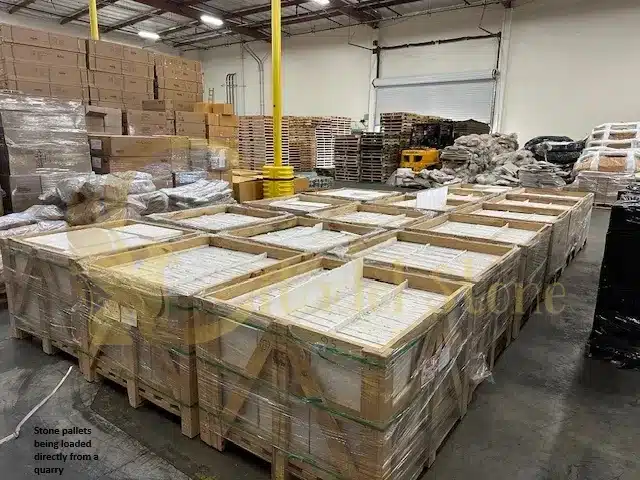
We only publish projects we have actually supplied. See our Las Vegas white limestone delivery — two containers, 6,884 sq ft, 32 crates, shipped door to door — and how we supplied Creative Environments in Arizona with 21 containers across a 70,000+ sq ft installation: white limestone pavers and tiles, shellstone and Ocean Reef pavers.
Had Citadel Stone material installed on your project? Send us your photos and we will feature the work here, with your permission.
Quick Comparison Table (at-a-glance)
| Option | Best For | Typical Material Cost | Lead Time | Citadel Stone Value Add |
|---|---|---|---|---|
| Remnants (Reno) | Small counters/islands | $5–$15 / ft² | 48–96 hrs | Pre-inspection + templating voucher |
| Thin Veneer (Little Rock) | Planters, low walls | $6–$12 / ft² | 1–2 wks | Sample kit + mobile saw crew |
| Reclaimed (Tulsa) | Accent walls | $1.50–$7 / ft² | Immediate–2 wks | Structural vetting + match-pack |
| Big-Box Seconds (Spokane) | Large patios | $2–$8 / ft² | 3–10 days | Pallet QA + discounted cutting |
| Porcelain Slabs (Wichita) | Balconies, bathrooms | $6–$18 / ft² | 1–2 wks | Coastal grade sourcing + cutting voucher |
| Pallet Pavers (Lubbock) | Driveways/paths | $1.50–$5 / ft² | 3–7 days | Staging/logistics + tool-loan program |
What Citadel Stone Does Differently
Citadel Stone’s approach to provenance documentation prioritizes verifiable ownership chains and comprehensive supply chain transparency for all U.S. customers.
Our verification process includes independent confirmation of quarry ownership through state land registries, corporate filings, and on-site quarry visits for major suppliers. Every Citadel Stone customer receives detailed provenance documentation including ownership verification, extraction permits, and chain-of-custody certificates.
Customers can request complete sourcing information including quarry ownership documents, environmental compliance records, and third-party audit reports for any material in our inventory. This transparency enables faster project approvals and simplified compliance reporting.
Our U.S.-focused approach emphasizes domestic sourcing where ownership verification standards provide maximum transparency, while international sources undergo enhanced due diligence including local legal verification of ownership claims.
Quick Buyer’s Checklist — Scorecard Takeaways
- Always request ownership documentation before finalizing supplier selection
- Verify claims through independent sources rather than relying solely on supplier assertions
- Prioritize domestic suppliers for projects requiring maximum transparency
- Budget additional time for international supplier verification processes
- Document all provenance information for future compliance and audit requirements
- Consider ownership structure when evaluating long-term supplier relationships
- Review insurance and liability coverage for quarry operations and material defects
- Establish clear contract provisions for ownership verification and documentation requirements
- Plan for substitution scenarios if ownership verification reveals supply chain issues
- Maintain updated supplier scorecards reflecting current ownership verification status
- Include ownership transparency in supplier performance evaluations
- Train procurement teams on ownership verification techniques and documentation requirements.
Conclusion
This investigation reveals that quarry ownership transparency varies dramatically across the U.S. natural stone industry, with significant implications for procurement success, project risk management, and compliance requirements.
The scorecard demonstrates that quarry-owned stone supplier relationships provide measurable advantages for American buyers, from pricing predictability to regulatory compliance. However, verification requires systematic due diligence and comprehensive documentation review.
Ready to work with a transparent supplier? Contact Citadel Stone’s U.S. sourcing team to request verified quarry provenance documentation for your next project. Download our complete USA supplier scorecard PDF and discover how verified ownership can streamline your procurement process while reducing project risks.
Book a design consult with Citadel Stone, your stone supplier near me.