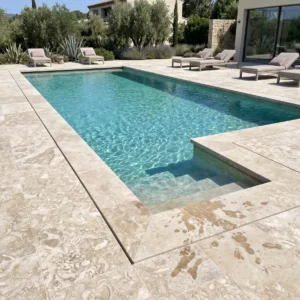
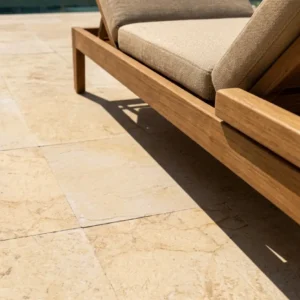
Everything Arrives by Boat, and That Sets the Rules
Paving in the Turks and Caicos Islands is a shipping problem before it is a design problem. Every square foot of cut stone on a Provo terrace arrived by sea. The island platform is soft limestone, and the material screened from it is used as fill and screening rather than as a wearing surface. That limestone is the ground underfoot, the reef offshore and the heritage fabric held by the Turks and Caicos National Trust. Imported cut stone is the finished wearing course laid on top of that platform, never a substitute for it. Plan the sea leg first and the laying plan second.
South Dock Sets the Size of Every Shipment
South Dock on Providenciales is the principal commercial port and handles more than 85 percent of national port traffic. Draft alongside is only about 11 feet, and only vessels of roughly 110 TEU can berth there, so no large container ship calls at the islands at all. Provo Stevedoring handles vessel offloading and port operations. Everything lands from shallow-draft feeders and barges, which is why a stone package works best as a series of modest, well-secured loads rather than one enormous drop.
The Florida Leg Runs Direct
Cargo reaches the islands straight from Florida rather than through a large regional relay. SEACOR Island Lines and Tropical Shipping operate container vessels between Florida and the islands, and between them they carry nearly all cargo imported into the country. For natural stone that directness is worth real money, because every extra handling event is another chance for an arris to chip or a pallet to shift. A few habits keep a stone consignment intact:
- Book the sailing before you confirm the stone order, never the other way around.
- Ask the carrier for its current sailing schedule instead of assuming a fixed slot.
- Get transit time confirmed in writing for your actual loading port.
- Keep the order on a single bill of lading wherever the volume allows it.
- Photograph every pallet before it leaves the US facility.
Consolidation Is Where the Weeks Disappear
The sailing itself is rarely the slow part of the chain. Where a freight forwarder consolidates your pallets with other people’s freight, allow roughly two to three weeks between delivery to a US facility and availability on Providenciales. That delay is predictable, and it only wrecks a schedule when nobody counted it. If the masons are already booked, count backward from the laying date through clearance, the road leg, the consolidation window and the sailing, then place the order. Ordering cut paving units for Provo early enough simply means the stone waits for the crew instead of the crew waiting for the stone.
Clearing the Dock and Getting a Truck
Clearance is the point where a stone shipment either moves or sits on the wharf. A licensed customs broker is not legally mandatory here, but the Border Force itself recommends using one to assist with declaration and clearance. Declarations go through ASYCUDA World on the Single Administrative Document.
- Give the broker a commercial invoice with clear, consistent unit descriptions.
- Make sure the packing list matches the pallet count exactly.
- Have any licenses or permits ready before the vessel arrives.
- Ask what a concession letter would require if an exemption applies.
- Budget the clearance fee, which runs about US$10 to US$25 on small shipments and over US$70 on larger broker-handled ones.
The Road Leg on Providenciales
Road distances on Provo are short, so the last leg is about access rather than mileage. A pallet of paving is heavy and unforgiving, and villa sites off the main roads often finish in soft sand, a narrow gated entrance or a turning area a loaded flatbed cannot use.
- Measure the gate opening and the turning space in advance.
- Nominate a firm, level drop point well clear of soft ground.
- Confirm whether the truck carries a tail lift or you need a machine on site.
- Keep pallets banded until the crew is genuinely ready to lay.
- Store stone away from the wash-down and mixing area.
Outer Islands Are Separate Sea Legs
Anything beyond Providenciales is a separate sea leg with its own cost and schedule, and it should never be folded into one bundled delivered figure. Three ferry routes run: Providenciales to North Caicos at Sandy Point, Providenciales to South Caicos, and Grand Turk to Salt Cay. There is no ferry at all between Providenciales and the Turks Islands, which means Grand Turk and Salt Cay reach you another way. North Caicos and Middle Caicos are the only two islands joined by a causeway, so one landing serves both. A cargo barge runs between Providenciales and North Caicos. Raise stone logistics across the Caicos chain at the quoting stage, not after the pallets have landed.
- Price Grand Turk, South Caicos, Salt Cay and North or Middle Caicos separately.
- Confirm the barge schedule before committing to a laying date.
- Allow for a second lift and a second set of handling charges.
- Order full pallets so nothing has to cross the water twice.
A Delivery Sequence That Holds
A delivery plan that survives contact with the real chain is deliberately boring. Confirm the sailing, confirm the consolidation window, brief the broker, agree the truck and the drop point, and only then fix the date the crew starts laying. Order a small hand sample well before any of that, so the tone and the finish are settled while the decision is still cheap to change. Get the sea leg right and the paving becomes the easy part of the job.