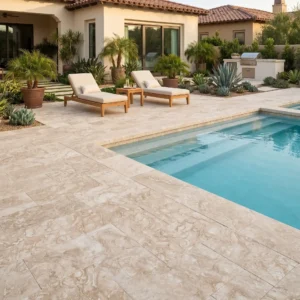
The territory’s pools sell its real estate. A St. John villa listing leads with its infinity edge; a St. Thomas hillside home is photographed from the water it overlooks; a St. Croix estate offers something rarer still — room for a pool that is not clinging to a gradient. Three islands, three genuinely different swim briefs, one specification logic underneath. Here is the territory’s pool guide.
Gradient decides everything
On St. Thomas and St. John the site’s slope writes the pool before the architect does: infinity edges because the ground falls away anyway, plunge geometry where the bench is too narrow for laps, and structural engineering that costs real money before a single stone is laid. The steep-lot disciplines apply directly — engineered platforms, retaining dressed as garden architecture, drainage designed for rain arriving on a slope — and the honest counsel is that a modest pool built properly on a hillside beats an ambitious one built optimistically. St. Croix inverts the problem: flatter ground, larger parcels, and the freedom to compose a pool as a garden centrepiece rather than a cantilever.
The cistern arithmetic
Territory code requires cisterns, and a pool is the largest discretionary draw a household owns. The planning consequence is straightforward: size the tank knowing the pool exists, cover the water because evaporation on an open surface in constant sun is measurable weekly, and route backwash to planted ground rather than the drain. Villas letting to guests plan a delivery top-up for the dry months as a matter of routine, and the rental-week water discipline treats level checks as part of changeover. A pool on a catchment island is entirely normal; a pool designed as though the water were piped is the one that surprises its owner in March.
- Deck falls that separate catchment water from pool splash-out
- Surfaces clean enough that runoff can be stored without treatment problems
- Overflow routes designed for the day the cistern is already full
- Access left for cistern inspection without lifting the whole terrace
Salt, everywhere
These islands are narrow and the trades cross them without obstruction, which means salt reaches pool courts that feel inland. The specification runs the cluster’s marine law without exception: dense low-absorption stone, stainless fixings at marine grade, coping and weir details cut as one drawn family, and sealant cycles kept on calendar rather than on memory. Textures follow the wet zones — brushed and bush-hammered where water lands and ground tilts, honed silk reserved for covered galleries.
The rental pool’s duty
Most territory pools earn. That changes the brief from private comfort to hospitality duty: eased edges everywhere because guests are not careful, denser sections where furniture drags, same-batch attic stock so a chipped coping is repaired between guest weeks rather than apologized for, and the management-audit standard from across the channel applied verbatim. The economics are unambiguous at territory rates — a deck that photographs perfectly for a decade is cheaper than one refreshed twice in the same period, and the listing tells the truth either way.
- Finishes that recover fast between back-to-back guest weeks
- Units replaceable one at a time during a single turnover day
- Spare stock held on island so a chipped coping never delays a booking
- Cleaning methods written for a housekeeping team, not a contractor
Storm season at the waterline
The 2017 lesson reached every pool court in the territory: furniture with a stow plan, shade structures engineered rather than improvised, equipment housed to survive, and ground-set stone as the element that needs no boarding and anchors the reopening photograph. The rebuild decade has made this ordinary practice here, and the pool that circulated through the last long outage — pump riding the house’s stored power — is a genuine selling point rather than a boast.
Specifying the territory’s water
The Virgin Islands pool kit is this library’s law tuned to gradient and catchment: slope-honest engineering, cistern-aware water planning, marine specification throughout, rental-grade durability and storm-season honesty — supplied through the territory supply page with the St. John barge leg written into the quote where it applies. Three islands, three briefs, one standard underneath — and the same pale stone doing the work in all of them.
Heating the shoulder: when a territory pool is genuinely cold
Nobody warns buyers about this one. The Virgin Islands sit far enough north in the Caribbean that January and February deliver cooler water and brisk northerly nights, and a shaded hillside pool in the winter months can be genuinely unwelcoming at exactly the season the rental calendar peaks. Owners discover it the first winter; the ones who planned for it never notice. The variables are the familiar ones — sun exposure, depth, wind and shelter — and they are decided at design stage rather than fixed afterwards.
The passive moves cost nothing if made early. Orientation that catches winter sun rather than only summer shade; walls and planting that break the northerly the way the four-season court craft teaches on a colder island; a pool sized honestly, because a vast shallow sheet loses heat far faster than a compact deeper one; and pale stone decking that banks the afternoon and returns it underfoot at five o’clock, which is when the difference is actually felt. Covers do more work here than owners expect — overnight heat loss on a clear breezy night is the real thief, not the daytime temperature.
Where heating is added, the territory’s electricity prices make the choice consequential: heat pumps rather than resistance, solar thermal where roof area allows, and the independence arithmetic applied honestly to a load that can dominate a bill. Rental properties should decide deliberately whether the listing promises a heated pool, because a guest arriving in February to a cold one writes a review about it — and the villa that quietly solved the problem with orientation, shelter and a cover has been enjoying warmer water for years without paying for the privilege.
Friction is the number to insist on
Everything else around a pool is preference. Grip is measurable. The research behind frictional testing of natural stone walking surfaces describes the ANSI A326.3 method, tested wet with a tribometer, and a benchmark dynamic coefficient of friction of at least 0.42 for level interior floors expected to be walked on wet. A hillside pool deck in the tropics is a harder case than that reference, so the sensible move is to test the delivered finish and specify with margin rather than trust a family name.
- Wet values requested on the exact finish being supplied
- More margin on steps, ramps and any sloping approach
- One texture held across deck, coping and surround
- Retesting whenever the finish or supplier changes late
Three islands, three microclimates
The territory is small and not uniform. The NOAA state climate summary covering the Virgin Islands records annual rainfall below 60 inches across all the islands, drier than most of the region, with sea surface temperatures up close to two degrees Fahrenheit since the start of the twentieth century. Within that, a steep north-facing site on St. Thomas holds damp far longer than an open plot on the flatter south of St. Croix, and a pool on St. John may sit under tree cover for most of the day.
- Shaded decks detailed for slower drying and biological growth
- Open decks detailed for heat gain and glare
- Drainage sized for intense rainfall despite a modest annual total
- A cleaning regime written for the site rather than the territory
Coping outlives the deck
Decks get refreshed. Coping tends to stay, and it does the hardest work on the whole project: constant wetting, hands and elbows, thermal movement, and the junction between two structures that move differently. It earns the thickest section and the most careful fixing on site.
- Profile chosen for the swimmer first and the elevation second
- Mechanical restraint in addition to bedding at every unit
- Consistent overhang, because an uneven shadow line reads instantly
- Spare units retained, since chipped coping is the common repair
Choosing swim court stone across the territory
Test wet, drain generously, restrain the coping and keep spares on island. Do that and the same short specification will work on all three islands with only the drainage and the cleaning plan changing. Our US Virgin Islands stone supply guide sets out the formats, finishes and lead times that suit these islands. A pool deck is judged barefoot and wet, which is the only condition worth designing for.