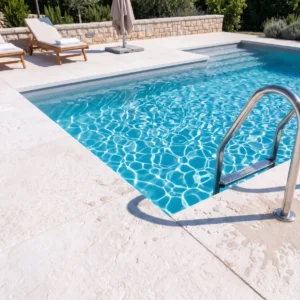
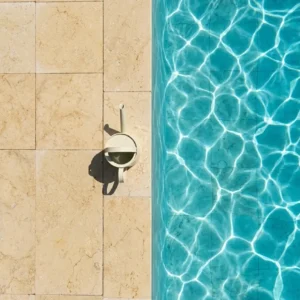
Puerto Rico’s pools swim across more settings than any single island in this library: rooftop plunges over Condado’s surf, Dorado estate courts behind design-review hedges, mountain pools framing the cordillera’s ridgelines, and family backyards in a thousand urbanizaciones where the pool is the summer’s whole institution. One island, many registers — and one specification logic underneath them all. Here is the big island’s swim-court guide.
The registers, mapped
The metro runs the vertical version: tower plunges and amenity decks on the above-grade file, weight and waterproofing documented for boards. Dorado and the enclaves run estate courts at the migration standard — infinity edges toward the Atlantic, outdoor programs wrapped around the water. The west and south run villa pools at beach-house ease; the mountains add the rarest register — pools at altitude, cooler air, ridge views — and the urbanización backyard runs the family version the gathering-court tradition would recognize in Spanish.
Two climates, one deck specification
The island’s finish zoning applies at the waterline: the lush north’s pools live with rain, leaf-fall and algae pressure — full wet-climate texture on surrounds, drainage at cloudburst honesty, the sweep-clean surface logic of every canopy court — while the drier south around Ponce leans on texture for glare and sandy feet, with maintenance lighter but sun harder. Both zones share the non-negotiables: pale stone at barefoot temperatures, low-absorption density against the coasts’ salt, and copings cut as a drawn family with weirs and spa caps from one batch.
- One finish family across deck, coping and steps so grip never changes
- A rougher texture only where water is thrown, not across the whole terrace
- Transitions to indoor floors detailed as a deliberate change, not an accident
- Lounger zones checked for heat gain as carefully as for slip
The concrete advantage
Puerto Rico’s pools sit on the region’s best substrate story: an island that builds in reinforced concrete produces pool shells and terraces engineered to mainland codes, and the stone package lands on structure rather than hope. Renovations exploit it constantly — a sound decades-old shell re-coped and re-decked transforms for a fraction of new construction, the renovation-island rhythm at its most satisfying — and new builds specify the finish layer knowing the structure beneath was never the question.
Storm season at the waterline
The island’s pool courts carry the María-era disciplines as standard: furniture with a stow plan, shade structures engineered to the wind codes, equipment housed to survive, and the deck itself — ground-set stone — as the element that needs no boarding and anchors the reopening photograph. The energy layer is PR-specific: pumps and heaters increasingly ride the house’s solar-and-battery plant, and the pool that runs through an outage is, on this island, a design brag with a straight face.
- Perimeter drainage sized for a downpour, not a splash
- Coping bedded and mechanically restrained at every corner
- Expansion provision between deck and pool shell
- Access left for the plant room without lifting half the terrace
Permits, boards and paperwork
The island’s professional layer expects documentation: enclave design reviews ask for palettes and drainage plans, tower boards ask for weight statements, and municipal permitting runs mainland-style process. The stone package answers as it does across this library — datasheets, slip ratings for the wet zones, batch records, retained samples — and the domestic freight lane keeps the logistics boring while the paperwork does the persuading.
Specifying the island’s water
The Puerto Rico pool kit reads as the cluster’s law tuned to a big island: registers chosen by setting, textures zoned by climate, structure trusted, storm and energy resilience built in, and supply at mainland rhythm from the island supply page. From a Condado rooftop at dusk to a mountain pool in coffee country, the island swims everywhere it lives — and the stone underfoot, pale and sure, is the one constant across every register.
Filling it: water sources and the island’s refill arithmetic
A pool is a standing water bill, and Puerto Rico’s supply picture makes the arithmetic worth understanding before the shell is poured. Most of the island fills from the public system, whose reservoirs run on rainfall the north receives generously and the south rations — dry-season restrictions are a periodic reality, and the household that fills a fresh pool during one earns a conversation with its neighbors it would rather avoid. Rural and mountain properties often draw wells; coastal estates sometimes blend sources; and every one of them benefits from the same discipline: fill scheduled deliberately, evaporation managed by cover, and the top-up habit tracked rather than assumed.
The design responses are modest and effective. Covers earn their keep here as everywhere the sun is constant — the uncovered pool quietly evaporates a measurable depth a week through the hot months — and the deck’s falls decide whether splash-out returns toward the water’s edge zone or exits to the garden. Backwash routing to planted areas rather than the storm drain turns a waste line into irrigation. Rain does real work on this island: north-coast properties with cistern capacity can top up from stored sky, and the household storage habit the renovation market is rediscovering pairs naturally with a pool that no longer depends entirely on the mains.
The outage dimension closes the loop. A pool without circulation clouds within days, which is why the energy-era specification now routinely puts the pump on the house’s stored power — and why the properties that ran clear through the last long event advertise the fact. Between stored sun for the pump and stored rain for the top-up, the island’s better pools have quietly become the most self-sufficient water features in this library: full, circulating and swimmable on a week the neighborhood is otherwise waiting.
Friction is the number worth arguing about
Around water, one measurement outranks every aesthetic decision. The research behind frictional testing of natural stone walking surfaces describes the industry move to the ANSI A326.3 method, tested wet with a tribometer, and the benchmark of a dynamic coefficient of friction of at least 0.42 for level interior floors expected to be walked on wet. An exterior pool deck is a harder case than that benchmark describes, which is the argument for testing the delivered finish rather than trusting a family name. The same work found that softer, lower-density stones often outperformed harder ones in comparable finishes.
- Ask for wet values on the exact finish being supplied
- Treat the published threshold as a floor for interiors, not a target for decks
- Retest if the finish changes late in the project
- Keep a record, because grip is the one claim worth being able to prove
Two climates on one island
A pool at sea level and a pool in the mountains are not the same brief. The NOAA state climate summary for Puerto Rico notes that rainfall ranges from more than 200 inches a year in the highlands to under 40 inches at Ponce on the south coast, with the Cordillera Central rising to 4,390 feet and dividing the two. A coastal deck fights salt, sun and constant use. A mountain deck fights standing damp, biological growth and long wet spells. The same stone can serve both, but the drainage design and the maintenance plan should not be copied across.
- Coastal decks detailed for salt, glare and heavy footfall
- Highland decks detailed for shade, damp and slower drying
- Open joints and generous falls anywhere rainfall is measured in feet
- A cleaning regime written for the site, not for the region
Coping is the detail that dates a pool
Decks get replaced. Coping tends to stay, and it carries most of the visual weight while doing the hardest physical work: constant wetting, hands and elbows, thermal movement, and the point where two structures meet. It deserves the thickest section and the most careful fixing on the whole project.
- Profile chosen for the swimmer first and the elevation second
- Mechanical restraint in addition to bedding at every unit
- Consistent overhang, since an uneven shadow line reads instantly
- Spare units retained, because a chipped coping is the common repair
Choosing pool deck stone at either altitude
Specify for water first, heat second and appearance third, and the result will still look considered in ten years. Test the finish wet, drain generously, restrain the coping, and keep spares. Our Puerto Rico stone supply guide sets out the formats, finishes and lead times that suit this island. The deck is the only part of a pool that everyone walks on and nobody is supposed to notice.