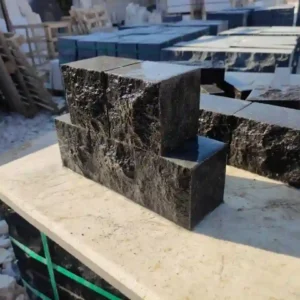
Decide the duty before the look
An expensive mistake in a paving schedule is to choose a format for its appearance and then discover it has to carry a vehicle. Work the other way around. Split the site into duty zones, then pick thickness first, format second and finish third. On Curacao that discipline matters because the sun is high, the trade winds are constant, and the ground under everything is dry and hard for most of the year.
Duty bands are also an ordering tool. Once the drawing is marked up, quantities come out band by band, and the container can be crated so the crew opens the right pallets in the right sequence instead of sorting stock in the sun.
What you are laying on
Curacao produces the ground beneath your paving. Mining Company Curacao has operated since 1874, when phosphate was found in the Tafelberg near Santa Barbara in the south-east of the island, and its published product list is aggregate, sand, fill and industrial powders rather than cut units.
- Base coarse at 0 to 50 mm for the sub-base build-up.
- Presieved sand at 0 to 3.5 mm and Barmac sand at 0 to 4.5 mm for bedding and jointing.
- Graded aggregates running from 25 to 50 mm down to 3 to 5 mm.
- Selected boulders up to 3.5 tonnes for marine defense work.
Imported dimension stone is the wearing course laid on top of that base course. The two are different product categories doing different jobs in the same build-up, and a schedule that names both reads as though someone has actually stood on the site.
Pedestrian zones: terraces and pool surrounds
Foot traffic is the least demanding duty structurally and the most demanding on comfort. Thinner units are viable here, which frees budget for a larger face size or a better finish. What you should not do is carry a pedestrian thickness across an unmarked boundary into a delivery route or a service gate, because that boundary is where failures start.
Pale limestone reads well on a terrace under a very high sun, and a worked face rather than a polished one keeps the surface honest underfoot when it is wet. Pool surrounds carry that extra requirement, so write the surface texture into the specification rather than assuming it will arrive.
The oprit and light vehicles
A driveway, or oprit, is a different structural problem. Wheel loads concentrate, they arrive repeatedly in the same tracks, and they include steering loads at the gate and at the turning point.
- Move to a heavier working depth than the terrace specification carries.
- Reduce the face dimension so each unit sheds load into the bed rather than spanning it.
- Detail a restrained edge so the field cannot creep sideways under braking.
- Run the laying pattern across the direction of travel rather than with it.
- Give the sub-base the same attention as the stone, because it carries the same loads.
The island’s own geology includes basalt, since the Curacao Lava Formation is described as roughly 5 km of pillow lavas with basalt intrusions, which is a note on the island’s geology rather than a source of finished paving units. Where a driveway takes daily turning loads, price basalt units for the oprit against the limestone option before you decide.
Turning, point loads and service access
Anywhere a vehicle turns on the spot, a delivery truck reverses, or a trailer jack sets down, the load stops being spread and becomes a point. These areas belong in their own band even when they are small in area.
- Entrance aprons and gate thresholds where vehicles pivot.
- Bin standings and service bays taking a static wheel load.
- Turning heads and any spot a delivery truck backs into.
- Trench reinstatements over buried services, which settle differently from the field around them.
Format and why large slabs argue with wheels
Face size and thickness are not independent decisions. A large unit spans more of its bed, so any softness underneath shows first as movement, then as a hairline, then as a break. Reduce the face, increase the depth, or improve the base, and in practice usually some of each. Pull the schedule together as pavers sorted by working depth rather than as a single line item, and the ordering gets simpler as well as safer.
Bedding and jointing follow the duty
The unit is one layer in a system, and the system fails at whichever layer is weakest.
- Match bedding depth and material to the duty band, not to the easiest delivery on site.
- Compact the sub-base in layers rather than in a single lift.
- Set falls before levels, because dry ground here does not absorb a cloudburst.
- Choose jointing that tolerates salt-laden air on coastal frontage.
- Restrain every free edge, including those a drawing shows abutting soft landscape.
Getting the schedule right
Mark the duty bands on the drawing, count each band separately, add a waste allowance for cuts, and order thickness by band rather than applying one depth everywhere. Order a sample of each format you are considering and lay it out on site in the light it will live in. Then check the counts again once the exposure bands are marked, because a windward terrace and a sheltered courtyard can want the same working depth and a different stone entirely. Thickness is decided by what drives over the stone, not by what it looks like on a pallet.