Duty Class First, Appearance Second
Most paving that fails in service was chosen the wrong way round. Somebody selected a stone they liked, then asked what thickness it came in, then discovered the delivery van uses the same apron as the front door. Start instead by writing down what will cross each area: people barefoot, people in shoes, garden machinery, a service pickup, a delivery truck turning under load.
Once that list exists the specification writes itself. Interior floors, sheltered galleries, open terraces, pool surrounds, paths, driveways and turning grounds are five or six different products, and treating them as one is what produces cracked units two seasons later.
Interior Floors and Sheltered Galleries
Inside the house, and under a deep roof overhang, the stone is asked to look right and stay clean rather than to carry load. That is where the thinnest gauge belongs, because it is easier to level, easier to cut around joinery and lighter to carry up stairs on a villa site.
- Thin gauge tile, bedded on a prepared screed rather than on aggregate
- Honed or lightly brushed surfaces for rooms that stay dry
- Textured surfaces for bathrooms, outdoor showers and covered galleries
- Consistent sizing, so joints stay tight across a long run
Open Terraces and Pool Surrounds
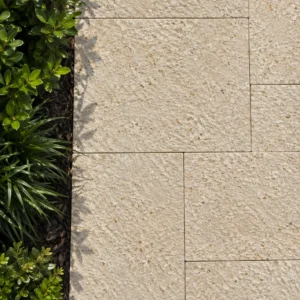
An open terrace in Saint Lucia takes sun, salt-laden air on exposed frontage, and rain that arrives with real force. The stone here steps up in thickness from interior tile because it is bedded outdoors, because it may span slightly uneven support, and because it has to survive being walked on wet.
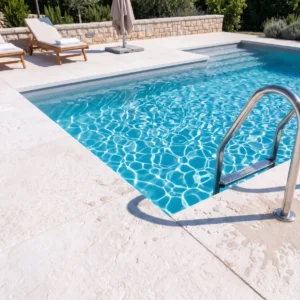
Pool surrounds are a special case. They stay wet for hours, they take bare feet, and a slick surface is a liability, so a textured finish matters more than an extra fraction of thickness. Pale stone also runs cooler underfoot than a dark unit in full sun.
- Step up from interior gauge for anything bedded outdoors
- Choose a textured surface everywhere bare feet meet water
- Keep pale tones where terraces sit in unbroken sun
- Detail a fall away from the house and the pool shell
- Allow a movement and drainage line at the terrace edge
Driveways, Aprons and Turning Grounds
Anywhere a wheel turns rather than simply rolls, the loading changes character. Turning imposes a twisting force on individual units and on the joints between them, which is why gateposts, garage aprons and service yards break up first.
- Move to a thicker unit, or to a small sett with real depth
- Reduce unit size, because smaller units share load better under a wheel
- Bed on a properly compacted base rather than on sand alone
- Restrain every edge, because an unrestrained edge migrates under traffic
- Detail the transition where a paved apron meets asphalt or concrete
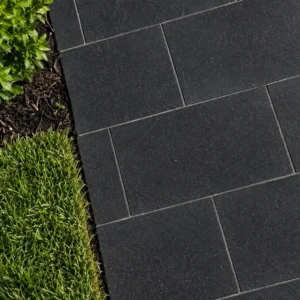
For heavy vehicle duty we frequently steer clients toward basalt where wheels turn hardest, because a dense dark stone tolerates that punishment well.
Setts, Curbstones and Edge Restraint
Small units earn their place on this terrain. They follow a fall, they turn a curve without endless cutting, and they let a mason work a slope in short sections rather than fighting a large slab into position on a gradient.
Curbstones and edging are not decoration on a steep site. They hold the field of paving together, they stop sheet flow undermining the outer course, and they give a laying crew a datum to work to. Specify them at the same time as the paving, not as an afterthought when the budget is already spent.
Setts also make phasing easier. A crew can complete a defined section, restrain it properly, and leave it usable while the next section waits for material, which suits sites where deliveries arrive in stages.
Format Size Against Site Access
The biggest slab that suits the drawing is not always the biggest slab that reaches the site. Northern villa developments around Cap Estate and Rodney Bay often have narrow service lanes and steep private driveways, and Soufriere projects are reached on the winding west-coast road.
- Ask what the crew can lift by hand without mechanical help
- Check whether crates can reach the stack or must be shuttled in
- Match crate weight to the smallest truck that can make the final approach
- Order one format per crate so partial deliveries stay workable
What Sits Underneath the Stone
Saint Lucia has an established, locally owned quarry and aggregate industry supplying crushed rock, sand, filter stone, armor stone, blocks and ready-mix. That material is what a good sub-base is made of, and it is sourced far more sensibly on the island than shipped across an ocean.
Imported dimension stone does a different job: it is the calibrated wearing surface that sits on top of that base. Get the local base right and the imported surface performs. Get it wrong and no thickness of stone will rescue the detail.
Write the Duty Class Into the Order
When you send an inquiry, describe the areas rather than only the square footage. Tell us which zone takes vehicles, which stays wet, which is interior and which sits on a slope. We would rather ask three questions at quotation than replace a broken apron a year later.
Ask for paving thickness for Saint Lucia sites to be confirmed in writing against each area of your drawing. A format matched to its duty class is the cheapest insurance a hardscape budget ever buys.