

Layout geometry does more work in a paver patio ideas project than most homeowners realize — the pattern you choose determines not just the visual rhythm, but also how loads distribute across the base, how joints handle movement, and where you’ll spend the most time on cuts. Picking a layout without understanding those trade-offs leads to cracked edges and rocking slabs within a few seasons. The twelve layouts below cover the full range of options, from straightforward running bond to intricate medallion patterns, with honest notes on where each one earns its place and where it falls short.
What Layout Geometry Actually Does for Your Patio
Paver pattern selection sits at the intersection of aesthetics and structural engineering. A herringbone layout, for example, interlocks units at 45- or 90-degree angles so that horizontal loads — from furniture movement, foot traffic, and freeze-thaw cycling — transfer through the joint network rather than concentrating at individual unit edges. Running bond does the opposite: it creates continuous longitudinal joints that can act as fault lines if the base prep isn’t perfect. Understanding that distinction lets you match the right patio paver layout to your actual site conditions, not just your mood board.
Stone selection also shapes the layout decision in ways that rarely appear in design guides. Thicker slabs — 1½ to 2 inches — carry enough mass to dampen minor base irregularities, while thinner material (¾ inch) demands a near-perfect screed and is more vulnerable to edge chipping during installation. According to Natural Stone Institute stone selection standards, dimensional consistency within a shipment directly affects joint tightness and pattern legibility, so verifying material calibration before layout begins saves significant correction time on site.
Running Bond: The Reliable Workhorse
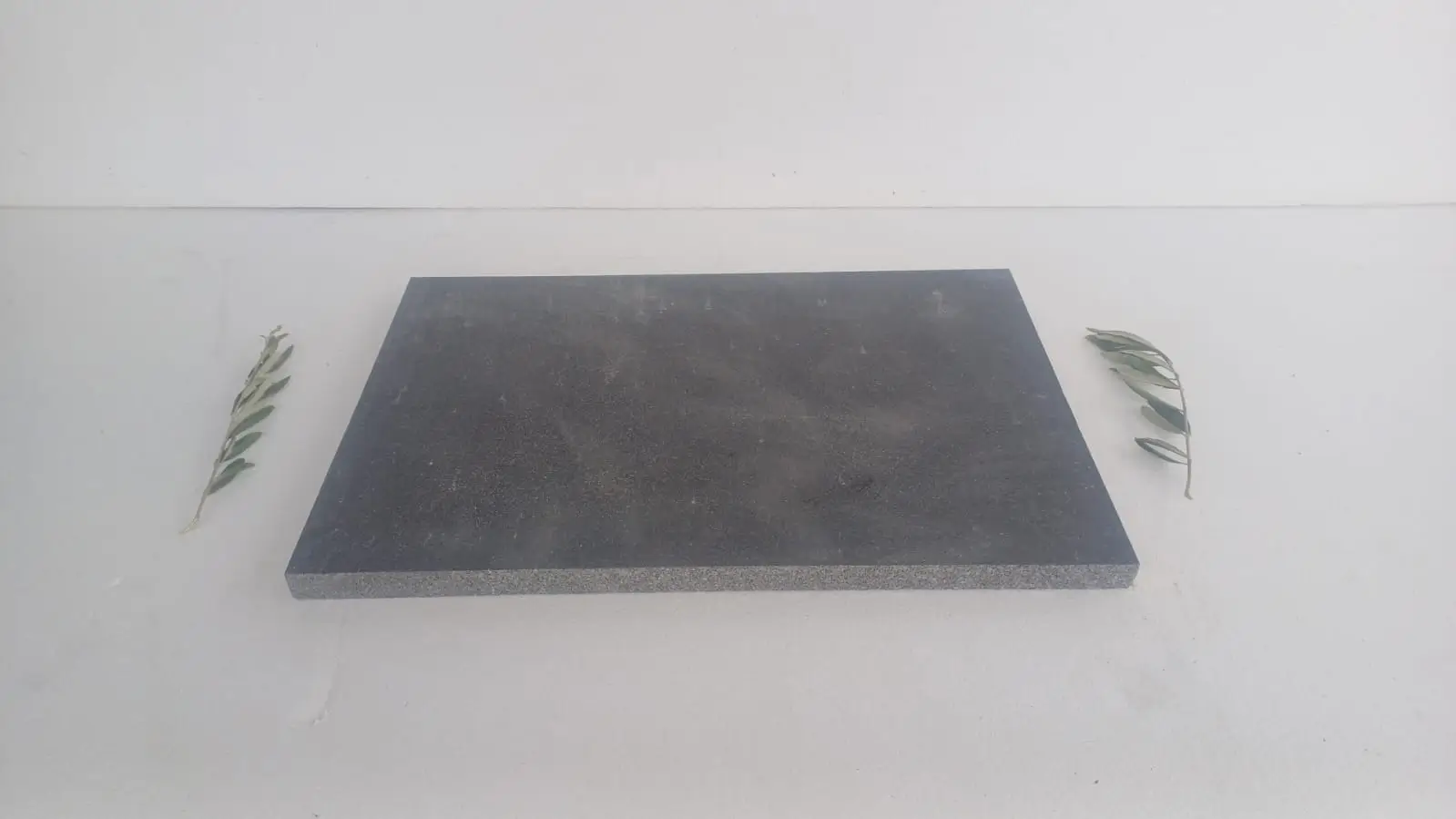
Running bond — units offset by half a length in each successive course — is the most forgiving layout for rectangular spaces. Your cuts happen primarily at the perimeter, the pattern reads clearly from any viewing angle, and installation moves quickly once the starter course is set. For a standard backyard stone patio, running bond in natural stone pavers delivers a clean, timeless result without demanding the cutting precision that basket weave or pinwheel patterns require.
- Offset each course by exactly 50% to avoid a continuous joint that travels more than two units — this keeps interlock integrity intact
- Orient the long axis of each unit perpendicular to your primary viewing line to create a sense of depth and draw the eye through the space
- Running bond tolerates minor base settlement better than stacked patterns because diagonal load transfer compensates for localized low points
- Edge restraint at the perimeter is non-negotiable — without it, the end units of each course migrate outward over time under thermal cycling and traffic
Herringbone: Maximum Interlock for High-Traffic Areas
Herringbone earns its reputation for structural performance because the 45-degree unit angle creates a self-locking matrix in both the X and Y planes simultaneously. This matters significantly in areas subject to heavy furniture, rolling loads, or freeze-thaw cycling. The pattern’s mechanical advantage comes from the way shear forces distribute through the joint network: no single joint runs more than one unit length without intersecting a perpendicular joint.
Durability in wind-exposed or storm-prone installations benefits specifically from herringbone because wind-driven rain and rapid drainage cycles stress edge restraint and joint sand cohesion. A tightly laid herringbone pattern with properly filled joints — polymeric sand compacted to 90-95% joint depth — resists joint erosion from high-volume water flow far better than straight-set patterns. Per ASLA outdoor patio material guidance, joint integrity under dynamic loading is a primary performance factor for natural stone patio installations.
- 90-degree herringbone runs parallel to the structure; 45-degree herringbone runs diagonally — the diagonal variant generates more perimeter cuts but produces stronger visual energy in larger spaces
- Waste factor for 45-degree herringbone runs 12-15% on rectangular sites — budget your stone order accordingly
- A wet saw with a consistent fence guide is essential for the perimeter triangles — freehand cuts here read poorly against the pattern’s geometric precision
Basket Weave: Traditional Character with Modern Appeal
Basket weave pairs two units side by side, then rotates the next pair 90 degrees. The result is a textile-like surface with strong historical associations — it’s common in period restoration work and traditional garden settings. Material needs to be precisely calibrated for basket weave to read correctly: if unit width doesn’t equal exactly half the unit length, the pairs won’t align and the pattern collapses visually.
Natural stone pavers require additional quality checking for basket weave because dimensional variation from the quarry affects pattern geometry more severely than in simpler layouts. At Citadel Stone, we verify calibration tolerances at the warehouse before shipment, which is especially important for basket weave orders where dimensional consistency across the entire pallet determines whether the pattern holds through the full installation.
- Basket weave works best with modular pavers where 2 × width = 1 × length — verify this ratio with your supplier before ordering
- The pattern creates a closed visual boundary around each pair grouping, which suits smaller patio areas better than large open expanses
- Joint sand erosion affects basket weave more visibly than herringbone because the orthogonal joint lines are more prominent — budget for annual top-dressing in exposed installations
Ashlar and Random Layouts: Organic Movement in Stone
Random ashlar — mixing two or three unit sizes in an irregular but balanced layout — is the most naturalistic of the common outdoor patio pavers ideas. The pattern mimics dry-laid fieldstone while maintaining the consistency of calibrated material, and it suits informal garden settings, woodland edges, and organic landscape designs where geometric precision would feel out of place.
Executing random ashlar well requires more pre-planning than the name suggests. Dry-laying a test section covering at least 25 square feet before committing to mortar or bedding sand lets you confirm that no four corners meet at a single point — that cross-joint is a structural weak spot and a visual fault that draws the eye. The ASLA permeable surface design guidance notes that joint continuity and base preparation quality determine long-term performance in naturalistic stone layouts more than material selection alone.
- Use a 60/25/15 ratio for three-size ashlar: 60% of the largest unit, 25% of the mid-size, and 15% of the smallest — this prevents the pattern from looking either too uniform or too chaotic
- Mark your layout lines on the base before placing stone — random patterns still need a consistent horizontal datum and working lines to prevent drift
- Impact resistance matters in ashlar layouts during installation: smaller infill units are vulnerable to edge chipping from adjacent placement, so handle each piece from the face edges, not the corners
Pinwheel and Windmill Patterns: Focal Point Layouts
Pinwheel arranges four rectangular units around a central square cap, creating a rotating visual effect across the patio surface. This is a statement layout — most effective as a feature zone within a larger patio rather than a wall-to-wall treatment. The pattern rewards careful material selection: the center cap reads as the accent piece, so specifying a contrasting tone or texture for that element drives the design intentionally rather than accidentally.
Pinwheel and windmill layouts demand precise dimensional control at every unit because the pattern repeats on a fixed module. Any variation in unit length propagates through the entire field, creating gaps that widen progressively toward the edges. Browse the Citadel Stone paving collection for modular natural stone options with the calibration consistency these geometric patterns require.
- Calculate your module size from the center cap outward — the surrounding rectangle width must equal the cap dimension for the pinwheel to close correctly
- Reserve pinwheel for zones under light foot traffic or dining areas where furniture placement is fixed — the pattern can be visually disrupted by misaligned furniture legs
- Contrast works best when the cap material shares the same thickness as the field material to avoid lippage at the center joint
Large-Format Slabs: Contemporary Minimalism
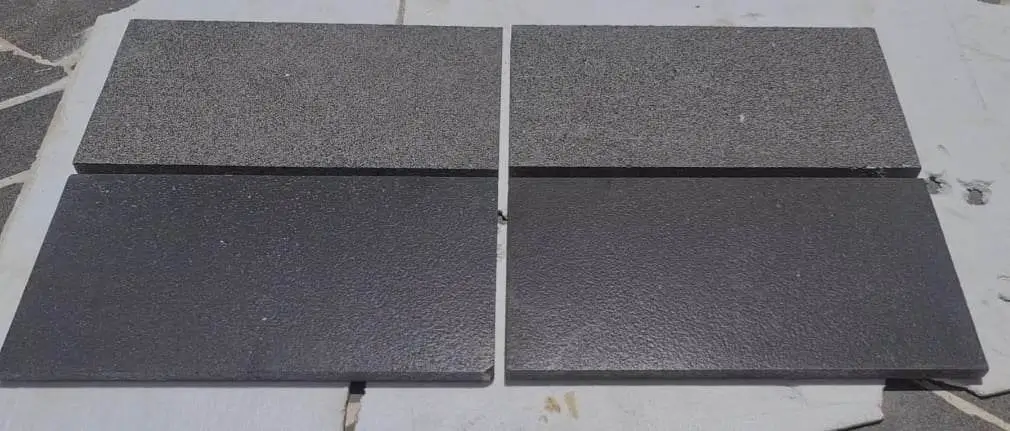
Large-format natural stone slabs — 24×24 inches and above — have become the dominant format in contemporary outdoor design, and for good reason. The reduced joint frequency creates visual calm and makes the material’s natural patterning the primary design element rather than the layout. A stone patio installed with large-format slabs reads as a continuous surface rather than an assembled mosaic, which suits modern architecture and clean-lined outdoor furniture particularly well.
The trade-off is installation complexity. Large slabs require a mechanically flat base — ±⅛ inch over 10 feet — because any base irregularity creates lippage that becomes a tripping hazard and concentrates point loads at the high corner of each unit. In regions with active freeze-thaw cycles, large-format slabs demand deeper aggregate bases (8-10 inches compacted) and proper drainage slopes (minimum 1% grade away from the structure) to prevent differential frost heave from rocking individual pieces.
- Check warehouse stock for slab lot continuity before ordering large-format — veining and tone can shift between production batches, and a mid-project reorder from a different batch is visually obvious
- Suction cup lifters and two-person placement are essential for anything above 24×36 — solo placement causes corner chipping and inconsistent bedding contact
- Expansion joints every 8-10 feet are mandatory in large-format slab patios — without them, thermal expansion concentrates stress at the weakest grout line or the nearest structural edge
Circular and Fan Layouts: Design Ambition with Real Constraints
Circular patterns — whether a full radial medallion or a fan section anchored to a focal point — create the most visually dramatic paver patio ideas in any portfolio. They command attention and establish hierarchy in the outdoor space immediately. The structural challenge is that circular layouts generate a high percentage of tapered cuts, and the quality of those cuts determines whether the finished pattern reads as intentional artistry or an approximation.
Tapered cuts in natural stone pavers require a wet saw with an adjustable angle fence and a skilled operator who understands stone grain direction. Cutting across the grain on certain limestone and travertine varieties causes edge spalling along the cut face — adjusting the cut angle slightly to run with the dominant cleavage plane rather than against it resolves this issue. This is detail knowledge that separates contractors who regularly do decorative stone work from those adapting from concrete paver experience.
- Pre-draw your circle geometry on the base using a chalk line and center pivot before any stone arrives on site — circular patterns laid by eye drift measurably
- Budget 20-25% waste for radial layouts, and order material from the same warehouse lot to ensure consistent thickness across all tapered pieces
- Circular layouts perform best when surrounded by a rectangular field pattern in running bond or ashlar — the contrast of geometries amplifies the medallion’s impact
Mixed-Material Layouts: Combining Stone Types
Combining two stone types in a single patio paver layout adds material texture contrast to geometric contrast, creating designs that read as intentionally curated rather than off-the-shelf. Common pairings include dark basalt headers with limestone field stone, or travertine field pavers with a granite border course. The key specification constraint is thickness matching — both materials must share the same nominal thickness, or persistent lippage will appear at every transition joint.
At Citadel Stone, our technical team advises customers on material pairings that share compatible thermal expansion coefficients. Mixing stone types with significantly different expansion rates — granite at roughly 4.7 × 10⁻⁶ per °F versus limestone at approximately 4.4 × 10⁻⁶ per °F — creates differential movement at transition joints that progressively opens gaps over time, particularly in installations exposed to large daily temperature swings.
- Match finish type across materials as well as thickness — a honed field stone with a rough-textured border reads as unfinished rather than designed
- Use the denser, darker material for border and header courses, where impact from mower wheels and edge maintenance equipment is highest
- Verify that both materials are available from the same warehouse stock before committing to the design — sourcing mismatches mid-project create costly delays
Storm Durability and Edge Integrity Across All Layouts
Severe weather events — high winds, hail, and storm-driven water flow — test paver installations in ways that calm-weather inspections miss entirely. Wind-driven rain at velocity creates lateral water intrusion through joints that exceeds normal rainfall percolation rates by a significant margin, and joint sand that isn’t properly compacted or sealed washes out rapidly in these events. The outdoor patio pavers ideas you pursue and the layout pattern you choose directly affect how vulnerable the installation is to this kind of mechanical stress.
Herringbone and running bond with offset joints handle storm water flow better than stacked bond patterns because the joint network redirects water laterally rather than channeling it straight through. Edge restraint strength matters most in wind-exposed locations: aluminum or polymer edging systems anchored at 12-inch intervals perform significantly better than those anchored at 24 inches under lateral loading from wind-driven debris and equipment impact. According to USGS dimension stone construction use data, natural stone pavers with compressive strength above 8,000 PSI demonstrate notably better hail impact resistance than lower-density alternatives — a specification threshold worth including in your project documentation when impact resistance is a design priority.
- Polymeric jointing sand outperforms standard bedding sand in storm-exposed installations — its polymer binders resist washout under high-volume water flow while maintaining permeability under normal conditions
- Specify minimum 1½-inch nominal thickness in any exposed or wind-corridor location — thinner material is more susceptible to edge chipping from impact and requires more frequent replacement
- Inspect edge restraint anchor spacing after any major storm event — lateral loads from water runoff can shift anchors, and early correction prevents progressive edge migration
Decision Points for Your Paver Patio Layout
The most durable paver patio ideas share a common foundation: the layout pattern, stone thickness, base depth, and edge restraint system are chosen together as a system, not as independent decisions. Your layout choice should follow from your site geometry, traffic expectations, and base conditions — not the other way around. Herringbone for high-traffic or storm-exposed zones, large-format slabs for contemporary minimalism with a near-perfect base, running bond for efficient installation across standard rectangular spaces, and medallion or circular elements where a focal point justifies the cutting investment.
Truck access for delivery deserves attention earlier in the planning process than most homeowners give it. Material for a mid-sized patio can arrive on a single truck if you coordinate staging areas in advance — but an unplanned delivery to a tight access point delays the installation timeline and can result in batch mismatches if a second truck pulls from a different warehouse lot. Confirm driveway clearance and staging area dimensions with your supplier before finalizing your order. As you finalize your stone patio design, exploring related hardscape materials can sharpen your specification decisions — black limestone flooring options covers how this material family performs in demanding applications and what thickness and finish choices matter most. Pavers from Citadel Stone come in modular sizes that simplify running-bond and herringbone paver patio ideas.
Related reading: How to Install Patio Pavers: Base, Joints, and Drainage · stone tiles vs deck tiles · fixing black stains on limestone.