Drive an hour down St. Lucia’s west coast and you change climates. The north around Cap Estate and Rodney Bay runs drier, breezier and flatter — beach-country weather on gentle ground. The southwest around Soufrière runs lush, steep and generous with rain — rainforest country with a resort belt in it. Most islands hand a designer one set of conditions; St. Lucia hands them two, and stone specification that treats the island as a single climate gets one coast wrong. Here is the two-climate playbook.
The split, stated plainly
The island’s geography does the explaining: its volcanic spine wrings rainfall out of the trade winds as they cross, so the mountainous southwest catches the water and the low northern tip stays comparatively dry. The north’s conditions echo a coral island — sun, sand, salt breeze, modest gradients; the south’s echo Grenada — canopy shade, damp mornings, real slopes. Same island, one hour apart, and nearly every stone decision — finish, tone, drainage, even logistics — lands differently on each side of the line.
Finishes: two problems, two answers
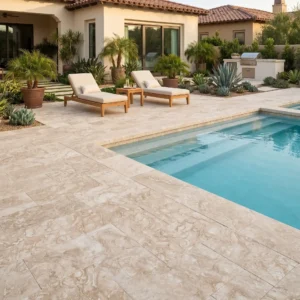
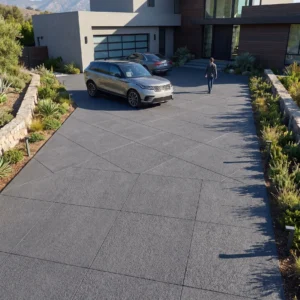
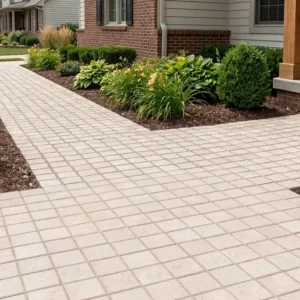
Texture is mandatory on both coasts for opposite reasons. Southern surfaces fight moisture: pool surrounds, shaded walks and stairs stay damp under canopy, algae keeps its seasonal calendar, and the full wet-climate grip package — brushed and bush-hammered faces, falls that clear water fast — is simply standard. Northern surfaces fight sun and sand: open terraces need glare management (mid-sheen finishes, tonal mixing on large paved areas) and grip that survives a film of beach sand underfoot, with the pale-deck comfort logic applying in full. The same catalog serves both coasts; the finish catalog within it should not.
- Southern surfaces detailed against moisture, with brushed or textured finishes on every damp route.
- Algae treated as a seasonal maintenance rhythm rather than a surprise.
- Northern surfaces detailed against heat and glare, with pale tones and comfortable texture.
- Wind-blown sand allowed for on beach-country sites, where it grinds a fine finish flat.
- The same stone family used both ends, with the finish doing the adapting.
Gardens: managing growth versus managing thirst
The landscape briefs diverge just as far. Southern gardens are exercises in taming the green — firm stone bones, defensible edges, root strategy and canopy-stain management, because everything grows enthusiastically and the hardscape is what keeps exuberance legible. Northern gardens lean the other way: drier ground rewards the gravel-and-slab composition — curated drought-tolerant planting as events within a stone framework, minimal irrigation dependency, wind-aware outdoor rooms. A designer fluent in both vocabularies can quote either coast honestly; a portfolio that only knows one will fight the other forever.
Communities: estate rules north, resort standard south
The human geography splits along the same line. The north is organized villa country — Cap Estate’s established community with its palettes and expectations, Rodney Bay’s marina life with its wet-gear practicality and its seasonal surge when the Atlantic rally fleet arrives — and stonework there answers to estate consistency, sand-wise surfaces and the sailing household’s working waterfront habits. The south answers to the resort belt’s bar: view-first composition, wet-climate engineering and the finish standard the flagship properties have taught every client to expect. Two briefs, two review audiences, one supplier conversation — as long as the specification names its coast.
Logistics follow the climate line
Even delivery splits north-south. Northern sites enjoy the island’s easiest logistics: short, flat runs from Castries to Cap Estate and Rodney Bay, generous access, simple staging. Southern sites inherit the west-coast road — winding, slow, occasionally needing transfer points and always needing planned crate weights — or the alternative of southern routing through Vieux Fort for deep-south projects, the two-port decision covered in the St. Lucia shipping guide. The practical rule: northern deliveries are scheduled; southern deliveries are designed.
- Northern sites served by short, flat runs from Castries with generous access and simple staging.
- Southern sites inheriting the west-coast road, which is slow, winding and occasionally single-lane.
- Vieux Fort considered as an alternative landing for the deep south.
- Crate weights planned to the handling equipment available at the far end.
- Transfer points identified in advance where a full-size truck cannot finish the journey.
One specification, zoned
None of this argues for two suppliers or two orders — it argues for one order specified in zones, the discipline the whole Caribbean cluster already runs. Tone and material hold constant across a property (and even across an owner’s two properties on opposite coasts); finish, thickness and detailing shift with each zone’s exposure; the cutting list carries the specials each coast demands — treads and wall caps for southern slopes, sand-tolerant thresholds and wind-wall caps for northern openness. St. Lucia’s two climates are a scheduling note, not a complication: name the coast, zone the finishes, and the island’s split personality becomes a design asset — the rare address where a client can choose their weather without changing their stone. The supply guide asks the north-or-south question at inquiry for exactly this reason.
The third St. Lucia: the windward east
The north-south split covers the coasts most projects build on, but the island keeps a third climate in reserve: the Atlantic east, from Dennery down through Micoud, where the trade winds arrive unfiltered and the sea works harder. Properties here — fewer, but growing as the island’s development spreads — inherit the windward brief: constant salt-laden wind rather than the leeward coasts’ gentler haze, spray reaching further inland, and vegetation sculpted by the same forces the stonework must shrug. The specification borrows from the region’s front-row playbook – dense, low-absorption stone throughout, marine-grade fixings without exception, textured surfaces for wind-driven wet, and the freshwater rinse discipline promoted from suggestion to schedule. Wind-wall thinking earns its keep here more than anywhere else on the island, turning exposed terraces into usable rooms. The east is the coast that punishes optimistic specification fastest – and rewards the honest one with the island’s wildest views and its emptiest horizons.
Reading your own plot: the micro-site survey
North-versus-south sets the headline, but every plot runs its own microclimate, and an afternoon of observation outperforms any generalization. The survey is simple and worth writing down. Track the sun: where morning light lands (breakfast), where afternoon heat concentrates (shade budget), where sunset reaches (the terrace that earns the west). Read the wind: the corners where it funnels between buildings or ridgelines, the lee pockets where a still dinner is possible on a breezy night — flags or a smoky mosquito coil map it in an hour. Watch the water: where the plot’s own runoff wants to travel in a serious shower, which existing routes to formalize and which to intercept. Note the neighbors’ evidence: how their walls have weathered on each face, where their algae grows, which of their trees lean — a street’s existing buildings are a weather report with years of data. Then zone the specification within the plot exactly as this guide zones the island: the exposed southwest corner may want the south’s full texture package while the sheltered courtyard twenty meters away takes the finer finish happily. The island’s two climates are really a spectrum, and every property sits at its own point on it — the plot survey is how you find yours before the stone is cut.
How different the two halves really are
The north-south split is not impressionistic; it is measured, and the numbers justify specifying in zones. The Caribbean Regional Climate Centre profile for Saint Lucia sets out the range.
- Mean annual rainfall of about 1,911 mm at George F. L. Charles Airport.
- Totals from around 1,500 mm in the extreme south to more than 3,000 mm at the highest inland elevations.
- A wet season from June to November, with monthly rainfall commonly around 200 mm from July onward.
- October the wettest month on record, at 681.5 mm in October 2010.
- Annual temperatures moving only between about 26 degrees Celsius in February and 28.1 in June.
Setting systems for two very different grounds
Flat, free-draining northern plots and steep, saturated southern ones do not want the same construction beneath the stone. Choosing the system by zone is what keeps one specification coherent. This overview of detailing natural stone paving covers the three options.
- Sand-set paving where ground is stable and units may need lifting and relaying.
- Mortar-set construction on slopes, steps and anywhere stability governs absolutely.
- Pedestal systems where a terrace sits over structure with drainage beneath.
- Base depth and compaction matched to the ground, not copied between coasts.
- Drainage capacity sized from the local rainfall figure rather than an island average.
Writing one order that serves both coasts
Two climates do not require two suppliers. They require one order written in zones, which is cheaper, faster and visually more coherent.
- One stone family and one tone across the whole property portfolio.
- Finish varied by zone, with texture increased wherever a surface stays damp.
- Thickness and format varied by traffic rather than by coast.
- A single batch reserved per continuous surface, wherever that surface sits.
- Spares held at each location, since the road between them is the slow part.
St. Lucia villa design across two climates, one specification
The island really does behave like two places, and pretending otherwise is what produces slick southern stairs and glaring northern terraces. The answer is not two schemes but one material logic applied with local judgment: same family, same tone, more texture where it stays wet, more reflectance where it stays hot, drainage sized from the rainfall the site actually gets, and delivery planned around the road rather than the map. For palette and lead times, our St. Lucia stone supply guide covers the rest. Specify one stone and let the finish do the traveling.