What the Numbers Reveal About Each Material
The natural stone tile vs porcelain debate looks simple on the surface, but the performance gap between the two materials widens dramatically once you move past aesthetics and look at the actual data. Porcelain absorbs less than 0.5% moisture — a technical threshold that changes everything about how you seal, maintain, and install it. Natural stone, depending on species, runs from 0.4% absorption in dense basalt to over 12% in some travertines. That range matters more than any side-by-side photo comparison ever will.
Your material choice locks in a cascade of downstream decisions: substrate prep depth, mortar type, grout selection, sealing schedule, and long-term maintenance cost. Understanding where each material excels — and where it genuinely struggles — is the only way to make a specification you won’t regret two installation cycles from now.
Surface Performance and Durability: A Realistic Assessment
Porcelain is fired at temperatures exceeding 2,200°F, which produces a vitrified body with compressive strength typically between 12,000 and 18,000 PSI. That makes it extraordinarily resistant to cracking under point loads — particularly relevant for commercial floors with rolling equipment or heavy foot traffic. Natural stone’s compressive strength varies widely: granite ranges from 15,000 to 30,000 PSI, while limestone sits between 4,000 and 15,000 PSI depending on density and quarry origin.
- Porcelain scratch resistance (Mohs hardness 6–7) outperforms softer stones like travertine and limestone (Mohs 3–4)
- Granite and basalt match or exceed porcelain hardness, making them genuinely competitive for abrasive traffic zones
- Porcelain’s uniform density means consistent performance across every tile — natural stone varies slab to slab from the same quarry lot
- Natural stone’s crystalline or sedimentary structure provides thermal mass benefits that porcelain, despite its density, cannot replicate
Here’s what most tile specifiers overlook: porcelain’s surface hardness creates a specific installation challenge. Cutting porcelain without a continuous-rim diamond blade rated for vitrified tile produces micro-fractures at cut edges that become water-entry points in wet applications. Stone tile comparison projects where porcelain was improperly cut often show edge delamination within 18 months in wet zones — a failure mode that rarely appears in natural stone tile installations using the same base system.
Moisture Absorption and Sealing Requirements
Your sealing strategy is where the natural stone tile vs porcelain comparison becomes most consequential for long-term project cost. Porcelain at sub-0.5% absorption is effectively self-sealed — it doesn’t require topical or penetrating sealer treatment in most applications. That’s a genuine maintenance advantage you’ll feel in year three and year seven, when natural stone installations are due for their second and third resealing cycle.
Natural stone requires penetrating sealer applied at installation and refreshed on a schedule that depends on traffic and exposure. For interior floors with moderate foot traffic, biennial resealing with a fluorocarbon-based impregnator is the practical standard. High-traffic commercial natural stone — lobbies, restaurants, retail — often warrants annual sealing checks. According to TCNA installation standards, proper surface preparation and sealing protocols are essential before grouting natural stone, particularly for stones with absorption rates above 3%.
- Travertine: absorption 3–12%, requires impregnating sealer before and after grout application
- Limestone: absorption 2–8%, penetrating sealer minimum every 24 months under normal interior traffic
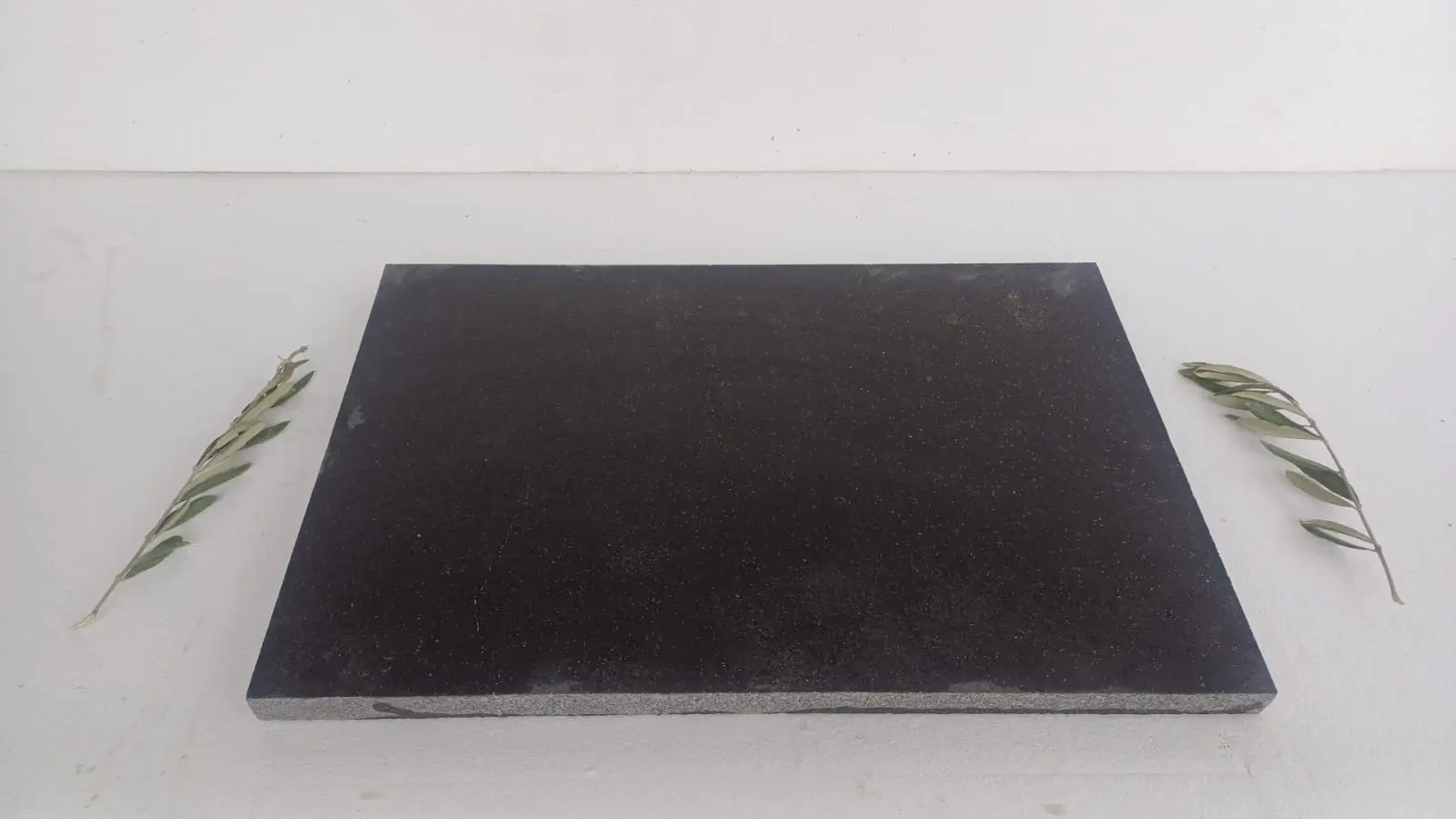
- Granite: absorption 0.1–0.4%, closest natural stone to porcelain in sealing demand
- Marble: absorption 0.2–2.0%, sealer needed but vulnerable to acid etching regardless of sealed status
- Porcelain: absorption below 0.5%, grout joints remain the primary moisture vulnerability — not the tile face
The practical takeaway here is that porcelain shifts maintenance burden from the tile surface to the grout joint. You’ll spend less on tile sealer but more attention on grout integrity, especially in wet areas where movement or thermal cycling can open hairline joint cracks over time.
Aesthetics and the Limits of Imitation: Tile That Looks Like Stone
Porcelain technology has produced genuinely impressive tile that looks like stone — current inkjet printing systems can replicate veining patterns across panels up to 60 inches wide with surface variation that’s difficult to distinguish from natural material in photographs. The challenge emerges at installation scale. Digital print technology repeats its pattern across a batch, which means a careful eye picks up repetition in large-format floor fields, particularly in herringbone or diagonal layouts where a recurring vein pattern becomes a visual rhythm that no natural quarried stone would ever produce.
Natural stone’s value proposition here is irreproducible variation. Every slab pulled from a travertine quarry or a limestone deposit carries unique fossils, vein paths, and tonal shifts that accumulate into a floor with genuine visual depth. NSI stone tile standards acknowledge this inherent variation as a characteristic of authentic natural material — not a defect — and project specifications should reflect it with appropriate shade and veining allowances in the tile order quantity.
- Porcelain tile that looks like natural stone works best in areas under 300 square feet where pattern repetition stays below the visual detection threshold
- Large-format natural stone tile (24×24 and above) creates a continuous visual field that no print-based product currently matches
- Honed finishes narrow the visual gap between stone and porcelain significantly — polished finishes expose the difference more sharply
- For tile floors that look like stone without the maintenance commitment, rectified large-format porcelain in a matte honed finish is the closest technical approximation
The specification question worth asking yourself is: will this installation be photographed in a controlled setting, or will it be experienced by people living or working in the space daily? The distinction shapes how much the replication gap matters to your client or end user.
Installation Variables and Base Requirements
Your substrate has to be right before either material touches it — and the tolerance thresholds differ. Porcelain at large format (18×18 and above) demands flatness within 1/8 inch over a 10-foot span, tightening to 1/16 inch in the immediate 24 inches around any grout joint. Natural stone, particularly irregular or hand-gauged product, tolerates slightly more variation, though the setting mortar bed absorbs some of that differential.
Both materials require an uncoupling membrane or crack isolation layer over concrete substrates that are less than 12 months cured or show any evidence of movement. Where natural stone tile and porcelain diverge is in deflection tolerance: natural stone’s crystalline or sedimentary structure does not flex — substrate deflection that porcelain might absorb as micro-movement can fracture stone along existing bedding planes. Your joist span, subfloor thickness, and live load calculations need to be tighter for stone tile than for porcelain in wood-frame residential applications.
- Minimum subfloor deflection for stone tile: L/360 of span; porcelain allows L/360 but stone failures are less forgiving when that threshold is crossed
- Exterior stone tile installations require full mortar coverage (95% minimum) versus the 80% minimum acceptable for interior porcelain
- Movement joints at 12–15 foot intervals are mandatory for both materials — stone’s lower thermal expansion coefficient doesn’t eliminate the need
- Epoxy-modified thin-set is worth the cost premium for both materials in wet or exterior applications where bond failure is the primary failure mode
For projects where you’re working with Citadel Stone natural tile, our technical team can advise on mortar system compatibility based on specific stone species and nominal thickness — stone tile sourced from different quarry regions can have meaningfully different absorption rates that affect thin-set open time and bond performance.
Cost Factors and Total Project Budget
Material cost is only one line item in a stone tile project budget, and it’s rarely the deciding factor when you map out the full cost picture. Porcelain tends to run $3–$12 per square foot at the tile level for commercial grades, while natural stone ranges from $6 for commodity limestone up to $30+ for premium marble or exotic granite. That gap sounds decisive until you factor in everything downstream.
Freight distance and material sourcing directly affect what you pay for either product. Natural stone tile sourced from Mediterranean quarries — Turkey, Spain, Portugal, Greece — carries international shipping cost that gets absorbed into the tile price. Citadel Stone’s national warehouse network compresses that supply chain, reducing lead times from the typical 6–8 week import cycle down to 1–2 weeks for in-stock material. That lead time reduction alone can prevent schedule overruns that cost more than the material price difference between stone and porcelain.
- Labor cost for natural stone installation typically runs 15–25% higher than porcelain due to weight handling, cutting complexity, and sealer application
- In markets with tight labor supply, that differential widens further — stone tile installation requires experienced setters who command a premium daily rate
- Porcelain’s uniformity reduces waste factor: plan for 10% overage on porcelain, 15–20% on natural stone to account for variation culling and cut waste
- Long-term maintenance cost for unsealed porcelain is near zero at the tile face; natural stone maintenance adds $0.50–$2.00 per square foot over a 10-year lifecycle depending on sealing frequency and product cost
- Value engineering option: use natural stone tile in high-visibility zones (entry, primary living areas) and switch to porcelain that looks like stone in secondary spaces — this concentrates aesthetic impact where it delivers ROI
Skilled installer availability affects this equation meaningfully across different labor markets. Where experienced stone setters are scarce, the labor premium for natural stone can close the cost gap between stone and a premium-grade large-format porcelain. Your total project cost analysis needs to account for installer availability and prevailing rates, not just the per-square-foot material number.
Thermal Performance and Practical Environment Considerations
Thermal mass is a genuine performance differentiator — not marketing language. Dense natural stone tile absorbs and releases heat slowly, which moderates surface temperature swings in high-heat environments. This makes stone tile the technically superior choice for radiant heat systems: stone conducts warmth evenly across the slab face, while porcelain’s lower thermal conductivity can create hot spots near heating element runs in improperly designed systems.
According to ASTM stone tile testing standards, absorption and thermal cycling resistance are two of the primary performance markers that distinguish stone species for demanding environments. In freeze-thaw regions, exterior stone tile needs to meet ASTM C97 absorption thresholds — typically below 3% for frost-resistant specification — which rules out softer travertines and some limestones for outdoor use in cold climates while keeping dense granite, basalt, and low-porosity limestone fully viable.
- Granite tile in exterior applications handles freeze-thaw cycles that would destroy most porcelain — its near-zero absorption means virtually no water penetration to expand and fracture
- Porcelain’s vitrified body also performs well in freeze-thaw conditions, but its grout joints remain vulnerable without proper sealant maintenance
- Hot, dry climates favor natural stone’s thermal mass — tile floors that look like stone in porcelain run measurably hotter underfoot in direct sun exposure
- Radiant heat systems deliver optimal efficiency under 3/4-inch or 3/8-inch natural stone tile; thicker stone slabs increase thermal lag but smooth out temperature cycling
Slip Resistance and Finish Selection
Finish choice controls slip resistance more than material type in most real-world applications. A polished marble and a polished porcelain present comparable DCOF (Dynamic Coefficient of Friction) values in the 0.35–0.42 range — both borderline for wet commercial use. Drop either to a honed, brushed, or tumbled finish, and the surface carries far more texture, which is what 0.42, the ANSI A326.3 wet DCOF threshold exists to verify.
Your finish decision also shapes maintenance complexity. Polished natural stone etches on contact with acidic cleaners — even mildly acidic — while porcelain’s vitrified surface resists etching entirely. That distinction matters in kitchens and restaurant settings where cleaning chemistry isn’t always controlled. Honed stone tile finishes are more forgiving of cleaning product variation and the right practical choice for most commercial food service applications.
- Tumbled or brushed stone tile offers the highest slip resistance in the natural stone category — surface texture creates mechanical friction that exceeds most porcelain finishes
- Rectified porcelain tile allows grout joint widths as narrow as 1/16 inch, while natural stone tile works best at 1/8 inch minimum to accommodate dimensional variation
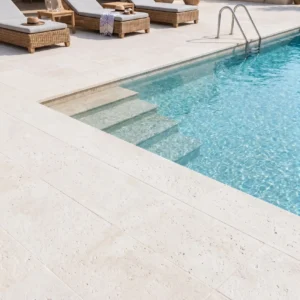
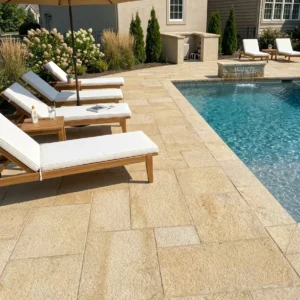
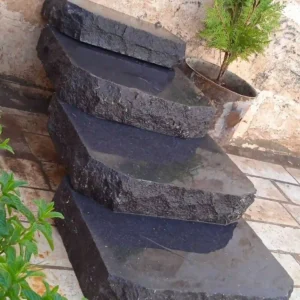
- For pool surrounds and wet outdoor areas, honed travertine or bush-hammered granite outperforms most porcelain finishes at equivalent grout joint widths
- Matte porcelain finishes can be specified to meet the ANSI A326.3 minimum wet DCOF of 0.42 for wet area applications without sacrificing visual refinement
Specifying the Right Material: Your Action Plan
The natural stone tile vs porcelain decision ultimately comes down to three project-specific factors: the tolerance your client has for ongoing maintenance, the structural capacity of your substrate system, and the visual authenticity requirement of the finished space. Porcelain wins on maintenance simplicity and dimensional consistency. Natural stone wins on thermal performance, long-term surface patina, and irreplaceable visual authenticity at scale.
For most residential interior applications, natural stone tile in a honed or brushed finish — properly sealed at installation and on a biennial schedule — delivers 25+ year performance without the visual limitations that come with porcelain tile that looks like natural stone through inkjet printing. For high-traffic commercial spaces where maintenance windows are constrained and installer labor costs are at a premium, large-format matte porcelain specified to the ANSI A326.3 minimum wet DCOF of 0.42 is a technically sound and aesthetically credible alternative. The nuance lies in knowing which environment you’re actually specifying for. As you extend your natural stone knowledge across different applications, our natural stone tile installation guide covers the step-by-step field process in detail — useful whether you’re supervising an installation team or briefing a contractor on your specification intent. Natural tile from Citadel Stone is sourced direct from quarries in Turkey, the Mediterranean, and beyond, graded for surface consistency.
Related reading: types of natural stone countertops · Stone Quarry to Slab: How Natural Stone Is Made · Types of Stone: A Complete Buyer’s Guide.