What Stone Type Actually Means for Your Project
Most specifiers treat types of stone as a cataloguing exercise — limestone here, granite there — but the real selection decision happens when you match pore structure, crystalline density, and surface finish to the specific loading, moisture, and finish demands of your application. The material family is just the starting point. Understanding the performance envelope of each stone type is what separates a specification that holds up for thirty years from one that starts showing fatigue within a decade. Your project deserves that depth of thinking from the very beginning.
Field performance data on different types of natural stone consistently shows that installation failures trace back to material mismatch, not material quality. A beautifully sourced travertine placed in a high-traffic commercial entry without the right fill and finish treatment will fail on timeline, not on geology. That’s the nuance this guide is built around — not just what each stone type is, but how it behaves under real conditions and where it belongs in your specification.
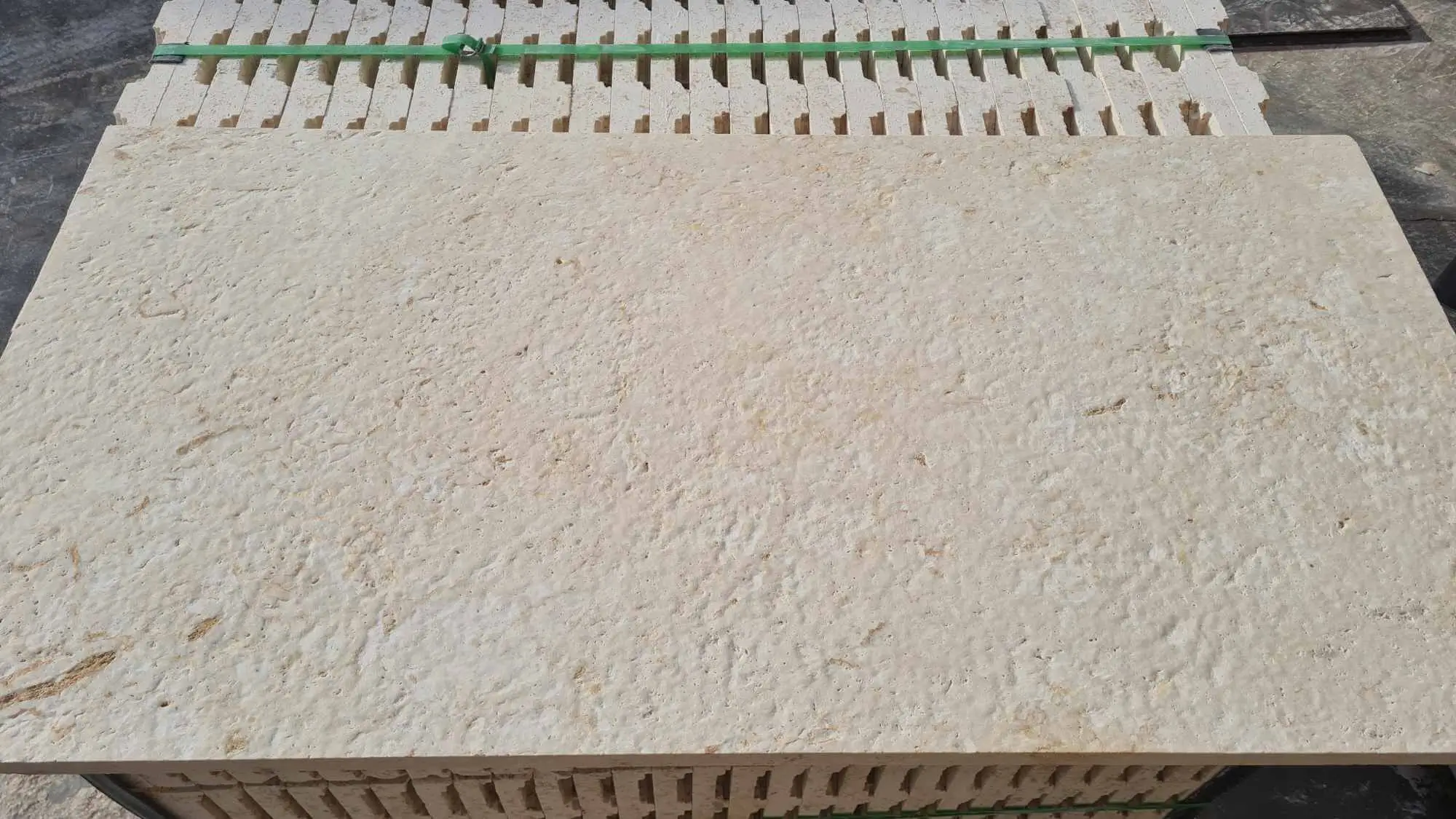
Limestone: The Workhorse of Natural Stone
Limestone sits at the centre of most natural stone specifications for good reason. Its calcium carbonate composition delivers compressive strengths typically ranging from 4,000 to 12,000 PSI depending on formation density, and its surface texture — whether honed, brushed, or tumbled — remains one of the most versatile in the industry. You’ll find it in pool surrounds, interior flooring, exterior cladding, and garden paving with equal credibility because it responds well to every standard fabrication process without the brittleness that plagues some metamorphic alternatives.
That said, limestone’s porosity range — typically 3–20% depending on the formation — demands that you assess your specific slab’s absorption rating before committing to a sealed or unsealed installation. Dense, low-porosity limestone from Jura or Jerusalem formations behaves almost like a sedimentary granite in outdoor applications. Highly porous shell limestone, on the other hand, requires penetrating sealer application every 18–24 months in wet-exposure zones to prevent staining migration into the matrix. According to NSI limestone technical properties, absorption rates vary significantly by formation, and specifying without testing is the single biggest mistake you can make with this material family.
- Honed finishes work well for interior floors and low-traffic exterior applications — they reduce surface reflection and feel underfoot is comfortable
- Brushed or flamed surfaces add tactile grip suitable for ramps, pool edges, and wet-zone applications without sacrificing stone character
- Tumbled limestone edges are best suited for informal garden settings — the rounded profile prevents chipping under foot traffic better than sharp-cut edges do
- Dense limestone (porosity below 5%) can be installed unsealed in exterior applications where water management is properly designed into the base
Drainage design matters enormously with limestone. In climates that see heavy seasonal rainfall or monsoon-pattern precipitation, a limestone paving specification without adequate slope — minimum 1.5% fall away from structures — will trap standing water long enough to initiate calcium carbonate surface dissolution. You don’t see this failure in the first year; it shows up as surface pitting and finish degradation between years three and five when base saturation accelerates the process.
Granite: Where Durability Meets Design Precision
Granite’s crystalline igneous structure places it at the top of the durability hierarchy among types of natural stone. Compressive strength values for quality-graded granite range from 19,000 to 30,000 PSI — numbers that make it the default specification for driveways, commercial plazas, and any application where point-load resistance from vehicle traffic or heavy equipment is a real concern. Its near-zero porosity (typically below 1%) also means it resists moisture absorption at a level no sedimentary stone can match.
For exterior applications, your finish selection is the most consequential decision in a granite specification. Polished granite is notoriously slippery when wet — a coefficient of friction that drops below 0.5 on a wet surface makes it a liability on exterior walkways and pool surrounds regardless of how striking it looks. Flamed or bush-hammered finishes bring that number back above 0.6 and maintain the stone’s visual depth without the hazard. For driveway and high-load applications, a sawn finish with light sandblasting achieves the grip profile you need while keeping fabrication costs reasonable. NSI granite durability standards provide the technical baseline for finish and application pairing that should sit behind every granite specification you write.
- Thermal cycling resistance in granite is exceptional — the low coefficient of thermal expansion (approximately 4.4 × 10⁻⁶ per °F) makes it one of the most freeze-thaw stable stones available
- Colour consistency in granite is directly tied to quarry uniformity — always request full-lot samples before approving large-format orders
- Jointing for granite pavers should account for thermal movement even at low expansion rates — 3mm joints at maximum 8-foot panels is the standard field recommendation
- Maintenance requirements for granite are minimal compared to limestone and travertine — no periodic sealing is required in most exterior applications
Travertine: Understanding the Pore Structure Trade-Off
Travertine is a calcium carbonate stone formed by mineral spring deposition, and its defining characteristic — the interconnected void structure that creates its visual warmth — is also the source of most installation problems when the material is specified without understanding that trade-off. You’re working with a stone that has natural voids ranging from 0.5mm hairlines to 15mm tunnels depending on the cut and fill treatment applied at the factory. Filled travertine uses cement or epoxy grout to plug surface voids; unfilled leaves them open for a more rustic character that requires ongoing maintenance in outdoor settings.
Pool surrounds are where travertine earns its reputation. The material’s thermal mass stays measurably cooler underfoot than dense igneous alternatives at the same solar exposure, and its naturally textured surface provides adequate wet-zone grip without requiring mechanical surface treatment. However, water management around travertine pool decks is non-negotiable — the stone must drain completely between wetting cycles to prevent chlorinated water from migrating into the fill compound and degrading the joint structure. A 2% minimum slope with French drain integration at the perimeter is the base-level requirement; anything less and you’re planning for remedial work within five to seven years.
For indoor flooring applications, types of natural stone like travertine in polished or honed finish deliver a warmth and material depth that most porcelain alternatives can’t replicate. The key specification decision is fill type — epoxy-filled travertine holds its surface integrity better in high-traffic zones because cement fill can loosen under repeated compression cycles. For a comprehensive look at how travertine and related stone types perform across different installation contexts, the Citadel Stone material guide provides sourcing and specification data drawn directly from quarry-level quality assessments.
Slate and Basalt: The Dense Metamorphic and Volcanic Options
Slate and basalt occupy a specific performance niche that most natural stone guides underserve. Both are exceptionally dense, low-porosity materials with distinct structural characteristics that make them strong candidates for specialised applications — but they also carry limitations that need to be front-of-mind in your specification.
Slate’s foliated structure — the layered metamorphic formation that gives it its characteristic cleft surface — is simultaneously its most valuable aesthetic feature and its structural vulnerability. The natural cleft provides excellent grip in wet conditions, but those same foliation planes can delaminate under repeated freeze-thaw cycling if water penetrates the laminar boundary. In freeze-thaw regions, specify only hard-slate formations with low water absorption (below 0.4%) and avoid soft slate entirely for exterior use. ASTM C629 slate dimension stone standards define the absorption and breakage resistance thresholds that separate acceptable exterior slate from material that will fail within three winters.
- Basalt’s fine-grained volcanic structure delivers compressive strengths comparable to granite — typically 22,000–28,000 PSI — with near-zero porosity that eliminates sealing requirements
- Honed basalt surfaces achieve a near-polished appearance with a subtle sheen that reads as modern and minimal in architectural applications
- Slate’s cleft surface in 20–30mm thickness is the standard specification for exterior cladding — thinner material risks delamination under UV and thermal stress
- Both materials are heavier than limestone and travertine — your base design and truck delivery logistics need to account for increased per-pallet weight, typically 20–30% higher than equivalent limestone
Sandstone and Flagstone: The Layered Sedimentary Family
Sandstone is a silica-bonded sedimentary stone that covers an enormous performance range depending on the degree of cementation in its matrix. Well-cemented quartzitic sandstone can reach compressive strengths of 18,000 PSI with porosity below 3% — a specification that holds up in demanding exterior conditions. Poorly cemented formations from the same quarry region may show porosity above 15% and compressive strength under 6,000 PSI, making them unsuitable for vehicle traffic or freeze-thaw exposure. The category name tells you almost nothing about the performance envelope; the test data tells you everything.
Flagstone is less a material type and more a format designation — irregular-cut natural stone slabs used for patios, walkways, and informal paving. The material beneath that format can be sandstone, limestone, bluestone, or slate depending on your region and supplier. Your specification needs to name the underlying stone type, not just “flagstone,” if you want consistent performance across a large project. Drainage is the critical design variable for flagstone installations — the irregular joint widths and varied thickness create hydraulic complexity that a standard mortared patio spec doesn’t resolve. Dry-set flagstone with a 4-inch compacted aggregate base and permeable joint sand handles precipitation variability better than a mortar bed in most residential and light commercial applications.
- Joint width in dry-set flagstone should maintain a minimum 12mm gap to allow drainage without creating trip hazards — wider gaps invite weed infiltration and require polymeric joint sand
- Thickness variation in natural flagstone (typically 25–50mm) needs to be accommodated in the sub-base design — a rigid base can’t compensate for 25mm of flag thickness variation without visible lippage
- Sandstone in high-rainfall or hurricane-belt climates requires a sealed surface if the porosity exceeds 8% — unsealed high-porosity sandstone absorbs enough water to expand perceptibly and create surface spalling over time
Marble and Quartzite: Interior Performance and Exterior Limits
Marble remains one of the most specified types of natural stone for interior applications — and one of the most consistently misapplied in exterior projects. Its calcite crystalline structure, which delivers the translucency and veining that make it visually extraordinary, is also what makes it reactive to acid rain, organic surface staining, and thermal cycling in freeze-thaw climates. For interior flooring, feature walls, and vanity surfaces, marble in honed or polished finish performs beautifully with appropriate sealing and maintenance protocols. For exterior use in regions that see significant precipitation variability — including heavy rain seasons, drought cycles, or freeze-thaw swings — marble is not a specification you want to defend three years after installation.
Quartzite sits on the opposite end of the durability spectrum among types of natural stone in the metamorphic family. Formed when sandstone undergoes heat and pressure metamorphism, quartzite achieves a silica-bonded structure with hardness values approaching 7 on the Mohs scale and compressive strengths regularly exceeding 20,000 PSI. It’s one of the few natural stones that performs credibly in both interior feature applications and demanding exterior environments. The challenge with quartzite is source consistency — true quartzite and quartzitic sandstone are frequently confused in the supply chain, and the performance difference between them is substantial. Always verify the material’s geological classification before committing to a quartzite specification on a structural or high-traffic project.
Water, Drainage, and Base Preparation Across Stone Types
The assigned support role of water management in natural stone selection is, in practice, the dominant failure variable across every stone type covered in this guide. Base preparation and drainage design aren’t secondary considerations — they’re the framework within which the stone type decision operates. Even the most durable granite paving will develop surface settlement and joint failure if the base saturates and loses bearing capacity during heavy precipitation cycles or extended wet seasons.
For any types of natural stone used in exterior applications, your base specification should include a minimum 4-inch compacted crushed aggregate layer (6-inch for vehicle traffic zones), a geotextile separation fabric between native soil and aggregate, and a minimum 1.5% surface slope for drainage. In regions with monsoon-pattern or hurricane-season rainfall — where you can receive several inches of precipitation in a matter of hours — bump that slope to 2% and design perimeter French drains into the layout from the start. Waiting to add drainage remediation after installation is consistently more expensive than building it correctly from the beginning. At Citadel Stone, we review base preparation specifications with customers before material ships, because the most common field failures we hear about are drainage-related, not stone-related.
- Limestone and travertine require slope and drainage that prevents standing water — even brief pooling accelerates surface carbonation and staining in these calcium-based materials
- Granite and basalt tolerate wetter base conditions better than sedimentary stones, but base saturation still causes settlement in any paving system regardless of surface stone type
- Flagstone and irregular-format stone need permeable joint fill rather than solid mortar in rainfall-heavy climates — this allows sub-surface drainage to relieve hydrostatic pressure under the slab
- Drought-cycle climates present a different challenge — expansive clay soils shrink and swell with moisture change, requiring a sand-set base thick enough to accommodate sub-grade movement without transferring it to the stone surface
USGS dimension stone production data confirms that natural stone’s longevity in field applications correlates closely with the quality of drainage infrastructure beneath it — a relationship that holds across USGS dimension stone production statistics for installed stone performance across all major geological categories. Your warehouse coordination before delivery should confirm slab dimensions and base specification simultaneously — ordering stone without finalising the base design creates sequencing problems that delay projects by weeks.
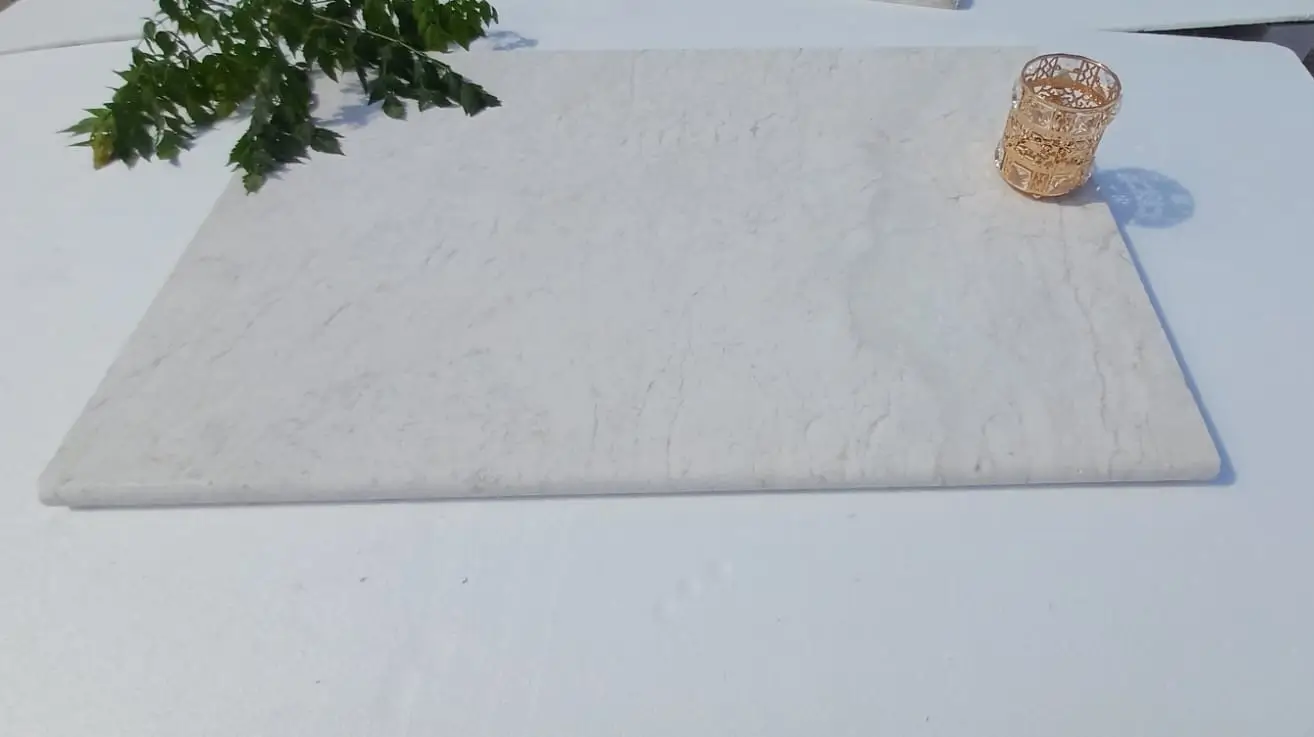
Matching Finish to Function Across Stone Families
Surface finish is the specification decision that most directly controls slip resistance, maintenance frequency, and long-term visual performance — and it’s the decision most often made on aesthetic grounds alone. Here’s what that approach costs you: a polished limestone interior floor in a high-humidity entry will require re-honing within five years as the foot-traffic-induced micro-scratching destroys the reflective surface. A flamed granite pool surround will hold its grip profile for twenty years with nothing more than an annual wash. The finish decision isn’t decorative; it’s functional.
For interior residential applications, honed finishes across all types of natural stone — limestone, marble, travertine, sandstone — deliver the best balance of visual appeal and maintenance practicality. Polished finishes belong on feature walls, fireplace surrounds, and low-traffic vanity surfaces where their reflective quality can be protected. For commercial interior floors, the coefficient of friction floor is 0.42 COF dry minimum under ADA and OSHA guidelines, which effectively rules out polished stone in most public-access applications without supplementary anti-slip treatment. The NSI ASTM stone specifications resource covers finish-specific testing protocols in detail for specifiers who need to document COF compliance.
- Tumbled finishes on limestone and travertine reduce COF below honed equivalents in some formations — test before specifying in high-traffic or wet-zone applications
- Sandblasted finishes on granite and basalt achieve consistent grip profiles suitable for exterior ramps and commercial walkways without mechanical texturing
- Brushed travertine provides better grip than filled-and-honed travertine in pool surrounds — the micro-texture created by brushing outperforms the smoother filled surface when wet
- Polished marble and limestone should never be specified for exterior horizontal surfaces regardless of aesthetic intent — the combination of acid rain, freeze-thaw, and UV exposure destroys the polished surface within eighteen months
Ordering, Lead Times, and Warehouse Logistics
Your project timeline depends heavily on understanding how natural stone moves through the supply chain. Imported stone — which covers most limestone, travertine, marble, and granite specifications — operates on 6–10 week lead times from quarry order to port arrival under normal shipping conditions. Planning your material order against that timeline means your stone specification needs to be locked before most contractors would consider it necessary. The projects that get into trouble are the ones where material selection happens concurrently with construction, leaving no buffer for lot consistency reviews or shipping delays.
Citadel Stone maintains warehouse stock across the most commonly specified natural stone types, which reduces lead times to 1–2 weeks for in-stock material and allows you to review actual warehouse inventory before committing to a specification. For large-format projects, our technical team reviews your quantity requirements against current stock levels and flags any lot-matching concerns before your order ships — because receiving two pallets from a different quarry run mid-project creates colour and thickness inconsistencies that are expensive to resolve in the field. Truck access at the delivery site is worth confirming early: most stone pallets ship on standard flatbed trucks, and sites with restricted access or low overhead clearance need to arrange crane offloading before the delivery date.
- Order a minimum 10% overage on natural stone — wastage during cutting, and the need to match future repairs, makes under-ordering consistently more expensive than over-ordering
- Lot consistency requires that all stone for a single project ships from the same quarry extraction — confirm this with your supplier in writing before the order is placed
- Warehouse inspections of sample slabs before full delivery acceptance are standard practice on any high-value project — don’t skip this step regardless of time pressure
- Truck delivery scheduling should account for site preparation status — stone delivered to a site that isn’t ready to receive it will sit on pallets in conditions that can cause edge chipping and slab damage
Before You Specify
The right material decision across all types of natural stone comes down to three converging factors: the application’s physical demands, the environmental exposure conditions, and the long-term maintenance commitment your client is prepared to make. You can over-specify — putting granite where limestone would perform identically at lower cost — and you can under-specify in ways that create real liability. Neither outcome serves the project, and neither happens when the specification process starts with performance requirements rather than aesthetics.
Different types of natural stone for house exterior applications follow the same logic as interior selection, but with higher stakes — UV exposure, precipitation cycling, and freeze-thaw stress compress the consequences of a mismatched specification into a much shorter timeline than you’d see indoors. Your base preparation, drainage design, and finish selection need to be resolved alongside the material choice, not after it. As you plan your natural stone project and explore complementary applications, stone-coated roofing material options represent another dimension of stone-based specification worth understanding as part of a complete building envelope approach. Stone for nationwide projects arrives from quarries across the Mediterranean and Middle East, each type graded for consistent thickness.