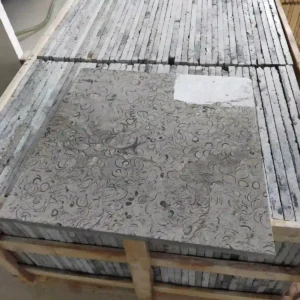
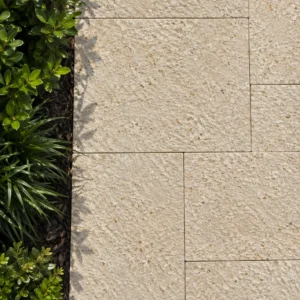
Not every Bajan stone project starts from lawn. The island renovates constantly — extending terraces, repairing storm corners, continuing a previous owner’s floor — and renovation asks the supply chain a harder question than new-build: can you match what is already there, in the quantity I actually need? This guide answers it honestly.
The matching problem, understood
Stone “matching” has three layers: material (the same stone family — usually identifiable), color range (the batch question — trickier), and weathering (the years of sun and rinse that no quarry ships). A perfect invisible match on day one is rare; a match that converges within a season — new stone weathering toward its settled neighbors — is the professional standard, and entirely achievable with the right process.
Identifying the incumbent
Start forensic, and gather three things before anyone quotes:
- A clear photo set — dry, wet, close-up of texture, wide of pattern
- A measurement of unit sizes and thickness
- Ideally a liberated sample: a spare from the original order, or a unit from an inconspicuous corner
From these the family identifies quickly — dense limestone, shellstone, basalt — and the matching conversation starts with evidence instead of adjectives.
Working the color range
Natural stone’s block-to-block variation is the enemy of naive matching and also the solution, and the work splits in two:
- The supplier cuts to order and selects toward your target range, with range samples confirming the trajectory before production
- The installer blends new units into the old field at the boundary — a stitched, staggered junction rather than a hard line — letting variation camouflage the transition
Absorption is the number that separates one limestone from another. The Natural Stone Institute records a range running from under one percent to over ten across the family, and notes that dolomitic stones generally carry higher density, lower absorption and better abrasion resistance — the industry variety data sets this out. That spread is why two stones sold under the same broad name can behave nothing alike underfoot.
Weathering: accelerating the handshake
New stone meets old across a weathering gap: brighter, sharper, unrinsed by years. Time closes it, and one Bajan wet season does wonders, but process hurries it along:
- The boundary blend described above
- A first-day wash of the whole combined field, so grime does not outline the join
- Patience through the season of convergence
What never works is distressing new stone to fake age — it reads as damage, then weathers anyway.
Small orders without apology
Renovation quantities — twenty square meters of extension, a coping run, one storm-bitten corner — are legitimate orders, and the logistics scale honestly: groupage freight carries pallets economically, cut-to-order needs no minimum drama for standard formats, and the buyer’s FAQ’s trust structure (samples, escrow, documents) applies at every size. The one small-order economy worth planning: consolidate the wish list — the extension plus the shower project plus spares — into one shipment, because the paperwork and sailing cost the same either way.
Installation method matters as much as the stone itself. Industry guidance separates mortar-set work, sand-set exterior paving and pedestal systems, and stresses that drainage, movement and substrate condition drive long-term performance more than the material name does — the detailing guidance is worth reading before you specify.
The renovation order, step by step
Condensed, the renovation order runs six steps:
- Photograph and sample the existing floor
- Identify the family and the unit sizes
- Request range samples aimed at the target
- Approve them wet and dry, against the old floor rather than in a showroom
- Order with a blending margin and future spares
- Stitch the boundary, wash the whole field, and let the season converge
Six steps, one sailing, and an extension the next owner cannot find.
When not to match: the deliberate contrast
Sometimes the honest renovation answer is contrast, not camouflage: an extension floored in the sibling stone with a clean border line reads as intentional chapters; a new terrace in the family’s other texture zones the garden’s eras gracefully. The decision rule: match within a continuous surface, contrast across a real boundary — and never split a single visual field between old and new stones, which reads as running out rather than designing.
The renovation survey worth an hour
Before ordering anything, survey what the years actually did: levels (settlement writes slopes into old floors that new work must meet or correct), bedding condition at the junction zone, drainage reality versus original intent, and the revival question — whether the incumbent floor wants restoration before extension. An hour with a straightedge and a hose converts the renovation from assumption to specification; the extension then joins a known quantity.
When the original supplier is gone
Most matching jobs on the island start from a dead end: the villa changed hands, the paperwork went with the previous owner, and nobody knows what the floor is. That is a normal starting point, not a lost cause. Work backwards from the evidence:
- The unit size and thickness narrow the era and the likely source, because formats move in fashions
- The finish tells you the family — a brushed cream limestone and a shellstone are unmistakable side by side
- A broken edge shows the section, which distinguishes a solid stone from a bonded or reconstituted product
- An inconspicuous lifted unit, weighed in the hand, settles the density question in seconds
Once the family is identified, the target is a range rather than a name, and a supplier cutting to order can aim at that range. What cannot be done is matching a discontinued reconstituted product, which is worth establishing early so the conversation moves to blending or replacement instead.
Matching the finish, not just the color
Owners photograph color and forget finish, and finish is what gives a mismatch away in raking afternoon light. A new brushed unit beside an old honed one will read as a different stone even when the tone is identical, because the two surfaces scatter light differently. Worse, a floor that has been walked for fifteen years has a finish nobody specified: the traffic lanes are polished smoother than the edges, and a factory-fresh unit dropped into a lane looks wrong in a way that is hard to name. Match the original finish where you can identify it, and where you cannot, choose the slightly finer of two candidates — new stone coarsens with use, so a marginally smoother unit converges on the old floor rather than diverging from it.
Documenting the match for whoever comes next
The last step costs nothing and saves the next owner the whole exercise you have just been through. Leave a record with the property:
- Photographs of the finished floor, dry and wet, with a scale in frame
- The stone name, finish, unit size and thickness as ordered
- The supplier and order reference, so a future top-up starts from a real batch history
- Where the attic stock is stored, and how much is left
Tape it inside a cupboard door or file it with the house documents. Renovation-grade matching is a solved problem when the information survives; it is an expensive puzzle every time it does not.
A matching stone renovation that does not show
The best renovation stone is the kind nobody discusses at dinner — the extension guests assume was always there, the repair the surveyor cannot date. That invisibility is craft: forensic matching, stitched boundaries, honest weathering, and the six-step order behind them all. Old floors deserve new chapters written in their own hand; this is how the island’s best properties keep their stories continuous.