The Rock the Islands Already Own
Anyone specifying stone in the Virgin Islands is working next to one of the most recognizable rock landscapes in the Caribbean. The Baths on Virgin Gorda is a labyrinth of massive granite boulders forming cavernous passages and sheltered sea pools, and the name is short for batholiths. That granite belongs to the Virgin Gorda batholith, a mass of magma that intruded into older volcanic and sedimentary rock around forty-five million years ago; it is mainly feldspar and quartz, and it underlies much of eastern Tortola and Virgin Gorda. Weathering rounded the cracked blocks into the forms visitors walk through today, and The Baths National Park protects roughly seven acres of it.
What That Geology Gives a Designer
A landscape like that sets the visual rules for anything built beside it, whether or not the design team says so out loud.
- A pale, warm gray palette that sits far closer to limestone than to dark volcanic rock.
- Rounded, water-worn edges rather than sharp arrises, which favors softened detailing.
- Generous scale, since boulders read as single objects and small fussy units look wrong beside them.
- Deep shadow against bright light, which flatters matte surfaces and punishes anything glossy.
Why Nearly Everything Else Arrives by Ship
The Territory has no commercial dimension-stone industry to draw on. It is described as having small rum distillation, construction and boat building industries, with most industrial products imported, and building materials follow that pattern. There is nothing awkward about that. Imported paving here is not displacing a local cut-stone trade, because none exists; it is filling a role that has always been filled from overseas. What it owes the place is respect for the landscape it lands in, and the boulders of The Baths are a protected national park, never a resource and never a product comparison. The practical consequence for a buyer is straightforward: the material schedule is written around what can be shipped, the timetable is written around a sailing, and the design is written around a landscape that was here long before either.
Where Imported Stone Belongs on the Plot
Cut and calibrated material earns its place in the parts of a property that have to be flat, level and repeatable.
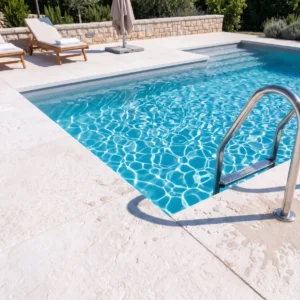
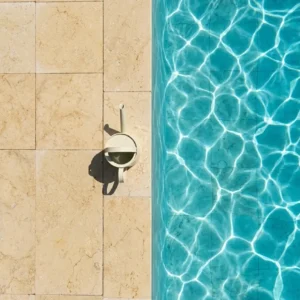
- Terraces, pool surrounds and outdoor rooms that need a consistent walking surface.
- Steps, thresholds and coping, where even thickness is the whole point.
- Interior floors that continue outward through a sliding line without a change of tone.
- Driveways and turning areas where a hard-wearing unit has to take vehicle loads.
Matching, Not Mimicking
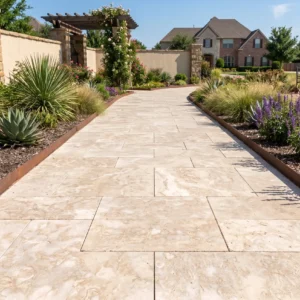
The worst outcome is paving that tries to impersonate boulders. Nothing cut and calibrated will ever read as a weathered batholith, and the attempt looks thin standing next to the real thing. The better move is quiet contrast held inside a narrow tonal range: pale limestone in warm gray or cream, honed or bush-hammered rather than polished, in generous units with restrained joints, and planting at a scale that answers the rock. Keep the joint pattern simple as well, since a busy laying pattern competes with the shapes in the background and never wins. The formats in our cut limestone beside granite boulders selection are chosen to sit in exactly that register.
Who Actually Signs Off the Work
Development permission runs through the Physical Planning Act, 2004, and the process has a shape worth knowing before you send a material schedule.
- The Town and Country Planning Department reviews an application and conducts a field visit.
- The Planning Authority, not the department, makes the final decision on development applications.
- A locally registered architect or surveyor must file the application with the required documents.
- Applications are processed in accordance with the Land Development Control Guidelines of 1972.
For an overseas owner that means a local professional is always in the loop, and that person is who your specification has to convince.
Landing the Material at Port Purcell
Freight into the Territory is simpler than most first-time importers expect, though the US dollar in everyone’s pocket tempts people to treat a shipment as a domestic move, which it is not.
- A direct ocean service runs Palm Beach, Florida to Port Purcell in Road Town on a weekly rotation with a six-day transit; confirm current sailing dates when you book.
- Declarations are completed and submitted online through CAPS, the Customs Automated Processing System.
- Import duty is assessed by HS code under the Customs Management and Duties Act, 2010.
- There is no VAT, no sales tax and no general consumption tax layered on top.
- Onward delivery from Tortola serves Virgin Gorda, Anegada and Jost Van Dyke.
Our notes on deliveries routed through Port Purcell set out where our responsibility ends and the local team takes over.
Building With What Is Already Here
The Territory is an associate member of CARICOM rather than a full member, so regional tariff rules of thumb do not apply and its own schedule governs. That autonomy runs through the design conversation too. A villa on Virgin Gorda does not need paving that argues with the boulders behind it; it needs a calm, pale, matte surface that lets the granite stay the loudest thing on site. Do that and the paving stops looking imported at all; it simply looks like the floor of the place. Get it wrong and no amount of quality in the material will save the finished view from the terrace. Imported stone earns its place here by deferring to the landscape, never by competing with it.