The Island’s Own Rock in Plain Terms
Bonaire’s bedrock is the Washikemba Formation, roughly five kilometers thick, made of basic lavas and porphyritic igneous rock. Part of it is pillow lava, basalt that took its rounded shape because it cooled underwater, along with submarine pyroclastic flows and sedimentary beds carrying ammonite fossils. Two volcanic cores are separated by limestone, and the coastal terraces that ring the island are coral limestone.
That is a geological description, not a supply chain. Whether any commercial dimension-stone or aggregate operation is running on the island at present is a question for local suppliers, not something to assume from off the island.
Why Gathering Material On Site Is Not an Option
Whatever the geology says, gathering material from the shoreline is not an option here.
- Collecting shells, coral, sand or other natural material on Bonaire is an offense.
- Taking living or dead material inside the marine park requires a permit from the Bestuurscollege.
- Fines are cited between one hundred and five hundred dollars depending on quantity.
- The marine park runs from the high-water mark down to sixty meters.
- Field and boundary walls out in the kunuku are somebody’s property, not a quarry.
That last point is worth stating plainly. Rural walls are part of a working landscape and of somebody’s title.
The Slave Huts and What Coral Stone Means
Along the south coast, on the road toward the Pekelmeer saltpans, stand two groups of small stone huts: the white group at White Pan and the ochre group at Orange Pan. They date from 1850, they hold official protected monument status, and they are where enslaved people who worked the salt pans were made to shelter. They are memorials.
They were built of coral stone cut from the island’s limestone reef formations. For that reason coral stone on Bonaire is not a finish, a style or a design reference, and it should never be borrowed as one in a specification or on a mood board. Imported limestone is not an imitation of it. It is a lawful modern building material for an entirely different purpose, at a time when the historic material can no longer be taken from the island at all.
Two Different Jobs on the Same Site
The clearest way to think about supply is by job rather than by origin. A paved terrace is a stack, and the layers are procured differently.
- Sub-base and base: bulk material, sourced and placed by the local contractor.
- Concrete, block and screed: local ready-mix and local trades.
- Bedding and jointing: washed, chloride-free material brought to the site.
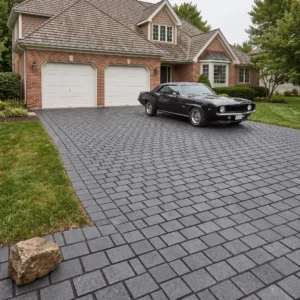
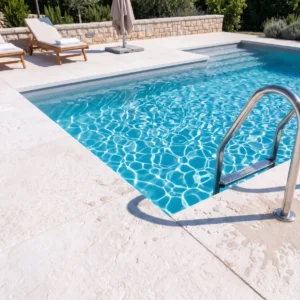
- Wearing surface: dimension-sawn paving, cut to size and shipped in.
Nothing in that list competes with anything else in it. Bulk and structural supply belongs to local trades, while the imported wearing layer on Bonaire is the calibrated top of the stack and nothing more than that.
Read the Building You Are Working On
Before choosing a tone or a module, establish what the property in front of you actually is. The fabric around a new floor may be block and render, concrete frame, timber, older masonry, or some combination that has grown over decades, and each of those sets a different reference for scale, joint width and color. Bonaire also runs a monument consent process, and a missing monument permit is a stated ground for refusing a building permit, so status is a question to answer early.
- Establish the wall fabric before fixing joint width and module size.
- Check whether the structure or the plot carries any monument status.
- Confirm what the spatial development plan allows on that parcel.
- Ask the contractor what the existing base and drainage actually are.
Consents, Plans and Timing
Bonaire is a special municipality of the Netherlands, not a separate country, and that shapes the statute names you will meet on a permit file. Building rules have applied since 1 July 2017 under the Wet VROM BES, with the BES Bouwbesluit setting general standards for structural safety, user safety, fire safety and accessibility. A bouwvergunning is issued by the bestuurscollege, which must decide within sixteen weeks of receiving the application and may extend that once by up to eight weeks. The Ruimtelijk Ontwikkelingsplan Bonaire, adopted by the island council on 8 October 2010 and revised since, sets what may be built and where.
Read that alongside the delivery schedule: a sixteen-week decision window and a five-day sailing are not the same kind of lead time.
Getting It There and Cleared
The logistics side is straightforward. Ocean freight reaches Kralendijk directly from Florida, and the tax position is short enough to state in a sentence.
- A weekly service departs Port Everglades on Saturday and reaches Kralendijk on Thursday.
- The sailing is direct, with no transshipment through another island.
- Import tax on goods is set at nil, so there is no tariff line to model.
- ABB applies at eight percent on goods at import, on value plus insurance plus transport.
- Declarations are filed with Douane Caribisch Nederland, and the currency is the US dollar.
If you want the port and pallet detail as well, read how we reach Kralendijk before building a landed budget.
Specify It Lawfully and Specify It Once
The respectful specification and the practical one turn out to be the same document. Leave the island’s protected material where it is, let local trades handle the ground, bring in a calibrated surface with test data behind it, and settle consents before a container is booked. That sequence avoids the legal problem and the expensive one.
Get the ground right locally and let the surface arrive tested.